
Virtual Production for TV: A Showrunner's Guide
Episodic television is built around repetition: recurring locations, tight turnaround windows, continuity demands, and budgets that must hold across an entire season. That makes production methodology as important as the creative concept. A workflow that reduces travel, weather delays, location resets, or late visual-effects decisions can create meaningful gains from one episode to the next.
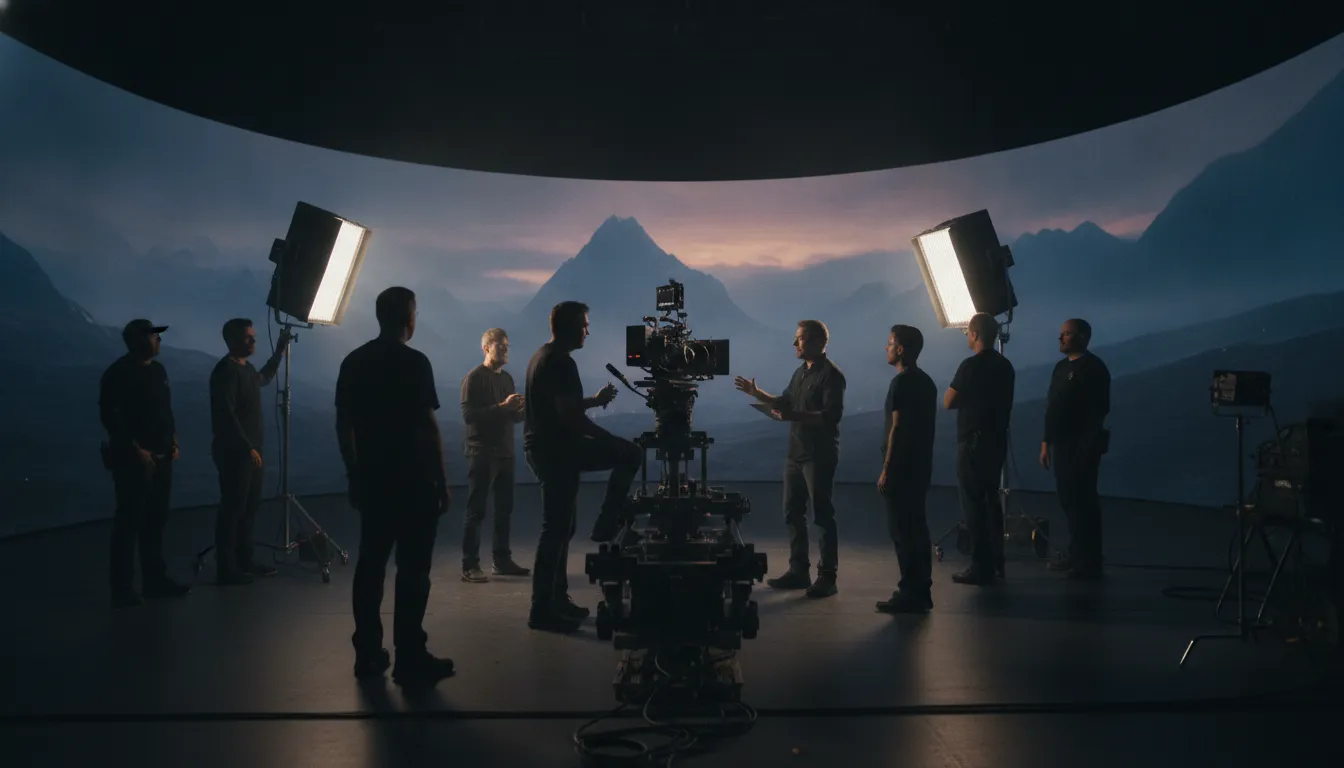
Virtual production for TV combines LED displays, tracked cameras, and real-time digital environments to place performers inside controllable virtual locations. Unlike the traditional sequence of pre-production, filming, and post-production, the approach brings more visual decisions into the shoot itself. LED displays can create a virtual set around the actors, while a game engine renders the digital environment in real time, as described by Deltacast and Unreal Engine.
For showrunners and producers, the opportunity is not simply to replace a physical location. It is to build a repeatable production system that supports story, schedule, and budget across multiple episodes. That shift becomes clearer when we examine why this method is reshaping television production itself.
Explore how virtual production services fit your episodic schedule.
Why Virtual Production Is Reshaping Television Production
Television production has always depended on controlling variables: location access, weather, continuity, travel, and the demands of a tight episodic schedule. Virtual production changes how many of those variables are managed. The technique uses LED displays to create a virtual set around the actors. Allowing the camera to capture an environment and its interactive light in the same moment as the performance. This in-camera approach can make the setting feel present on the stage rather than something added only after filming.
The shift is larger than replacing a green screen. Traditional production generally moves in a linear sequence from pre-production to filming and then post-production. Virtual production brings parts of those stages together in real time. Digital environments can be prepared before the shoot, adjusted during filming, and reviewed by creative and technical teams as the scene is captured. That gives producers a more immediate view of the final image and can reduce the distance between a creative decision and its practical result.
From broadcast graphics to dramatic worlds
The underlying idea is not entirely new to television. Virtual production has been used in broadcast for years to deliver live, real-time graphics for sports and news, including election coverage, as Unreal Engine explains. What has changed is the scale and ambition of the environments. The same real-time principles can now support recurring locations, expansive landscapes, and story worlds that would be difficult to build or revisit physically for every episode.
The Mandalorian, which premiered in 2019, helped establish the LED-volume model as a practical option for large-scale screen storytelling. Its influence was visible in the rapid expansion of the infrastructure behind the work. Industry figures cited by Epic Games through Wikipedia indicate that the number of LED virtual production stages grew from roughly three worldwide in 2019 to approximately 300 by October 2022. That growth reflects more than enthusiasm for a new visual effect. It signals a broader recognition that real-time environments can become part of a repeatable production system.
Why the change matters for episodic production
For a television series, the value is often found in repetition. A digital set can be refined once and adapted across multiple episodes, while lighting, camera context, and environmental continuity remain easier to coordinate. Producers can also make creative choices earlier, when changes are less disruptive than they would be late in post-production. Research on virtual production identifies gains in efficiency, collaboration, and decision-making through the combination of real-time graphics engines and immersive technologies. It also points to future opportunities for remote co-creation in large productions. Those capabilities make virtual production for TV especially relevant to teams building serialized worlds, where consistency and speed matter as much as spectacle.
How In-Camera VFX Serves Episodic Schedules
Episodic television rewards production systems that can deliver visual consistency at speed. A recurring set may appear across multiple episodes. While a season can require the cast and crew to complete a substantial block of shooting before the production moves on. In-camera VFX helps turn that repetition into an advantage. Instead of rebuilding every location physically or sending the unit back on the road. A production can return to a controlled stage and reproduce a virtual environment with greater consistency.
LED displays create a virtual set surrounding the actors, allowing the environment to appear in camera during the shoot. That approach gives performers and directors a visible context rather than asking them to imagine a green-screen background. It also captures interactive light, reflections, and the visual relationship between the foreground and the setting as part of the shot. For a series, these details matter because the same fictional world must hold together from episode to episode. The underlying technique is described by virtual production technology specialists as using LED displays to create a virtual set around the actors.
Recurring sets without recurring travel
Virtual locations can replace many travel-heavy or logistically difficult scenes. A production might need a city street, remote landscape, spacecraft interior, or historical setting several times during a season. With the environment prepared digitally, the team can return to the same stage. Adjust the scene for a new episode, and preserve the creative rules established for the series. Weather, time of day, and geography can change without moving the entire unit between physical locations.
This does not make every location inexpensive or every shoot simple. Digital environments still require design, technical preparation, stage time, and careful approvals. The benefit is operational control. Producers can plan a block around a recurring stage setup instead of coordinating repeated permits, transport, accommodation, weather contingencies, and location resets. That predictability is especially valuable when a show has a fixed delivery schedule or must coordinate multiple units.
Shortening the path from set to final episode
Real-time environments are rendered live behind the actors, so the creative team can evaluate composition, lighting, and performance against the intended world during production. In a traditional workflow, production moves in sequence from pre-production to filming and then post-production. Real-time workflows bring some visual-effects decisions earlier, which can reduce the amount of work left to reconstruct after the shoot. A well-designed virtual production pipeline therefore supports both creative review and schedule management.
For episodic teams, the value compounds across a season. Decisions about assets, camera movement, lighting, and stage operation can be documented and reused rather than rediscovered for every episode. Directors still need room to adapt a scene, but the production begins from a reliable foundation. A defined virtual production workflow can connect those creative choices to editorial and post-production, helping the series move from capture to delivery with fewer avoidable handoffs.
The Technology Behind a Virtual Production TV Workflow
A television virtual production workflow begins with the digital environment. A game engine such as Unreal Engine 5 or Unity builds the world, including its geometry, materials, lighting, atmosphere, and interactive elements. That environment is not simply a background added after filming. It becomes a live production asset that can be adjusted as the creative team works, giving directors and cinematographers a more immediate view of the final frame. As Arc Studios explains, a game engine is required to build the digital environment for virtual production: https://arcstudios.tv/blog/what-do-you-need-for-virtual-production.
On an episodic show, this approach is particularly valuable because environments can be developed, refined, and revisited across multiple episodes. A recurring location can evolve without requiring the crew to rebuild a physical set or travel to a new exterior. The engine also supports real-time changes to time of day, weather, camera perspective, and set dressing. Producers should treat this digital world as part of the production design pipeline, not as a last-minute visual-effects layer. A well-planned virtual production tools strategy connects creative decisions to the technical systems that will deliver them on stage.
LED stages bring the environment into the camera
The LED stage is the physical interface between the digital world and the actors. LED walls and ceilings can surround performers with projected environments, allowing the camera to capture interactive light, reflections, and background imagery in the same take. Stage scale varies by production. One documented example includes a 1,000-square-foot LED stage, illustrating the infrastructure available for controlled virtual environments.
Image quality depends on more than the size of the wall. Pixel pitch, panel performance, processing, color calibration, and the relationship between the camera and the display all affect what appears in frame. A representative large-stage specification uses approximately 2.8mm pixel-pitch ROE Black Pearl 2v2 panels with Brompton SX40 processors. These components help the team manage image quality and color consistency, both of which matter when scenes must match across a television season.
Tracking and rendering keep the scene responsive
Camera tracking is what makes the illusion respond convincingly to movement. Optical tracking systems such as OptiTrack measure the camera's position and orientation, allowing the engine to update the perspective of the digital environment as the camera moves. Without accurate tracking, the background can appear to slide or distort instead of behaving like a stable location.
Render nodes then generate the imagery quickly enough for the stage to respond in real time. In a typical setup, Unreal render nodes work alongside the LED processors and tracking system, while the crew monitors exposure, color, reflections, and playback. The result is a connected pipeline rather than a collection of isolated tools. For producers evaluating a virtual production studio, the key question is whether the engine, stage, tracking, and render infrastructure have been designed to operate as one dependable system throughout an episodic schedule.
What Virtual Production for TV Costs and How It Saves Money
For an episodic series, the cost question is not simply whether an LED stage is more expensive than a location day. It is whether the production can repeat environments, protect the schedule, and reduce costly work later in the pipeline. Virtual production introduces upfront requirements, including an LED stage, tracking, real-time rendering, and a game engine such as Unreal Engine 5 or Unity. Those costs are real, but they can be distributed across multiple episodes and seasons when the creative plan supports recurring worlds.
Virtual production uses LED displays to create a virtual set around the actors, allowing the environment, lighting, and camera perspective to be developed together on stage. That changes the financial profile of a show. Instead of treating every location, weather condition, and visual-effects shot as a separate downstream problem. The production can make more decisions while the cast and crew are working in the same controlled environment. The comparison below shows where those effects tend to appear.
| Production area | Traditional approach | Virtual production approach | Potential episodic benefit |
|---|---|---|---|
| Location travel | Repeated travel, transport, permits, accommodation, and weather contingencies for each episode. | Digital locations can be staged on a controlled LED volume and revisited without relocating the unit. | Fewer travel days and less exposure to weather or access delays, especially for recurring settings. |
| Set builds | Physical sets must be built, struck, stored, or redressed as the story moves between locations. | A reusable digital environment can be adjusted for time of day, geography, and story continuity. | One environment may support multiple episodes and reduce repeated construction and reset work. |
| Reshoots and post-production | Visual effects, color work, and background replacement may create later revisions and schedule pressure. | Actors and cinematographers see the environment in camera, while real-time graphics support earlier decisions. | Fewer unknowns after principal photography and faster feedback between creative and technical teams. |
| Per-episode consistency | Matching lighting, geography, weather, and continuity across separate shoots can require additional oversight. | Saved digital locations and controlled stage conditions provide a repeatable visual baseline. | More consistent episodes and less time correcting mismatched backgrounds or lighting in post. |
So, is virtual production expensive? It can be when a series needs a bespoke stage build, substantial environment development, or a specialized crew for only a small number of shots. The model becomes more compelling when the show has repeatable locations, complex worlds, tight shooting windows, or a high cost of travel. Research on virtual production identifies increased efficiency and new possibilities for remote co-creation in large-scale audiovisual work, which can also reduce friction between distributed teams. Producers should model the full season rather than compare a single stage day with a single location day.
The strongest decision is often a hybrid one. Use virtual production services for environments where control and reuse create measurable value, while reserving practical locations and builds for scenes that genuinely benefit from them. That approach treats the LED stage as a production asset, not merely a visual-effects expense, and gives the series a repeatable foundation for future episodes.
What Showrunners and Producers Should Plan For
- Scout the stage before you commit to the schedule. Start by identifying a virtual production studio whose LED volume, ceiling height, camera access, loading capacity, sound control, and technical crew fit the series. A stage is not interchangeable with a soundstage, and the practical limits of its footprint will shape blocking. Lens choices, set extensions, and the number of company moves you can avoid. Ask prospective partners to demonstrate how they handle color calibration, reflections, lighting continuity, and stage resets. The right partner can also help determine which recurring locations are worth building digitally, rather than treating every scene as a custom technical exercise.
- Define the digital-art pipeline with the game engine team. Virtual production depends on a digital environment built in a game engine such as Unreal Engine 5 or Unity. So the art department, production designer, VFX supervisor, environment artists, and engine team need a shared process from the outset. The game engine is a core requirement for building the digital environment, not a late-stage display tool. Establish who owns asset creation, approvals, version control, optimization, and continuity between episodes. Build reusable assets for recurring sets, and define how concept art becomes a stage-ready environment without losing the visual language of the show.
- Lock tracking, render, and monitoring requirements early. Camera tracking, lens data, perspective, LED playback, and real-time rendering must work as one production system. Confirm the tracking method, calibration procedure, render-node capacity, frame-rate requirements, latency tolerance, and backup plan before principal photography. Budget for technical rehearsals, operator time, content optimization, and troubleshooting, not just the stage rental. This is where a promising virtual production for TV workflow can become fragile if the creative plan exceeds the real-time system's capacity. A clear technical specification also gives producers a defensible basis for comparing studios and vendors.
- Choose a pilot, rollout, or full-season model deliberately. A pilot can validate the visual language, stage configuration, asset pipeline, and crew responsibilities before the series scales. A limited rollout may be more effective when only specific locations, action sequences, or weather-dependent scenes benefit from LED capture. A full-season approach makes more sense when the show reuses environments and can amortize digital-world development across episodes. Virtual production can increase efficiency and support creativity, collaboration, and decision making when immersive technologies and real-time graphics are integrated into the process, as documented in this academic review. The production model should reflect where that benefit is greatest, not follow a blanket rule.
- Build a hybrid workflow instead of forcing every scene into the volume. Plan which scenes belong on the LED stage, which require a traditional location or soundstage, and which should use conventional post-production VFX. Schedule asset development, stage days, location work, editorial reviews, and final finishing as connected workstreams. Include remote review protocols so approved artists, producers, and partners can participate without being physically present. Research on virtual production identifies remote co-creation as a potential capability for large-scale audiovisual productions, but that benefit depends on clear approvals, shared files, and dependable communication. A hybrid plan gives the show creative flexibility while reserving the volume for shots where real-time iteration and in-camera results create measurable value.
How Arctic7 Builds Serialized Storytelling With Virtual Production
Serialized storytelling asks a production to think beyond a single release. Characters, locations, visual rules, and audience expectations must remain coherent across episodes, seasons, and sometimes entirely different media. Virtual production gives that continuity a practical foundation by allowing teams to work with real-time digital environments. In-camera visual effects, and virtual locations while performers and physical elements remain on stage.
For a showrunner, the value is not simply the ability to create a spectacular backdrop. It is the opportunity to design a repeatable production language. A recurring location can be developed as a digital environment, refined before a shoot, and revisited as the story expands. That makes visual development part of the series architecture rather than a one-off decision made for each episode. It also gives creative and production teams a shared reference point when schedules, departments, or locations change.
Arctic7 approaches this work as a transmedia partner, not as a vendor focused on one isolated shoot. Its role is to connect story strategy, creative execution, and technical delivery so that an IP can grow across games, film, and television without losing its identity. A virtual environment built for a series may establish visual assets, world rules, or character context that can later inform a game or another screen experience. The aim is an interconnected entertainment ecosystem in which each extension strengthens the larger world.
That requires planning the production pipeline around the demands of serialized work. Digital environments need to support continuity. Real-time content needs to respond to the needs of cinematography and performance. The team must also understand how a virtual stage fits into episodic scheduling, from asset preparation and previsualization through capture and post-production. Arctic7's virtual production services sit within that broader capability, combining technical excellence with the creative decisions that make a world usable over time.
Arctic7's virtual-production studio, Narwhal Studios, provides a concrete proof point for this approach. The studio represents the kind of production capability needed when an IP holder wants visual ambition and operational control to work together. Rather than treating virtual production as a visual effect added at the end. Arctic7 can help build it into the way a serialized world is planned, produced, and extended.
For producers, that distinction matters. The strongest result is not a single impressive frame. It is a production system that supports consistent storytelling, makes creative choices visible earlier, and leaves the world ready for its next chapter.
Talk to Arctic7 about bringing virtual production for TV to your series.
Frequently Asked Questions
Does virtual production work for television series?
Yes. It is especially useful for episodic shows that revisit the same locations, environments, or visual conditions across multiple episodes. A production can build and refine digital sets once, then adapt them for recurring scenes while maintaining continuity in lighting, perspective, and background detail. The approach also supports live collaboration between creative and technical teams, which can make schedule decisions earlier in the process.
Is virtual production expensive for a TV show?
It requires meaningful upfront investment in stage time, LED infrastructure, tracking, and real-time content. The relevant comparison, however, is the total cost of achieving the same result through location travel, physical construction, weather contingencies, and extensive post-production. For a series with recurring environments or demanding production windows, reusing digital locations can improve the economics across episodes rather than treating each setup as a one-off expense.
What technology does a television production need?
A typical setup combines an LED stage, camera and performer tracking, real-time rendering. And a game engine such as Unreal Engine 5 or Unity to build the digital environment. The exact configuration depends on the show. Producers should plan the technical pipeline alongside previs, art direction, cinematography, and post-production so that the stage can deliver the required frame rates, color consistency, and camera movement.
What are the main limitations of virtual production for TV?
Virtual production is not a universal replacement for locations, practical sets, or conventional visual effects. LED stages impose physical limits on scale, lighting, camera angles, and available volume. Digital environments also need preparation, optimization, and on-set technical supervision. The strongest results come when producers select scenes that benefit from controlled real-time environments and use other methods where they are more efficient.
Virtual production is no longer a niche film technique. It is a practical, schedule-driven advantage for episodic television, and the teams that adopt it now are setting the standard for serialized storytelling.
Talk to Arctic7 about building a virtual production workflow for your series.
Arctic7 partners with IP holders, showrunners, and studios to extend worlds across games, film, and television. From real-time environments and in-camera VFX to full LED-stage production, Arctic7 brings the technical and creative expertise to make virtual production work within your episodic schedule.
New Immersive & XR Media Capabilities Added to Arctic7's Suite of Games, Film & TV and Digital Services

Arctic7 Shares Details of its Work on Skeleton Crew and Cinematics Partnership with Fateless

The Human Touch: Adding Personality to Project and Product Management
Whether it’s your team, your client, or your stakeholders, understanding the human dynamics is just as critical as hitting milestones.

McDonald's Case Study: Bridging Brand and Play | Arctic7
Bridging Brand and Play: An Interview with Lindsay Blenkhorn Daggitt