
Spatial Computing Development Company: A Guide for IP Owners
A spatial computing development company helps an IP owner turn a story world into an experience that responds to place, movement, objects, and presence. The strongest partner combines product strategy, spatial UX, real-time 3D, narrative design, technical production, testing. And launch planning so the experience feels native to the IP rather than a technology demo.
Explore Arctic7's immersive and transmedia capabilities
For entertainment brands, this distinction matters. A spatial experience may live inside a headset, a location-based installation, a retail activation, a museum, a live event, or a companion layer around a film or game. The surface changes, but the strategic question remains the same: how can a new interaction deepen the audience's relationship with the world without weakening its identity?
What does a spatial computing development company actually deliver?
A spatial computing development company delivers more than a 3D scene or a headset build. It translates an audience and IP strategy into a repeatable experience system: a product definition, interaction model, story logic, technical architecture, tested prototype, production plan, and launch path. The deliverable is a coherent way for people to enter, understand, and influence a world.
That work usually begins before a device or engine is selected. A partner should clarify the intended audience, the role of the experience in the broader franchise. The setting in which people will use it, and the behavior that signals success. A five-minute location-based encounter has different requirements from a persistent mixed-reality companion or a premium spatial game.
- Product strategy: define the audience, use case, platform, experience length, success measures, and production scope.
- Spatial UX: design how people look, move, gesture, listen, touch, and orient themselves in an environment.
- Real-time 3D: build the assets, rendering, lighting, physics, audio, and runtime systems that make the world responsive.
- Narrative systems: connect interaction to character, place, stakes, discovery, and the rules of the IP.
- Testing and operations: validate comfort, comprehension, accessibility, performance, safety, and repeatability.
- Launch planning: prepare the content, staffing, support, analytics, updates, and audience journey around release.
Apple's current visionOS guidance illustrates why this is a multidisciplinary problem. Teams can adapt an existing app, build a spatial experience with native or third-party tools, or stream an existing PC or Mac experience through a spatial interface. The right path depends on the product job, not on a preference for a particular platform.
For an IP owner, the practical evaluation is therefore not "Can this vendor make a 3D demo?" It is "Can this partner connect creative intent. Interaction design, production reality, and the next chapter of the franchise?"
How should IP owners define the experience before production?
Before production starts, an IP owner should define the audience promise, the experience setting, the narrative role, the interaction loop, and the boundaries of the world. This brief gives creative and technical teams a shared decision framework, reducing the risk of building an impressive prototype that has no durable role in the ecosystem.
Start with the audience moment. Is the experience meant to let a fan explore a known location, play a character. Solve a story problem, collaborate with others, or see a familiar object in a new way? Each answer implies a different spatial grammar. Exploration needs orientation and environmental storytelling. Play needs readable affordances and consequence. Social participation needs clear roles and reliable shared state.
Next, define the relationship to canon. The experience can extend an existing story, reveal an adjacent event, make a fictional place tangible. Or provide a new point of entry for people who do not know the franchise. Make that role explicit. It prevents the experience from becoming a disconnected branded layer and gives the narrative team a standard for deciding what belongs.
Finally, specify the operating context. A home headset, a location-based installation, and a live event impose different constraints on space, time, staffing, privacy, accessibility, and reset. A development partner should surface these constraints in discovery, not after the creative concept has been locked.
Arctic7's virtual production workflow guide is a useful adjacent reference because it treats real-time environments as collaborative production systems rather than isolated visuals. The same principle applies to spatial product development: the world, the interaction, and the pipeline must be designed together.
What capabilities matter in spatial UX and interaction design?
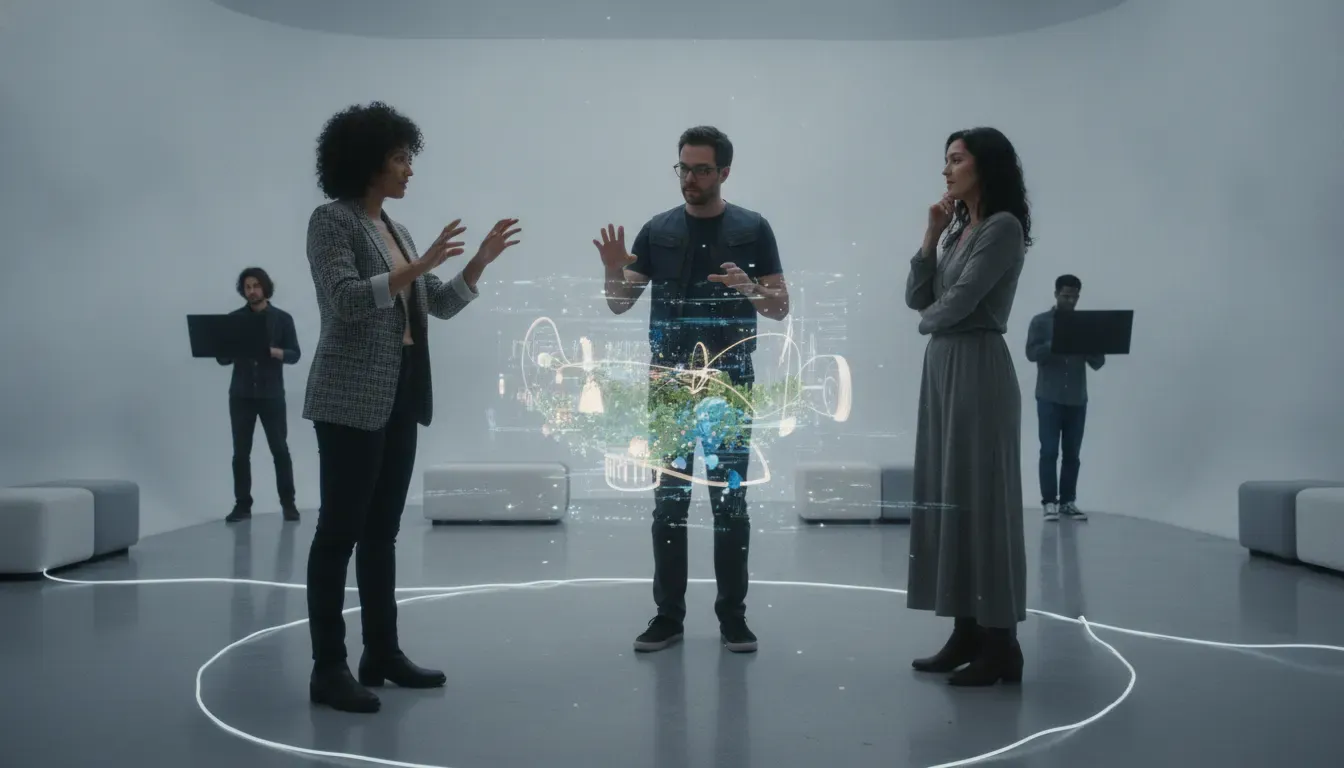
Spatial UX is the design of attention, movement, feedback, and understanding in three dimensions. A qualified partner designs for the whole body and environment, not just for a flat screen placed in front of the user. The goal is to make important actions discoverable, comfortable, meaningful, and consistent with the fiction.
Look for a partner that can answer practical questions early:
- How does a new user understand where to look and what to do without a conventional menu?
- What happens when the user is standing, seated, moving slowly, or sharing the space with others?
- How do sound, lighting, scale, and proximity communicate importance?
- How does the experience recover when tracking is imperfect or the user misses a cue?
- How are accessibility needs handled for vision, hearing, mobility, language, and cognitive load?
- How does the design respect personal space, real-world hazards, and location staff?
Spatial design should also account for the difference between a virtual object and a story object. An artifact in a fictional world may carry history, status, or emotional meaning. If it is reduced to a generic interaction token, the experience loses part of the IP's value. Narrative design and UX should agree on what the audience is meant to notice, infer, remember, and do next.
Apple's object-tracking guidance shows how a real-world object can become an anchor for digital content. That capability is technically useful, but the creative opportunity is larger: an object can become a portal, clue, character relationship, or ritual within a story world. The development partner should be able to move from the API capability to the audience meaning.
For related production context, compare this approach with Arctic7's guide to Unreal Engine in a virtual production studio. The relevant lesson is not that every spatial product should use Unreal Engine. It is that tool choice should support the required creative behavior, review cadence, and production scale.
How does real-time 3D support an entertainment IP?
Real-time 3D is the shared foundation that lets a spatial experience respond to the user's position, input, environment, and choices. It includes more than models and rendering. A production-ready foundation also covers scene structure, lighting, animation, audio, physics, data, performance budgets, content versioning, and the interfaces that connect creative tools to the runtime.
IP owners should ask for a technical plan that separates durable world assets from experience-specific logic. A location, prop, character, or material may need to appear in a game, cinematic, installation, marketing activation, or future experience. Reusable assets are valuable only when they are organized with clear ownership, naming, versioning, licensing, and quality standards.
| Decision area | What to evaluate | Why it matters for IP |
|---|---|---|
| Runtime and engine | Rendering, input, device support, deployment, and team skill. | Determines how reliably the world can evolve across platforms. |
| World assets | Modularity, fidelity, optimization, provenance, and reuse. | Protects continuity and reduces duplicated production effort. |
| Interaction systems | Input mapping, physics, tracking, feedback, and state. | Turns a visual world into an experience with meaningful agency. |
| Content pipeline | Review tools, source control, publishing, and rollback. | Lets creative teams iterate without destabilizing the product. |
| Measurement | Completion, comprehension, comfort, engagement, and return behavior. | Connects product learning to franchise and audience strategy. |
Apple's visionOS 27 materials describe updates to RealityKit, immersive media, object tracking, and multiple engine pathways. These developments reinforce a broader point: spatial platforms are becoming more capable, but capability does not replace product judgment. A spatial computing development company should recommend the smallest technical system that can deliver the intended audience promise and grow responsibly.
Arctic7's virtual production tools guide and pipeline guide provide useful examples of why tools and workflow should be considered together. For an entertainment IP, the same discipline helps protect the connection between the asset library, the creative review process, and the live experience.
Discuss a real-time world or immersive experience with Arctic7
How can narrative systems protect the identity of an IP?
Narrative systems protect an IP by translating its identity into repeatable rules for place, character, conflict, language, visual motifs, and audience agency. They give creators room to make the experience interactive without treating canon as a list of restrictions. The result should feel like a new expression of the world, not a branded wrapper around generic mechanics.
A useful narrative system answers four questions:
- What must remain recognizable? Define the emotional promise, core relationships, visual language, themes, and world rules that audiences should feel in every format.
- What may be discovered? Identify spaces, events, artifacts, or character perspectives that can be expanded through interaction without rewriting the foundation.
- What can the audience change? Set boundaries for agency, progression, social behavior, and consequence so interaction feels meaningful but remains coherent.
- What can travel forward? Document assets, story data, audience insights, and production learnings that can inform the next game, film, show, or activation.
This is where transmedia strategy and spatial product development meet. A spatial experience may be a destination in its own right, but it can also create a bridge to a film release. A game community, a live event, or a new piece of story. The bridge should be designed as part of the product, not added as a promotional message at the end.
Arctic7's film workflow coverage shows how real-time production can bring story, art, and technical teams into earlier conversations. That same early alignment is valuable for spatial projects where narrative choices affect interaction logic, environment design, performance, and testing scope.
What should testing and launch planning include?
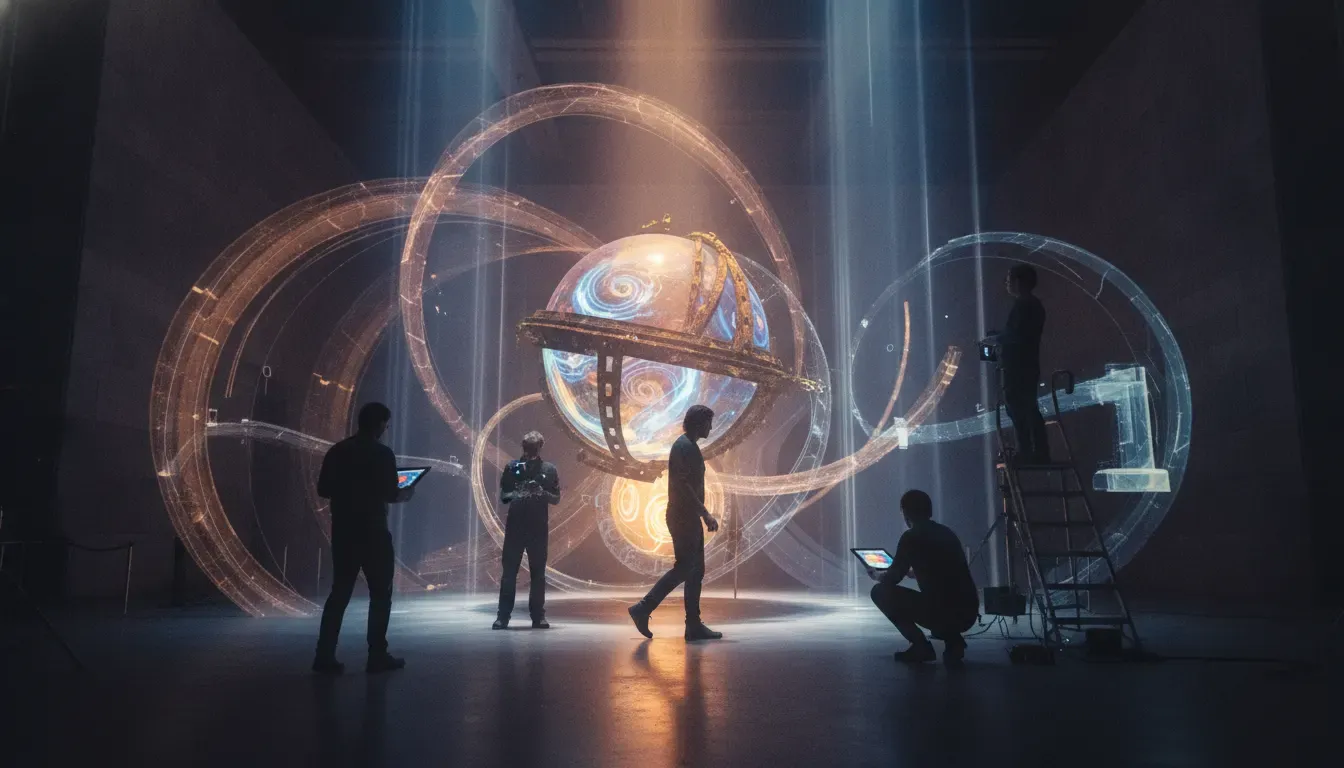
Testing should start with the first interactive prototype and continue through launch. Spatial products can fail when users miss cues, feel discomfort, misread scale, collide with objects, or lose the story after tracking changes. These are product, creative, and operational risks, so testing must cover interaction, comfort, accessibility, environment, narrative comprehension, and recovery.
A practical test program should include:
- Concept tests: confirm that the audience understands the promise and the role of the experience in the IP.
- Interaction tests: measure discoverability, input clarity, feedback, recovery, and task completion.
- Comfort tests: examine motion, acceleration, visual load, audio, session length, and transitions.
- Device and environment tests: validate tracking, lighting, network conditions, room layouts, hardware variation, and reset time.
- Narrative tests: check whether users understand character intent, stakes, world rules, and the next meaningful action.
- Accessibility tests: include representative users and verify alternatives for key interactions and story information.
- Operations tests: train staff, test cleaning and handoff, and rehearse recovery from interrupted sessions.
Launch planning then connects the product to its audience and operating model. Decide how people discover the experience, how they access it, what they need before starting, how results are measured, and what happens after the first session. For a location-based experience, staffing and throughput may be as important as rendering quality. For a home product, onboarding, updates, support, privacy, and device compatibility may dominate.
Arctic7's workflow perspective on filmmaking and its production workflow guide both point toward an integrated review model. In spatial computing, that model should bring product, narrative, design, engineering, QA, accessibility, and operations into the same evidence loop.
How should an IP owner evaluate potential partners?
An IP owner should evaluate potential partners on integrated judgment, not on a reel alone. Ask each candidate to explain how it would define the product, protect the IP. Choose the technical path, test with real users, and prepare the organization to operate the experience. The strongest response makes tradeoffs visible and connects them to audience and business outcomes.
Use these questions in a partner review:
- What audience moment and franchise role would you prioritize in discovery?
- Which parts of the experience would you prototype first, and what evidence would change the plan?
- How would you translate the IP's narrative identity into spatial interactions and environmental rules?
- How would you structure reusable world assets, source files, technical documentation, and approvals?
- What comfort, accessibility, safety, privacy, and operational risks would you test before launch?
- How would the experience connect to the wider ecosystem without becoming a forced cross-promotion?
- Which capabilities would you keep in-house, and where would you add specialist production support?
- What does the post-launch learning loop look like for content, technology, and audience engagement?
Also ask for a clear definition of done. It should cover creative quality, runtime performance, narrative comprehension, accessibility, operational readiness, analytics, documentation, and handoff. A partner that cannot define these criteria may still produce a compelling demo, but the IP owner is carrying the delivery risk.
Arctic7 combines transmedia strategy, game development, virtual production, and immersive capabilities. Its Narwhal Studios virtual production team is a concrete example of how real-time worlds and production workflows can support premium entertainment. The right engagement may be a full development partnership, a co-development model, or a focused strategy and prototype phase. The important point is to choose the model that matches the IP's next decision.
Build an IP-ready spatial computing roadmap with Arctic7
FAQ: Spatial computing development for entertainment IP
What is the difference between spatial computing and virtual reality?
Virtual reality usually places the user inside a fully simulated environment. Spatial computing is a broader product category that can blend digital content with physical space, track people and objects, and support shared or mixed modes of interaction. The right format depends on the audience experience, setting, and IP objective.
Does a spatial computing project require a new entertainment IP?
No. An existing entertainment IP can benefit from spatial computing when the experience adds a meaningful way to explore its world, characters, objects, or themes. The project should begin with the IP's audience promise and narrative boundaries, then choose the spatial interaction that deepens them.
Should an IP owner choose the engine before the concept?
Usually not. The concept, audience setting, interaction model, device requirements, and production constraints should guide the engine decision. A capable spatial computing development company can compare native frameworks, third-party engines, streaming, and custom approaches against the product job rather than selecting a tool by habit.
How early should user testing begin?
User testing should begin with low-fidelity interaction and concept prototypes, before the team commits to expensive assets or complex systems. Early tests reveal whether people understand the space, the story, and the action. Later tests should add performance, comfort, accessibility, device, and operational conditions.
Can spatial assets be reused across games, film, and live experiences?
They can, if the assets are planned for reuse from the beginning. Reuse depends on consistent provenance, rights, naming, formats, levels of detail, technical documentation, and review standards. A shared asset library is most valuable when it supports a common narrative spine while allowing each medium to behave natively.
What should the first engagement with a spatial partner produce?
The first engagement should produce a decision-ready brief: audience and IP role, experience principles, technical options, prototype plan, risks, success measures, indicative production path, and next-stage recommendation. It should help the owner decide what to build, why it matters, and what evidence is still needed.
Talk with Arctic7 about your next spatial entertainment experience
New Immersive & XR Media Capabilities Added to Arctic7's Suite of Games, Film & TV and Digital Services

Arctic7 Shares Details of its Work on Skeleton Crew and Cinematics Partnership with Fateless

The Human Touch: Adding Personality to Project and Product Management
Whether it’s your team, your client, or your stakeholders, understanding the human dynamics is just as critical as hitting milestones.

McDonald's Case Study: Bridging Brand and Play | Arctic7
Bridging Brand and Play: An Interview with Lindsay Blenkhorn Daggitt