
Location Based Entertainment Development for IP Holders
A franchise can remain on a screen. Or it can become a place audiences enter, explore, and remember together. For IP holders, that choice makes location based entertainment development more than a real-estate or technology project. It is a strategic extension of the world, designed to deepen participation while giving the franchise a durable relationship with a physical audience.
Explore Arctic7's virtual production capabilities
Location based entertainment development turns intellectual property into a repeatable physical, digital, or hybrid experience. The discipline aligns story, spatial design, technology, audience behavior, operations, and commercial assumptions before a venue is built.
The best concepts begin with the role the attraction should play in the broader entertainment ecosystem. A permanent venue may make a fictional world feel tangible. A touring experience may introduce it to several markets. A hybrid attraction may connect an on-site story to a mobile game or a continuing digital layer. The correct format depends on what the franchise wants people to feel, do, and share.
What Is Location Based Entertainment Development?
Location based entertainment development translates an intellectual property into an interactive experience for a specific place or real-world context. It aligns narrative, spatial design, technology, staffing, guest flow, maintenance, and franchise governance before the visitor journey is built.
It brings together narrative, spatial design, creative direction, software, hardware, staffing, guest flow, maintenance, and franchise governance. The output is not simply a room with branded scenery. It is a complete visitor journey that must work emotionally, technically, and operationally.
Unlike a film or game experienced primarily through one screen, an LBE attraction gives place a meaningful role. The setting can become part of the story, the audience can move through a sequence, and multiple visitors can experience the same world at once. The result may be a permanent attraction, themed venue, pop-up, touring installation, location-based game, or mixed-reality experience. IP holders can use immersive and XR media development as one reference point when considering how a physical venue should connect to a wider world.
The category includes more than one format
Industry descriptions commonly distinguish venue-based LBE, which depends on a fixed site, from device-based LBE, which uses personal devices or wearables across real-world locations. The wider category also includes augmented and virtual reality, projection mapping, interactive gaming, 4D experiences, and other forms of participatory entertainment. Brogent's overview of LBE illustrates that breadth.
That breadth is strategically useful, but it can also create confusion. An IP holder should not choose a technology because it is fashionable or visually impressive. The development brief should start with the audience promise, then identify the setting, interaction model, and operating requirements that can deliver it. A family attraction may need intuitive participation and high reliability. A fan destination may prioritize world-building, performance, and emotional recognition. A location-based game may make movement and geography central to play.
Why the distinction matters to an IP holder
An attraction must feel like a legitimate expression of the franchise rather than a promotional shell. That requires a clear answer to several questions: What part of the world is the visitor entering? What can the audience do there that they cannot do elsewhere? Which elements are canonical, adaptable, or experimental? How does the experience connect to the franchise without requiring every visitor to know its history?
Those questions also protect the visitor journey. Arrival, orientation, queueing, accessibility, social viewing, staff interaction, pacing, and departure all affect whether the experience feels coherent. A technically advanced installation can still disappoint if guests do not know what to do, cannot move comfortably, or leave without a meaningful memory. Location based entertainment development therefore treats the attraction as a component of an interconnected ecosystem, not as an isolated venue.
Which Experience Format Fits the Franchise?
The best LBE format depends on the franchise promise, audience behavior, venue conditions, and desired engagement cadence. Permanent, touring, pop-up, device-based, and hybrid models each create different trade-offs in control, reach, repeat visits, and operational complexity.
The right format depends on the franchise promise, audience behavior, venue conditions, and desired cadence of engagement. Permanent, touring, pop-up, device-based, and hybrid experiences can all be effective. The strategic decision is to select the format that makes the IP more tangible and gives the audience a clear reason to participate.
| Format | Best fit | Key planning issue |
|---|---|---|
| Permanent venue | A world that benefits from architecture, physical scale, repeatable show control, and a controlled guest journey. | Can the attraction sustain quality, relevance, and return visits at one location? |
| Touring installation | An IP with demand across markets and a format that can be adapted to different partner venues. | What must remain fixed for authenticity, and what can change by market? |
| Pop-up experience | A launch, seasonal moment, concept test, or limited-time fan event. | What audience and operational evidence will justify a longer-term version? |
| Device-based experience | A world that can use maps, mobile devices, AR, or wearables across multiple real locations. | What real-world behavior makes participation meaningful rather than incidental? |
| Hybrid experience | A franchise seeking an intentional connection between a physical attraction and a persistent digital layer. | How should each layer reward engagement with the other? |
A permanent venue offers control over atmosphere, interaction, and service design. It can make the destination itself part of the franchise promise. Its constraints are equally important: geography, capacity, staffing, maintenance, local permissions, and the need to keep the experience fresh. A touring or pop-up model can reach new audiences and test demand, but transport, installation, reset time, and venue variation may complicate consistency.
Device-based formats extend reach beyond a single building. Research on location-based games describes experiences in which physical location is central to play, often combining real-world maps with fictional or playful content. Research on location-based games is useful context when assessing how maps, sensors, and physical-world elements can support a franchise experience. The same thinking can inform an end-to-end virtual production workflow when cinematic assets and real-world interaction must remain visually coherent.
Hybrid formats can be powerful when the connection is purposeful. A physical attraction might introduce a story event that continues in a game. A mobile layer might guide discovery before a visit and create a reason to return afterward. The design should avoid turning every touchpoint into an obligation. Each layer needs a distinct role, and the audience should understand the value of moving between them.
How Should You Choose Technology for an LBE Venue?
Choose LBE technology by starting with the audience promise, site conditions, and operating model. Projection, AR, VR, tracking, sensors, game engines, and show control should make participation clearer and more reliable, not add complexity without a visitor benefit.
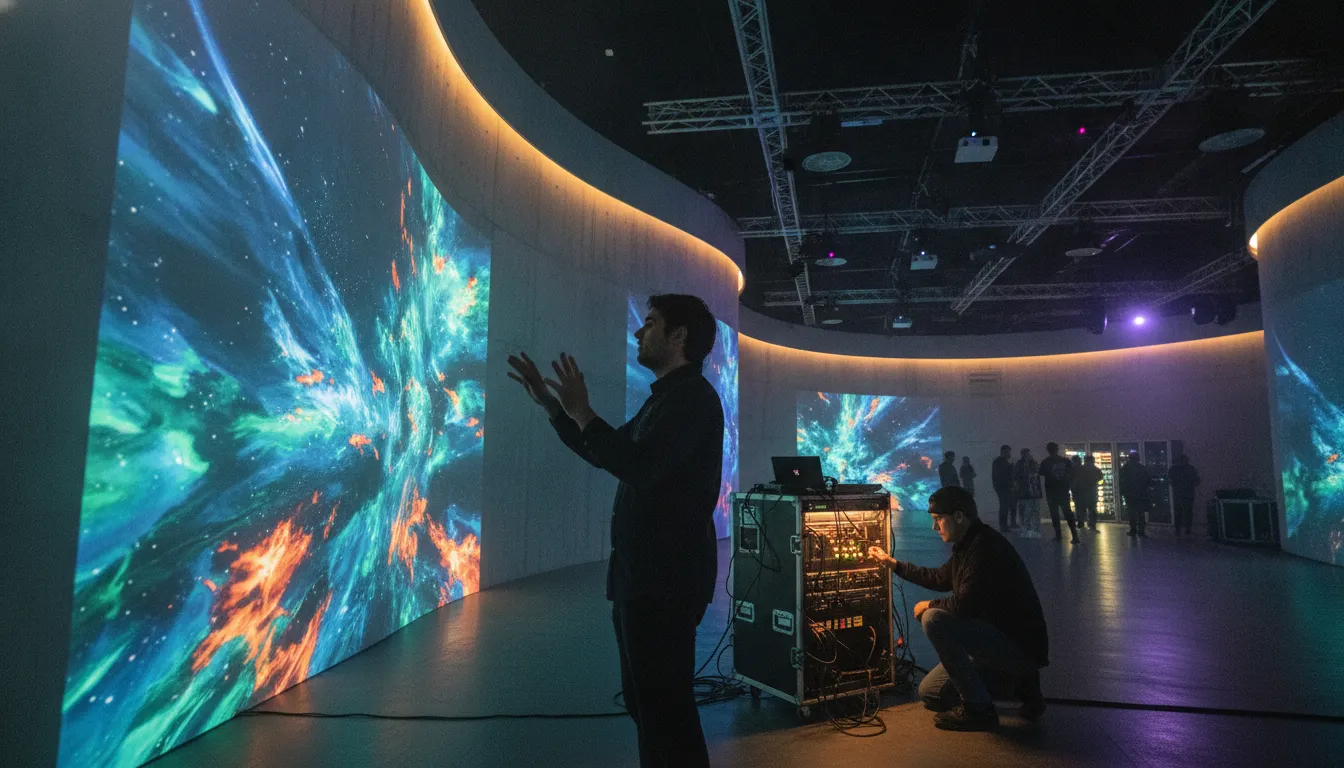
Technology choices should follow the audience promise, site conditions, and operating model. Projection mapping, AR, VR, game engines, tracking, sensors, show control, and content-management systems are tools within a larger experience architecture. The strongest stack is adaptable and serviceable, not merely advanced on opening day.
Match the technology to the experience promise
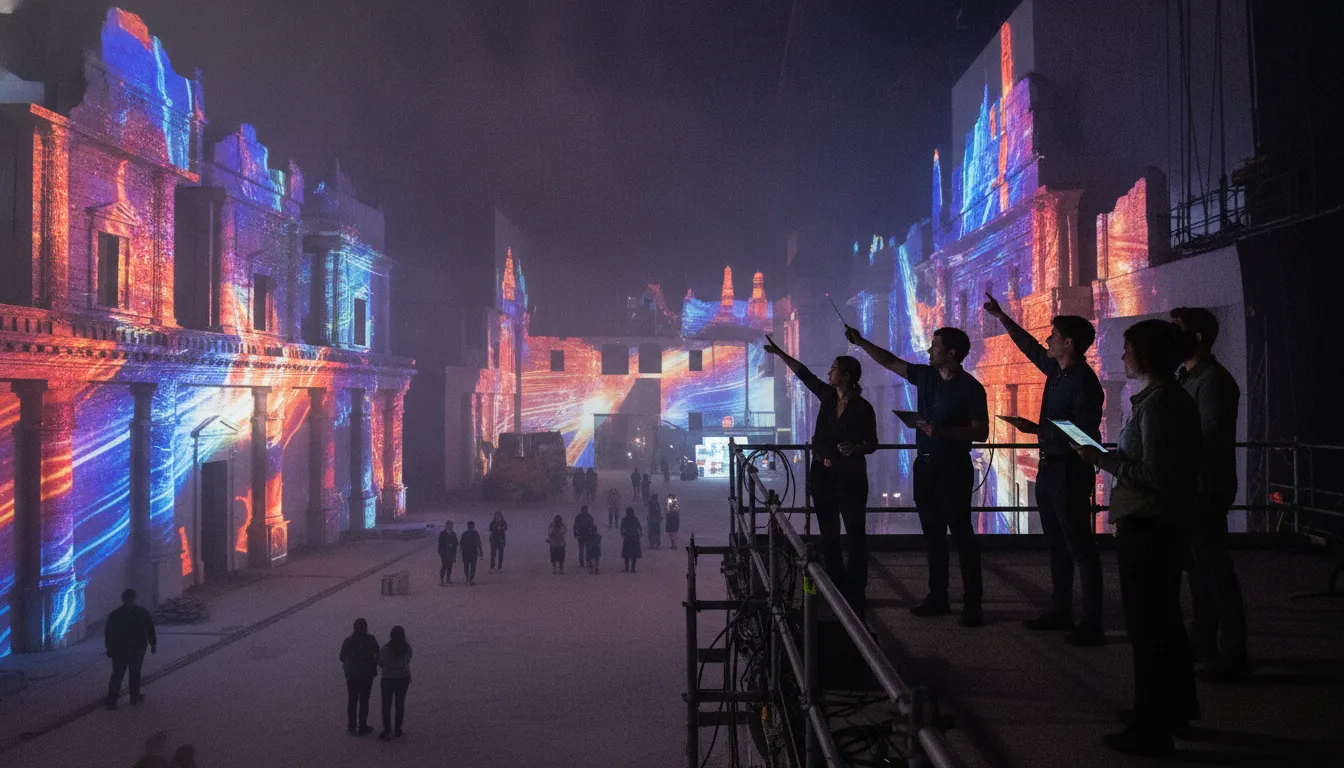
Projection mapping can turn architecture into a shared storytelling surface. It suits concepts that depend on scale, atmosphere, and social viewing. AR can place fictional content into a visitor's surroundings. VR can create a controlled world with less dependence on the venue's physical architecture. Interactive game systems can support branching logic, persistent characters, missions, and progression.
No technology is automatically immersive. Immersion can come from physical detail, performance, sound, pacing, interaction, or the feeling that a visitor's action matters. A simple proximity trigger may be the right choice for a high-throughput family experience. More precise body, object, or spatial tracking may be justified when movement is central to the narrative. The question is whether the system remains convincing when the venue is busy, lighting changes, and visitors behave unpredictably.
Design for interoperability and operations
Interoperability should be an early requirement. Define how the game engine communicates with tracking hardware, how content is versioned, how show control is synchronized, and how operators identify and recover from failure. A content-management layer should support approved updates to assets, languages, configurations, and event states without requiring a full rebuild for every change. Teams can apply related lessons from a virtual production pipeline, especially around version control, handoffs, and repeatable technical delivery.
Plan for several kinds of scale: more simultaneous visitors, additional rooms, new venues, seasonal content, language variants, and later connections to mobile or wearable experiences. The stack should also have a graceful failure mode. If one sensor or display is unavailable, the visitor should still receive a coherent experience whenever possible. Arctic7's work across virtual production and game development and co-development reflects the value of connecting cinematic intent, interactive design, and technical delivery.
How Do You Model Venue Economics Without Overpromising?
Model an LBE venue by separating measured operating inputs from demand forecasts. Test capacity, dwell time, staffing, maintenance, utilization, ancillary revenue, and downtime under different conditions, then use a pilot to replace provisional assumptions with observed evidence.
A credible venue model connects the visitor experience to operational reality. Start with observable assumptions about capacity, time, space, labor, maintenance, and secondary spending. Keep those inputs separate from demand forecasts and label every assumption as measured, benchmarked, or provisional. A pilot can then test the model before a larger commitment.
- Measure practical throughput. Count the visitors an experience can serve during a defined operating period, including entry, briefing, loading, transitions, cleaning, resets, and accessibility needs. The theoretical capacity of a room is not the same as usable capacity.
- Model the complete dwell journey. Track queue time, orientation, core experience time, transitions, social areas, and departure. A longer visit can create more value, but only when the experience earns that time through meaningful participation and thoughtful destination design.
- Test utilization by operating condition. Build separate scenarios for weekdays, weekends, peak seasons, off-peak periods, and private or partner events. Do not allow a peak-day scenario to become the default business case without evidence.
- Separate core and ancillary revenue. Food and beverage, merchandise, premium sessions, memberships, sponsorship, and retail may add resilience. Each should have its own conversion assumption and operational requirement. Ancillary spending should not be required for the core attraction to work.
- Include the full service burden. Budget assumptions should account for hosts, technical operators, guest support, security, cleaning, content updates, equipment inspection, repairs, and downtime. Operations are part of the product, not an afterthought.
- Use a pilot to test repeatability. Measure throughput, dwell time, utilization, guest satisfaction, technical incidents, staffing load, ancillary conversion, and return intent. Compare observed results with the original model, then revise the plan when evidence disagrees with the forecast.
Visitor emotion and destination satisfaction matter alongside capacity and revenue. A study of entertainment destinations highlights the importance of the overall destination experience, not only the signature spectacle. That destination-experience research supports a practical conclusion: the venue model must measure the complete journey, because the journey is what the audience evaluates. A related virtual production workflow for filmmaking can help teams connect the attraction's visual language to the wider franchise.
How Does Location Based Entertainment Development Deepen Franchise Fan Engagement?
Location based entertainment development deepens fan engagement by turning a screen-based audience into active participants. A well-designed attraction creates shared discovery, physical memory, and meaningful agency while connecting the visit to the wider film, television, game, and digital ecosystem.
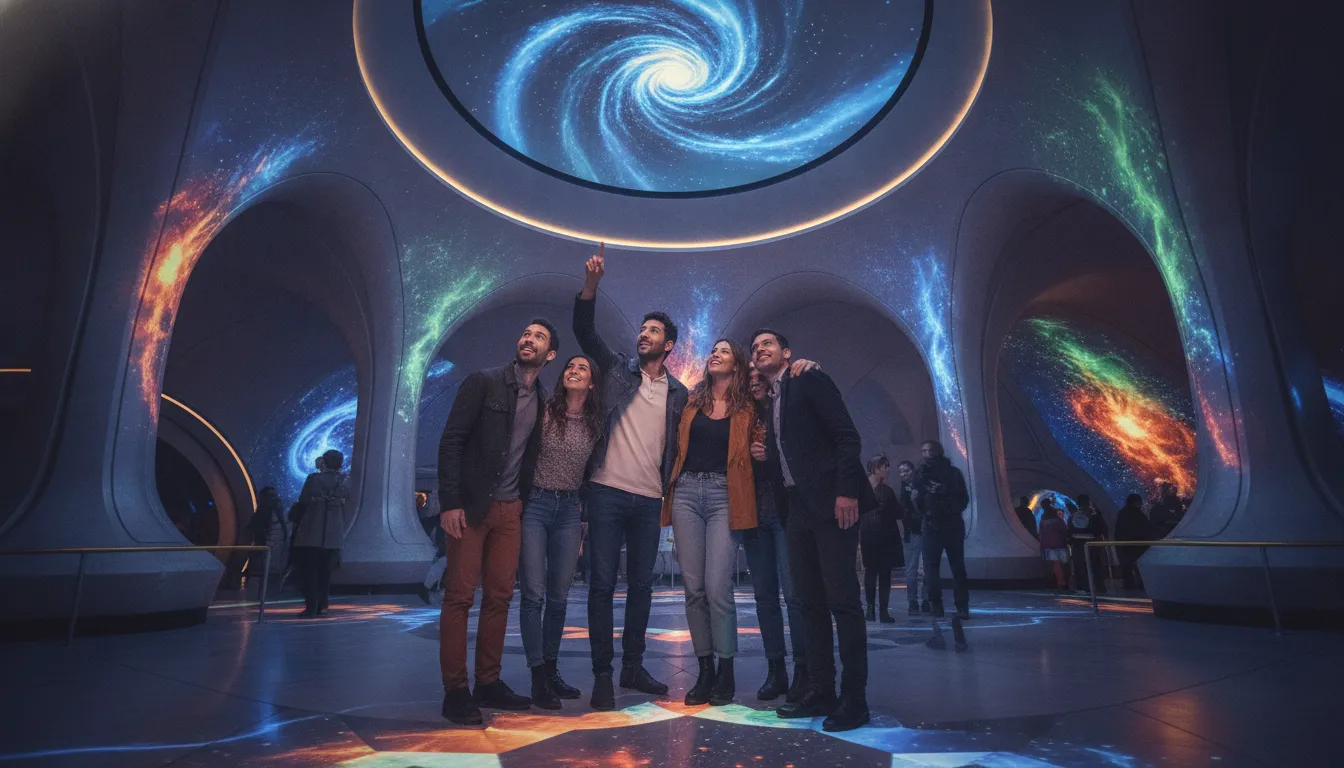
Location-based entertainment turns a fan from a viewer into a participant. A well-designed attraction creates shared discovery, physical memory, and moments of agency that a screen experience cannot fully reproduce. It can also give the franchise a recurring place in the audience's social life, provided the visit connects naturally to the wider world.
Participation makes the world personal
In a passive format, the audience receives a defined sequence. In an LBE experience, visitors can investigate, solve, choose, perform, or influence the pace of an encounter. Even when the underlying story is carefully controlled, that sense of agency makes the experience more personally memorable.
Authenticity gives participation emotional weight
Fans notice when a venue understands the emotional logic of an IP. Authenticity does not require every detail to be copied from an existing film or game. It requires the environment, interaction, characters, and service behavior to express what the franchise means. A new story can feel credible when it respects the world rules and gives the audience a meaningful role within them.
Community extends the visit
Shared experiences create conversation, photos, fan theories, and repeat rituals. A venue can support that community through social spaces, collectible moments, live events, rotating content, or missions that reward return visits. The goal is not to manufacture noise. It is to create experiences people want to discuss because the participation gave them something specific to remember.
This is where an attraction becomes strategically valuable. It can introduce new audiences to a world, deepen the commitment of existing fans, and create story or gameplay opportunities that complement film, television, and games. In an interconnected entertainment ecosystem, the venue is a living expression of the IP rather than a one-time campaign. That ecosystem perspective is also central to building virtual worlds with Unreal Engine, where visual continuity and audience immersion must carry across formats.
What Does a Strong LBE Development Process Look Like?
A strong LBE process moves from franchise intent to audience experience, then to a production and operating blueprint. It connects creative, technical, commercial, and operational decisions so the concept remains compelling when it meets the realities of a venue.
A strong process moves from franchise intent to audience experience, then from experience design to a production and operating blueprint. It keeps creative, technical, commercial, and operational decisions connected so that the concept remains compelling when it meets the realities of a venue.
1. Get the IP transmedia ready
Begin with a narrative audit and a clear definition of what makes the IP worth entering. Identify the world rules, emotional promise, audience segments, adaptable elements, and boundaries that protect the franchise. This stage prevents the attraction from becoming a collection of disconnected references.
2. Define the audience and venue strategy
Describe who will visit, with whom, under what conditions, and with what prior knowledge. Then assess venue type, location, access, dwell pattern, capacity, accessibility, and partnership requirements. A concept that works for a destination fan audience may need a different interaction model for a broad family audience.
3. Prototype the experience
Use storyboards, spatial studies, interactive prototypes, technical tests, and audience research to examine the experience before committing to a full build. Test the moments that carry the most risk: orientation, movement, interaction clarity, queue transitions, content synchronization, and recovery when a system fails. A documented virtual production tools strategy can make those tests more repeatable when the concept depends on real-time visuals.
4. Create the production blueprint
Translate the concept into a coordinated plan for narrative, spatial design, content production, software, hardware, staffing, training, maintenance, launch, and future updates. Establish ownership across partners and define how changes will be approved. Arctic7's transmedia approach is built around aligning strategy, creative execution, and technical excellence across formats. Its transmedia services and Narwhal Studios virtual production team offer relevant examples of how those capabilities can connect.
5. Pilot, measure, and evolve
Launch the smallest credible version that can answer the most important questions. Measure both audience response and operating performance. Then use the evidence to refine the story, technology, staffing model, and content cadence. A pilot is not only a risk-control exercise. It is a way to discover what the audience finds most meaningful.
Why Does the Right Development Partner Matter?
The right development partner connects IP strategy, spatial design, production, game systems, technology, and operations. That integration protects creative intent while translating an ambitious concept into a buildable, serviceable, and adaptable visitor experience.
Location based entertainment development crosses disciplines that are often managed separately. The partner must understand the IP, the audience, the physical environment, the production pipeline, and the operating model. A collection of specialist vendors may deliver individual components, but the experience still needs one coherent creative and technical direction.
Look for integration, not a list of capabilities
Ask how a partner connects narrative development, spatial design, game systems, virtual production, content operations, and measurement. The answer should describe decisions and handoffs, not only services. Integration reduces the risk that the story, technology, and visitor journey evolve in conflict.
Assess the bridge between ambition and execution
Immersive concepts often fail at the handoff between a compelling pitch and a buildable system. Look for a team that can translate creative intent into prototypes, production plans, technical requirements, and operating procedures. That bridge matters especially when the attraction must extend an IP across film, television, games, and live experiences.
Choose a partner that can evolve with the franchise
An attraction should have a reason to remain relevant after opening. That may come from new missions, seasonal content, connected digital experiences, live programming, or a disciplined refresh cycle. A partner with experience across multiple formats can help the IP holder plan those extensions without losing the central identity of the world.
Arctic7 partners with IP holders, game publishers, studios, and entertainment brands to build interconnected entertainment ecosystems. Its capabilities span transmedia strategy, game development, virtual production, cinematic storytelling, ecosystem design, and content optimization. The objective is to connect the strategic reason for an experience with the creative and technical work required to make it real.
Frequently Asked Questions
How does location based entertainment development work?
It starts by defining the franchise role, audience promise, format, and venue conditions. Teams then prototype the visitor journey, select technology that supports the experience, model operations and economics, build the production blueprint, and pilot the attraction before scaling.
What technology is used in location based entertainment development?
Common technologies include projection mapping, augmented and virtual reality, game engines, tracking systems, sensors, show control, mobile devices, wearables, and content-management tools. The best choice depends on the interaction, environment, reliability requirement, and future content plan.
How do you build a successful location based entertainment venue?
Design the full journey, not only the headline spectacle. Plan arrival, orientation, accessibility, guest flow, interaction clarity, staffing, maintenance, technical recovery, throughput, and content updates. Test those assumptions with prototypes and a pilot, then refine the venue using observed evidence.
How do IP holders benefit from location based entertainment development?
An attraction can make a fictional world tangible, deepen fan participation, introduce new audiences, create recurring engagement, and connect physical experiences to film, television, games, and digital content. It can also give the IP holder a new format for storytelling and community building.
What should an IP holder evaluate before starting an LBE project?
Evaluate the franchise fit, audience demand, venue strategy, accessibility, operating model, technology requirements, content cadence, partner responsibilities, and pilot plan. Avoid unsupported attendance or cost promises. A defensible concept separates what has been measured from what still needs to be tested.
Talk with Arctic7 about building an immersive extension for your IP
New Immersive & XR Media Capabilities Added to Arctic7's Suite of Games, Film & TV and Digital Services

Arctic7 Shares Details of its Work on Skeleton Crew and Cinematics Partnership with Fateless

The Human Touch: Adding Personality to Project and Product Management
Whether it’s your team, your client, or your stakeholders, understanding the human dynamics is just as critical as hitting milestones.

McDonald's Case Study: Bridging Brand and Play | Arctic7
Bridging Brand and Play: An Interview with Lindsay Blenkhorn Daggitt