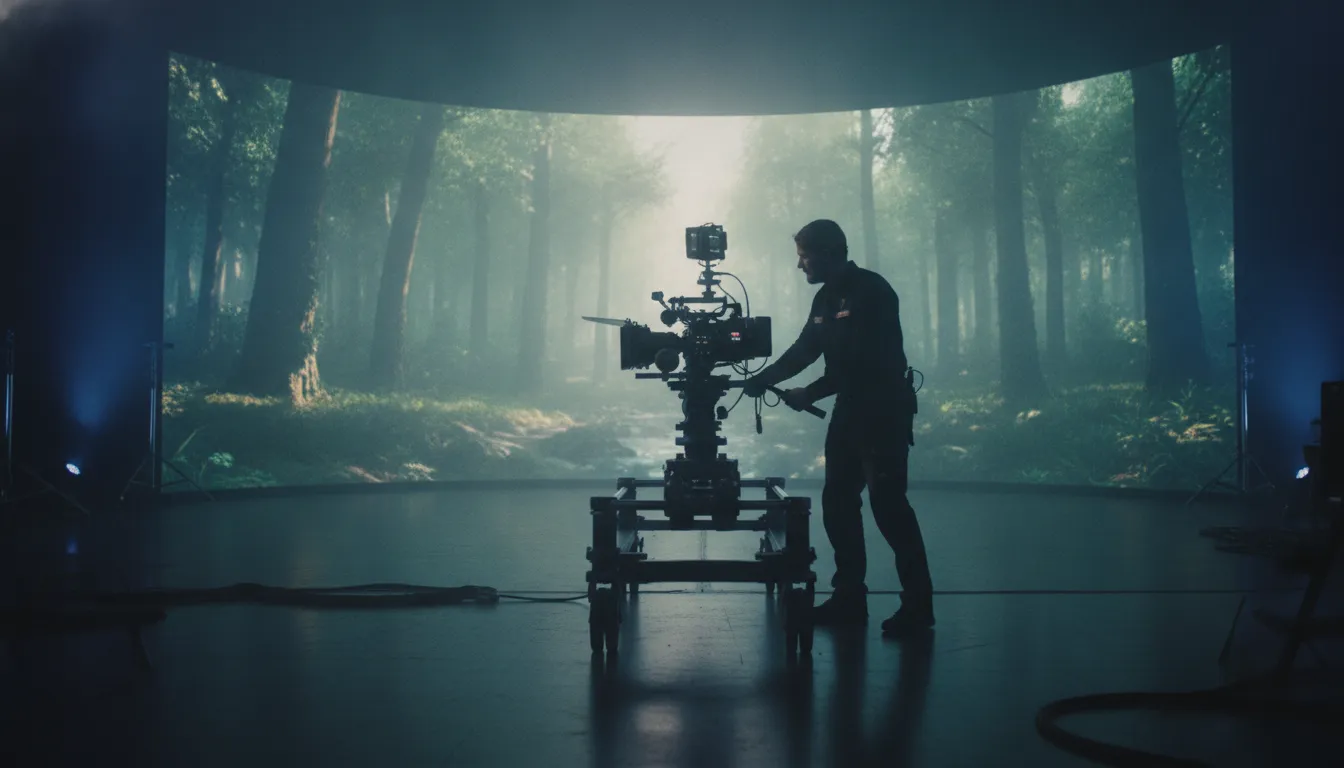

LED Volume Stage: The Anatomy of a Real-Time Production Wall
A single day of bad weather on location can derail a multi-million dollar film budget. Forward-thinking producers bypass these costly outdoor risks by shooting inside controlled digital stages.
An LED volume stage is a controlled virtual production space. It combines camera tracking, real-time rendering, and high-resolution LED panels to capture physical actors and digital backgrounds directly in-camera. By linking physical cameras to real-time engines, the system updates the digital backdrop to match camera movement. This creates a natural, responsive perspective in real time. Research from the Savannah College of Art and Design shows this setup cuts down on location costs and travel times. It also lets directors shoot final visual effects in-camera. In short, this system gives filmmakers complete control over lighting and weather conditions on set. They can capture true reflections and natural depth without leaving the physical studio.
While this setup is highly effective, running a virtual stage needs a deep knowledge of its moving parts. To help producers use these systems, we must first break down the core physical and digital tools that make these sets work. The path begins with The Anatomy of an LED Volume Stage.
Discuss your LED volume production with Arctic7's virtual production team.
The Anatomy of an LED Volume Stage
Modern filmmaking is changing fast. Producers no longer need to travel to far places or wait for weeks to see their work. Instead, an LED volume stage combines tracking, real-time rendering, and LED panels to shoot virtual scenes directly in-camera. This physical and digital space lets actors, directors, and crew work with real backdrops on set. By blending these tools, production teams can work with greater speed and creative control. They can change the digital background in minutes, which makes the filming process much more flexible.
The core physical and digital components
To understand how this setup works, you must look at its main parts. The system relies on a curved wall of high-resolution LED panels that surrounds the stage. This wall displays the digital backdrop and gives real light to the actors on set. Camera tracking sensors are mounted to the camera rig. These sensors detect exactly where the camera is and how it moves. As the camera moves, the background shifts to match its perspective. This process makes the flat screen look like a real, deep space. It creates a natural sense of depth that a green screen cannot match.
How real-time game engines power the scene
The magic of this process depends on advanced software. Real-time game engines are the core software that lets LED volume stages update backgrounds instantly as the camera moves. This has redefined how studios use virtual production technology. In the past, game engines were only used to build video games.
Today, they serve as crucial virtual production tools in film and television. The software renders the digital world at sixty frames per second. It uses the camera tracking data to update the visual perspective on the fly. This means that if the camera tilts up, the virtual sky above also moves up in real time. The camera and the virtual engine must work as one.
This real-time system also makes on-set decisions much easier. Directors do not have to guess what the final shot will look like. They can adjust the digital assets, move virtual lights, or change the time of day with a few clicks. This level of control cuts the need for costly post-production work later. It lets the creative team focus on storytelling during the shoot.
The shift to on-set virtual production
This method has quickly changed how the entertainment industry works. On-set virtual production, or OSVP, became widespread after its use in the first season of The Mandalorian in 2019. That groundbreaking show used Unreal Engine, developed by Epic Games, to display realistic deserts and alien worlds. Rather than shooting on a traditional green screen, the crew captured final-pixel shots directly on set. Since then, the use of a professional virtual production workflow has become a standard for major studios. This shift helps teams avoid high travel costs and gain complete control over their shooting schedule.
As more studios build these stages, the technology becomes much easier to use. Large media brands and small indie teams alike now use these setups to expand their creative reach. Building these digital worlds needs careful planning before the cameras roll. But the final results show that the investment is well worth it for modern storytelling.
How the LED Wall and Curved Panels Build the Backdrop
The real backdrop of a modern LED volume stage relies on a massive screen. This setup replaces the old green screen. Instead of one giant display, the wall uses hundreds of small screens joined together. These parts form a seamless screen to show high-quality 3D scenes. The massive size of this wall changes how actors work with the digital world.
Modular LED screens and pixel pitch
Building a pro stage needs a lot of care. Each block has small light dots. The space between these dots is the pixel pitch. A smaller pitch means the dots are closer. This makes the image look sharp even when the camera is close. For example, the expert team at the AMS Studios LED volume stage uses CineLumen panels with a tight 2.6mm pixel pitch. This design gives the stage extreme detail. The wall has a total of 11,280,384 pixels. With a resolution of 6528x1728, the screen displays rich 10-bit color, which creates a deep sense of realism. High brightness is also key. This specific wall can reach 1000 nits of brightness to match studio lights. High nits help the screen blend with real props on set.Why curved panels keep perspective accurate
A flat LED wall works well for simple shots. But it has limits. If the camera moves to the side, a flat wall can quickly distort the background view. To solve this, builders use curved panels to make cylindrical walls. These curved screens have a set center-of-curvature radius that matches the path of the camera gear. This curve ensures the perspective of the background stays true from any angle. Keeping this view in sync needs smart camera tracking. As the camera moves on set, tools like Ncam and Mo-Sys StarTracker always watch its path. These tools send camera and lens metadata in real time to the game engine. Facts from B&H Photo Video show that this data includes lens distortion, focal length, and camera position. This stream keeps the virtual world in perfect sync with the real camera.Technical workflow and system alignment
Running an LED volume stage is a hard task. Creating the digital assets for the wall needs a skilled team. This work is often led by the Virtual Art Department role in pre-production. Then, on set, the technical crew must align the game engine, camera tracking, and the LED wall processor. If any part lags, the illusion breaks. Research at Full Sail University notes that these systems must function as one. This perfect sync prevents visual bugs like tearing or flickering on screen.How Camera Tracking and Real-Time Rendering Stay in Sync
An LED volume stage must look real to the lens. When the camera moves, the background must move with it in perfect sync. If the screen lags, the illusion breaks. To stop this, tech teams link the camera to the background engine.
This seamless sync between camera and screen is what sets virtual stages apart from green screens. In the past, filmmakers had to guess what the background would look like. Today, camera capture and background rendering happen at the exact same time. This blend of real and virtual worlds creates a believable space for the actors.
Camera tracking systems and metadata
Special sensors track the camera on set. Tools like Ncam and Mo-Sys send live camera data to the display system. This data includes camera position, focal length, and lens distortion. Every small movement goes to the engine in milliseconds.
This real-time flow is why camera tracking systems are vital. Without lens data, the background looks flat and fake on the screen. When the camera pans, the background shifts to match. The camera data guides the software so the perspective stays true.
Real-time game engines as core software
At the center of this process is the game engine. These real-time game engines act as the main software for the stage. They take live data from the camera sensors and redraw the 3D scene in real time. This lets the background update instantly as the camera moves.
To make this setup work, crew members follow a specific virtual production workflow that aligns all hardware. The tracking systems, LED processors, and render nodes must form a tight loop. When you set up these virtual production tools correctly, you get perfect alignment. This ensures that the virtual horizon and background shift with the camera in a natural way.
Iterative rendering and final-pixel shots
This fast loop gives film teams great creative freedom on the stage. Directors and crew do not have to wait for weeks of post-production. They can see final-pixel shots right on set as they work. Through real-time rendering, the team can change lighting and digital props on the fly.
Crew members can move digital trees, shift the time of day, or adjust mountains in seconds. There is no need to rebuild physical sets or travel to distant spots. Instead, the crew works on a unified digital stage where lighting and art change with a few clicks. This setup lets creative teams make decisions fast, which saves both time and money on set.
Stage Lighting and In-Camera Visual Effects on a Volume
One of the biggest strengths of an LED volume stage is how it handles light. On a green screen set, actors stand under flat lights that do not cast natural light onto them. But on an LED volume, the massive screen acts as a real light source. The wall shows the background and throws real light and reflections on the actors and props.
Interactive Light and Ambient Realism
The emissive panels on the wall cast soft, colorful light that changes as the background moves. This is called interactive lighting. When an actor stands in front of a digital sunset, the warm orange glow falls on them. Props like cars or helmets also show real reflections from the digital world.
The camera captures these reflections and light changes in real time. This makes the digital backdrop and the physical actors blend together. This method has become common since the filming of The Mandalorian in 2019. That show used Unreal Engine to run its backgrounds on the on-set virtual production stage.
Integrating Physical and Digital Light
While the LED wall provides ambient light, it cannot do all the work alone. Screen light is soft, so crews must mix it with physical studio lights. This hybrid approach is needed to shape the actors, add hard shadows, and keep skin tones looking natural.
Lighting crews must match the color of their physical rigs with the light from the screen. This blend of screens and physical rigs helps crews achieve natural depth. This hybrid light setup is a key part of virtual production setups. By linking digital scenes with physical lights, the team can control the entire set from a single desk.
Eliminating Post-Production Compositing
In the past, artists had to spend weeks replacing green screens after filming. This old workflow was slow and often led to flat, fake-looking scenes. An LED volume stage changes this by showing final-pixel scenes right on set.
The camera captures the reflections and ambient light live. This means there is much less need to fix colors or add digital effects later. According to industry guides, the LED volume provides interactive lighting and reflections that cut down on digital effects work.
This lets directors and producers see the final look of the shot right away. By using these tools, crews can cut post-production times and focus on creative choices on set. Our virtual production services help studios set up these systems to make filming easier.
LED Volume vs Green Screen: Trade-Offs for Producers
When you plan a shoot, you must weigh the cost and speed of each method. A modern virtual production pipeline uses an LED volume stage to capture final visual effects on set. Studios now seek low cost and high creative speed. This drive explains the rapid growth of virtual methods, as noted by the Savannah College of Art and Design. Choosing the right setup can make or break your schedule.
With a green screen, you shoot first and build the world later. With an LED volume stage, you build the world first and shoot it live. This shift changes the entire creative process for your crew.
Creative control and real lighting
With green screens, actors stand in front of a blank backdrop. Crucial light and reflections must be added later in post. This flat look affects skin and props. You also need hours of rotoscoping and color grading.
An LED volume stage throws real light and reflections onto the set. Achieving true depth and natural skin tones still needs a hybrid approach. You must blend digital screen light with physical lighting rigs, as outlined by North Carolina State University. This mix of light makes the scene feel real.
Upfront costs and team alignment
Producers must balance a high upfront technical investment against long-term savings. An LED volume stage is costly to set up. But this choice can save money on travel, physical set builds, and post work. You do not need to fly a crew to distant sites.
To succeed, your on-set crew must also maintain a highly synchronized workflow. The game engine, camera tracking, and wall processor must function as one, per Full Sail University. This unified technical setup takes deep skill but gives you final-pixel shots on the day. It prevents issues like screen tearing.
Post production and final pixel goals
Traditional green screens leave much of the work for the post stage. This delay drives up your edit bills. Editors must key out the green, build background assets, and composite them by hand. This process can drag on for months after the cameras stop rolling.
An LED volume stage shifts this effort to pre-production. The goal is to capture final pixels directly in the camera. This saves time in the edit bay and lets you see the final look on set. Directors can make choices with real context.
| Production Metric | LED Volume Stage | Green Screen |
|---|---|---|
| In-Camera Finality | High. Captures final pixels on set. | Low. Requires post-production compositing. |
| Lighting & Reflections | Natural. Screen light reflects on actors. | Artificial. Added later in post-production. |
| Planning Lead-Time | Long. Assets must be ready before shooting. | Short. Backgrounds can be created during post. |
| Upfront Cost | High. Needs substantial initial tech investment. | Low. Lower barrier to start shooting. |
| Post-Production Effort | Reduced. Fewer visual effects tasks remain. | High. Heavily relies on downstream editing. |
The Role of the Virtual Art Department
Bridging physical and digital art
The virtual art department, often called the VAD, is the team that brings your world to life before a single camera rolls. When planning a virtual shoot, knowing the role of a Virtual Art Department is key to success. On an LED volume stage, this group acts as a key link between different teams.
Based on research from NC State, the VAD is a critical bridge. It connects physical sets with digital assets. In the past, art teams built physical sets while digital artists worked in post-production. Now, this department combines those roles to ensure physical props on the stage match the digital screens.
By acting as a link, the team helps the director and crew make smart creative choices early. They plan layout, scale, and lighting in 3D spaces before construction starts. This early work saves money and cuts stress on set.
Physical set builders and digital world creators now work side by side. For example, a physical desk on the stage can blend into a digital room shown on the wall. The VAD maps out these blends so the scene looks seamless to the camera.
Preparing assets in pre-production
Timing is everything when you shoot on an LED volume stage. The VAD builds and prepares the digital assets during the pre-production phase. This ensures that complex environments are fully ready for live shooting on the stage. Early asset prep is needed to keep live shooting on schedule.
By building the assets early, the team avoids delays. You do not want to design a background while actors are waiting on set. The VAD ensures that every digital mountain, building, or sky is complete and loaded into the system before day one of the shoot.
This early planning also gives directors more room to explore. They can test different camera angles, change the time of day with a click, and adjust set pieces on the fly. Doing this in the computer first saves key production hours.
Designing for real-time speed
Digital environments on an LED volume stage must run at high speed. As the camera moves, the background must update instantly to maintain the illusion of reality. If the digital set lags, the shoot must stop. This means every asset on the wall must be fast.
The VAD solves this issue by tuning every 3D model, texture, and light source. They reduce file sizes. They also clean up complex shapes to keep frame rates high. Their work keeps the virtual world running smooth and looking real under the camera lights.
Planning and Operating Your Own LED Volume Stage
Building a virtual stage is a big step for any production team. A physical setup takes careful design, but running it is about daily workflow. To succeed, you must think of the wall as part of a larger plan. Setting up a virtual production pipeline helps you map out your physical and digital needs early.
Your team must treat the wall, the cameras, and the real-time software as a single tool. In fact, most modern stages are no longer separate spaces. Today, these stages are built directly into existing film studio sites to keep all production needs under one roof. This setup provides soundstages, editor suites, and art spaces in a single creative hub.
This process also changes how you plan your budget and schedule. Unlike classic shoots where post-production happens after filming, virtual production shifts the work to the front of the timeline. You will spend more time in pre-production building 3D assets, which frees up your schedule once you are on set. This upfront investment saves time and allows for a much smoother shoot.
Core steps for volume shooting
Managing a live shoot on an LED volume stage needs a clear plan. Each step relies on tight teamwork between tech crews and artists. To run a smooth shoot, producers should follow these main steps:
- Scope the shoot early. You must design your shots around the physical size of the wall before any cameras roll.
- Build your digital worlds. The virtual art team must build, test, and optimize the 3D assets before the shoot starts.
- Align the tech pipeline. Your tech crew must sync the game engine, camera tracking, and wall processor so they act as one system. This keeps the camera view in sync and prevents visual errors on the LED volume stage.
- Balance the stage lights. Crews must blend the light from the screens with physical rigs to get natural depth and realistic skin tones. Using hybrid lighting setups ensures that physical actors blend well with the digital backdrop.
- Shoot and iterate. The director and camera crew can now run takes and adjust digital lights or assets on the fly with no downtime.
Managing crew and technology
Running this setup needs a new kind of film crew. Classic film crew members must work hand in hand with real-time artists and game engine experts. This mix of skills is what makes the virtual workflow function. Since every scene is built in pre-production, the crew does not spend hours resetting lights or moving physical sets on the stage. Instead, they can focus on shooting the best possible scenes and keeping the workflow moving fast.
Testing and quality checks
Testing is also a core part of running an LED volume stage. Before any actor steps onto the stage, the technical team must run latency checks. Any delay between camera movement and the background update can break the illusion of depth. By running daily tests, you ensure that the entire pipeline is fast and responsive before the cameras roll.
Frequently Asked Questions
How do producers balance the costs of an LED volume stage?
Producers must balance the high upfront cost of renting a stage against long-term savings. While renting a stage and hiring a tech crew is expensive, it cuts travel costs, set build times, and post-production work. A virtual production guide from B&H Photo Video shows that these upfront investments save time and speed up work on set.
Why must a virtual art department build assets before filming?
A Virtual Art Department (VAD) must build and test digital assets during pre-production. This team connects physical set design with digital assets to ensure everything looks real. Research from North Carolina State University shows that this early work ensures digital scenes are optimized for live shooting.
How do technical teams prevent visual errors on an LED volume stage?
The tech crew must align the game engine, camera tracking, and LED wall processor. If these parts do not work as one, the camera will capture visual bugs like screen tearing. A study from Full Sail University notes that keeping these tools in sync is key to clean shots.
Why do LED volume stages require physical studio lighting?
While the LED wall shines light on actors, crews must still use physical studio lights. Combining digital screen light with physical studio lamps creates real skin tones and soft fill light. According to North Carolina State University, this hybrid lighting mix is vital to make physical sets and digital backdrops blend.
Are you ready to plan your next LED volume stage project?
Every single day of delay on a standard stage means spending more of your limited production budget on travel, bad weather, and building physical sets. If you do not plan your virtual shoot early, you risk losing prime studio space and facing costly visual design delays that slow you down. Setting up your digital assets today ensures that your scenes are fully optimized, which gives your team complete schedule control from the very first day.
Ready to build your next virtual environment on a modern set?
Get a free consultation to plan your LED volume production with Arctic7's virtual production team
New Immersive & XR Media Capabilities Added to Arctic7's Suite of Games, Film & TV and Digital Services

Arctic7 Shares Details of its Work on Skeleton Crew and Cinematics Partnership with Fateless

The Human Touch: Adding Personality to Project and Product Management
Whether it’s your team, your client, or your stakeholders, understanding the human dynamics is just as critical as hitting milestones.

McDonald's Case Study: Bridging Brand and Play | Arctic7
Bridging Brand and Play: An Interview with Lindsay Blenkhorn Daggitt