
Cinematic Storytelling Studio for Entertainment IP
A franchise can have a compelling premise and still lose its impact when every format interprets that premise differently. The costume language, camera grammar, pacing, and worldbuilding that shape a film may not automatically translate into a game, television series, or campaign asset.
A cinematic storytelling studio turns narrative intent into a coherent visual system that can travel across games, film, television, immersive experiences, and marketing. The work connects story, design, cinematography, technology, and production planning so each expression feels native to its format while remaining recognizably part of the same world.
That distinction matters because visual storytelling communicates emotion, character, and meaning through images, while choices such as lighting and framing guide how audiences interpret a scene (Los Angeles Film School). Understanding the studio's role begins with the strategic and production decisions that make this consistency possible.
What Does a Cinematic Storytelling Studio Actually Do?
A cinematic storytelling studio turns a narrative ambition into a coordinated visual experience. It may shape the story and world, define the visual language, guide production, and prepare assets for different platforms. The strongest partners connect creative decisions to a broader IP strategy, so film, games, television, and marketing feel related rather than retrofitted.
In practical terms, the work spans four connected responsibilities: narrative strategy, visual development, production execution, and technical delivery. The balance changes by project. An IP holder may need a worldbuilding workshop and pilot script; a production team may need virtual production and real-time pipeline expertise. A marketing group may need a cinematic brand film that belongs to a larger ecosystem.
From narrative intent to visual language
The first responsibility is deciding what the audience should understand, feel, and remember. Visual storytelling uses images to convey emotion, character, and meaning without relying primarily on words, according to the Los Angeles Film School. That means a studio does more than make scenes look polished. It translates the narrative spine into choices about framing, lighting, movement, production design, pacing, and sound.
Those choices carry meaning. Lighting can shape mood and direct attention, while high-key light may read as optimistic and low-key contrast can create tension or mystery. A wide frame can communicate isolation without dialogue, and a lingering close-up can signal that something is wrong. These are not decorative details. They give directors, editors, and producers a shared language for making decisions throughout the project.
From visual system to production and delivery
Once the creative direction is established, the studio turns it into workable production materials and processes. Lookbooks, treatments, scripts, previs, asset plans, and technical specifications help align internal teams and external partners before expensive decisions become difficult to change. Production may combine live action, game engines, virtual production, animation, CGI, and audio, depending on the story and the intended audience experience.
Delivery is equally important. A cinematic storytelling partner should understand how an idea travels across a feature, game experience, episodic series, immersive installation, or campaign asset without losing its identity. Arctic7 describes this integrated approach through its services, combining strategy development, creative execution, and technical production. Its work on multi-platform narrative design reflects the same principle: build the connective logic early, rather than trying to impose coherence after each format has been developed separately.
That distinction matters when choosing a partner. You are not only commissioning a film or a set of visuals. You are assessing whether the studio can protect the meaning of the IP while moving confidently from story development to production and platform-specific delivery.
Why Does Cinematic Storytelling Matter Across Games, Film, and Television?
Cinematic storytelling matters because it gives an entertainment property a coherent narrative spine while allowing each format to express that story on its own terms. Games can invite participation, film can concentrate emotion through composition and performance. Television can develop character and consequence over time, and marketing can create a concise entry point into the world.
A strong approach does not force every channel to repeat the same scene. It defines what must remain consistent, then adapts character, pacing, point of view, and visual language to the audience experience each medium makes possible.
One narrative spine, different audience experiences
When film, television, games, and digital content are developed in isolation, connections can feel retrofitted. A central narrative spine gives teams a shared understanding of the world, its emotional stakes. Its characters, and the promise an audience should recognize wherever they encounter the property. That foundation supports creative variation without turning every extension into a disconnected asset.
For a game, the spine may become a set of player-driven choices, environmental storytelling, or a character arc that unfolds through interaction. In film, the same underlying idea may be shaped through performance, framing, lighting, editing, and sound. Television can give supporting characters room to evolve across episodes. The goal is not visual sameness. It is meaningful continuity.
This is why a strategy to extend IP across platforms should begin before individual deliverables are commissioned. Narrative development, worldbuilding, lookbooks, pilot scripting, and production planning need to inform one another, so each team understands which elements are foundational and which are open to interpretation.
Why does the same story need format-specific expression?
Every medium creates a different relationship between the audience and the story. Interactive worlds give players agency and discovery. Film controls the sequence of attention. Television builds anticipation through return visits. Marketing must communicate quickly enough to earn the next action, while still feeling connected to the larger world rather than like a generic advertisement.
Character-led content can extend into episodic films, social content, podcasts, and wider transmedia use, provided the character and narrative logic are defined first. In production, live action, CGI, animation, generative tools, and audio can also be directed around one coherent treatment. This keeps the execution flexible without allowing technology to become the idea.
The same principle applies to distribution. A cinematic brand film can be edited into 60-, 30-, and 15-second versions for a website and social platforms. Creating useful entry points without requiring the marketing team to invent a separate story for every channel. A unified game and virtual production approach can further connect real-time assets, visual development, and screen production when the project calls for it.
For IP holders, the value is strategic as much as visual. A cinematic storytelling studio should help protect the emotional identity of the property while making its worlds usable across games, film, television, and marketing. That requires narrative judgment, production fluency, and enough technical understanding to carry intent from the first treatment through the final format version.
How Does a Cinematic Storytelling Studio Turn an Idea Into a Production Plan?
A cinematic storytelling studio turns an early idea into a production plan by connecting creative intent to defined audience outcomes, a coherent narrative spine, and practical delivery requirements. The process moves from purpose and visual language through look development, previs, production, post-production, and platform-specific versions, so each decision supports the larger IP.
Define the purpose, audience, and action
The first step is not choosing a camera or writing dialogue. It is clarifying what the film must communicate, who needs to care, and what should happen afterward. An IP holder may want to introduce a new world, deepen a character. Support a launch, or give audiences a reason to move from a film into a game. Those objectives shape the brief, audience assumptions, success criteria, format, and distribution plan.
Shape the central idea and visual language
Next, the team develops the narrative structure and the visual system that will carry it. This includes the central idea, character or world priorities, tone, pacing, composition, lighting, color, and camera language. Visual storytelling can communicate emotion, character, and meaning without relying primarily on words. Lighting can direct attention and establish mood, while framing can communicate isolation or tension. These choices become a practical creative reference rather than subjective preferences. They also help keep a cinematic asset aligned with the wider world of a franchise.
Build the lookbook and previs
A lookbook makes the intended experience tangible for creative, production, and stakeholder teams. It can establish environments, wardrobe, lighting references, motion principles, and the relationship between live action, CGI, animation, or game-engine content. Previsualization then tests sequences, camera movement, staging, and technical assumptions before the shoot. For projects using virtual production, a real-time production pipeline can connect digital environments with production decisions earlier, while still requiring deliberate planning for assets, tracking, lighting, and performance.
Choose the production approach and execute
With the treatment established, the studio selects the right combination of live action, CGI, animation, generative production, audio, and virtual production. The goal is not to use technology for its own sake. It is to make the chosen story achievable within the project's creative, logistical, and technical constraints. A mature plan anticipates permits, travel, weather, locations, crew needs, approvals, and the handoffs between departments. Arctic7 aligns cinematic storytelling, lookbooks, pilot scripting, and virtual production with a central narrative spine, helping prevent film, game, and digital work from becoming disconnected.
Edit, design sound, and deliver variants
Post-production brings the material into a coherent final experience through editing, motion graphics, grading, sound design, and music. The team can then prepare versions for the intended channels, such as a hero film, trailer, website placement, social cutdowns, or platform-specific formats. Planning these variants early protects the core story while making the production more useful across a connected entertainment ecosystem. It also gives stakeholders a clear release package rather than a single asset that must be reworked after delivery.
What Should You Look for When Choosing a Cinematic Storytelling Studio?
A strong cinematic storytelling studio should do more than produce polished images. It should connect narrative intent to a coherent visual system, work fluently across games, film, television, and marketing, and show how ideas move from early development through delivery. Evaluate the studio's thinking, pipeline, collaboration model, evidence, and ability to scale.
| Criterion | What to look for | Question to ask |
|---|---|---|
| Narrative and worldbuilding | A central narrative spine, character logic, world rules, and a clear visual language. | How will you protect the story as the project expands? |
| Cross-format fluency | Experience adapting the same world for games, film, television, immersive media, and marketing. | What changes between formats, and what must remain consistent? |
| Technical pipeline | Practical command of game engines, virtual production, previs, post-production, and delivery formats. | Where can your pipeline reduce creative or production risk? |
| Collaboration model | A defined approach to in-house development, co-development, or focused bespoke services. | Who owns decisions, assets, and approvals at each stage? |
| Portfolio evidence | Relevant examples that demonstrate decisions, not only attractive final frames. | Can you explain the brief, constraints, process, and deliverables? |
| Scalability and delivery | A route from concept and lookbook through production, versioning, and platform-specific outputs. | How would the work evolve if the audience or format mix changed? |
Test the narrative foundation
Ask to see how the team moves from an idea to a narrative spine, treatment, lookbook, or pilot script. The goal is not simply an appealing aesthetic. It is a shared system that helps directors, designers, editors, producers, and platform teams make consistent decisions. A useful studio should be able to discuss character motivation, worldbuilding, visual language, and audience intent in the same conversation.
Probe format and pipeline fluency
Cross-format fluency means understanding what should be translated and what should be redesigned. A game may require interactive systems, while a film demands controlled performance and editorial rhythm. Marketing may require concise versions for different channels. Ask how the studio coordinates game engines, virtual production, live action, CGI, animation, sound, and post-production rather than treating each as a disconnected handoff. Narwhal Studios offers a relevant example of a Virtual Art Department approach integrating game-engine workflows with traditional film production.
Examine collaboration and proof
The right engagement model depends on your project's stage, internal team, and desired level of ownership. Arctic7 describes options including full-scale in-house development, equal-partner co-development, and bespoke production services. Ask which model fits your governance and where your team remains involved. Also request a portfolio walkthrough that includes the original brief, tradeoffs, approvals, and final deliverables. Concept trailers can provide cinematic proof of an idea before a larger campaign or platform is funded, as described by Visually Sonic. That makes the portfolio discussion more useful than a reel alone.
Finally, test scalability. A studio should explain how the creative system can support new characters, episodes, platforms, or campaign assets without losing coherence. Arctic7's broader approach aligns cinematic storytelling, lookbooks, pilot scripting, virtual production, and platform-specific deliverables with an IP strategy. That is the level of continuity to look for when the project is intended to become an ecosystem, not a one-off asset.
How Does Virtual Production Strengthen Cinematic Storytelling?
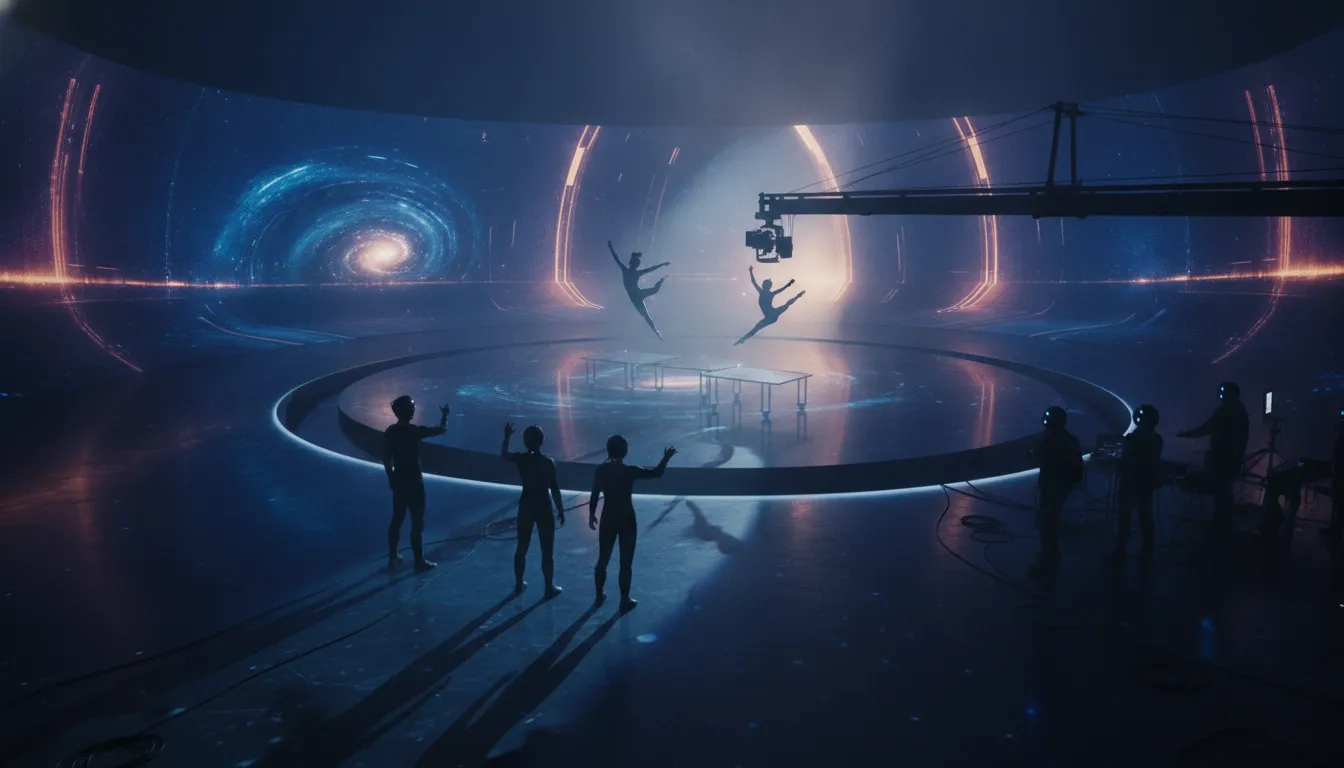
Virtual production strengthens cinematic storytelling by bringing the environment, lighting, and camera language into the same creative space as the performance. Dynamic LED walls can place characters inside responsive worlds, support rapid visual iteration, and reduce dependence on multiple physical sets or distant locations. The result is greater creative control, provided the production is planned with the same discipline as any other major filmmaking process.
For a cinematic storytelling studio, the technology is not the story. It is a production system that helps the story remain coherent from concept and previs through principal photography and delivery.
Make the world respond to the narrative
LED volumes replace conventional green screens with dynamic LED walls that display the digital environment around the performers. Instead of asking an actor to imagine an entire location, the production can create a more immediate visual context for the scene. The wall can also provide interactive light and reflections, helping the camera, production design, and performance operate within a shared visual frame.
Backdrops can change in an instant, allowing one stage to support different locations, times of day, or story beats without rebuilding the physical environment. That flexibility can be especially useful for worlds that move between realistic settings and difficult-to-create fantasy environments. UCLA identifies virtual production scenarios that can replace travel, dangerous or extensive set builds, and locations that are otherwise impractical to recreate: its virtual-versus-physical production research provides useful context.
Expand access while reducing physical dependencies
Virtual production can increase accessibility by bringing complex environments into a controlled stage setting. Teams may spend less time moving cast and crew between locations, and productions can reduce the need for extensive set construction or on-location filming. These are production possibilities, not automatic savings or environmental guarantees. The right choice depends on the creative brief, stage requirements, travel profile, assets, and technical pipeline.
That distinction matters when assessing sustainability. UCLA's comparative life-cycle assessment approach is designed to examine the environmental impact of virtual and traditional physical production rather than assume one method is always better. A responsible team should measure the relevant sources of energy use, carbon emissions, materials, travel, and waste for the specific production. This turns sustainability from a marketing claim into an assessment question.
Plan the technology around the creative intent
LED volumes expand what filmmakers can achieve, but the process is not automatic. Environments must be designed for the camera, content must be prepared for real-time playback, and lighting, lensing, tracking, and stage operations must be coordinated before the shoot. Poor preparation can make a technically impressive volume feel visually flat or constrain the performance it was meant to support.
Arctic7 connects virtual production with cinematic storytelling, lookbooks, and a central narrative spine so the technology serves the world and its characters. That deliberate integration helps decision-makers judge virtual production by what it enables audiences to feel, understand, and remember, not simply by the novelty of the wall.
How Can Brands Measure Whether the Story Is Working?
A cinematic storytelling studio should help you define evidence before cameras roll. Measure whether audiences understand the intended message, feel the intended emotional tension. Recognize continuity across formats, take the next desired action, and whether the resulting assets can be reused. These indicators reveal creative effectiveness without pretending that every production guarantees a fixed return.
Start with the decision the story must support. Is the audience meant to understand a new world, care about a character, explore an IP extension, join a community, or move toward a launch? Translate that purpose into observable signals. A short comprehension test can ask viewers to explain the premise in their own words. Emotional response can be assessed through structured interviews, reaction scales, or comparative edits, rather than by relying on internal consensus.
Measure the story before measuring the campaign
Pre-production is the right time to test whether the narrative spine is carrying the creative work. Show a treatment, lookbook, animatic, or concept trailer to representative stakeholders and audience groups. Check whether they identify the same central idea, understand the character or world stakes, and know what they are expected to do next. If interpretations diverge, the problem is usually cheaper to solve in development than during a final edit.
Creative choices can also be tested systematically. Research has compared Steadicam, dolly, handheld, and static camera approaches in controlled cinematic scenes, demonstrating a practical route for examining how technique affects audience involvement. The findings do not support a universal formula: camera movement may increase involvement without reliably changing emotional response in every situation. Use testing to inform a specific creative decision, not to manufacture a guaranteed outcome. Read the cinematography research.
Track continuity and intended action across formats
For a transmedia property, evaluate more than the hero film. Compare the language, character logic, visual motifs, and world rules across film, television, games, immersive experiences, and marketing. Ask whether each format feels native while still belonging to the same universe. Reviewers can score continuity against a shared narrative spine, then flag contradictions before they become expensive downstream revisions.
Finally, record the intended action for each audience and channel, then measure it separately. Watch time, completion, qualified visits, trailer-to-launch-page movement, community participation, or game-related engagement may be useful depending on the brief. Asset reuse is another practical measure: document which scenes, characters, sound elements, and compositions can be adapted into platform-specific deliverables without weakening the story. Visual storytelling informs directing, editing, and producing, so the measurement plan should travel through the whole pipeline, not sit only with marketing. This is the discipline behind extending IP across platforms.
The goal is not to reduce cinematic storytelling to a dashboard. It is to create a shared basis for creative decisions, identify weaknesses while they are still manageable, and distinguish demonstrated audience signals from assumptions about future ROI.
Explore Arctic7's virtual production capabilities for your entertainment IP
Frequently Asked Questions
What does a cinematic storytelling studio do?
A cinematic storytelling studio translates a brand's narrative intent into a connected visual system. That can include narrative development, worldbuilding, lookbooks, scripting, cinematography, virtual production, editing, and platform-specific assets for games, film, television, immersive experiences, and marketing.
How is cinematic storytelling different from a conventional brand video?
Cinematic storytelling begins with meaning, character, and audience experience rather than treating production as a standalone asset. The team defines the narrative spine and visual language first, then builds executions that can remain coherent across a campaign, franchise, game world, or broader entertainment ecosystem.
Can one studio support projects across games, film, and television?
Yes, provided the studio has genuine cross-format production and technical fluency. Look for experience connecting game engines, live action, virtual production, animation, post-production, and platform delivery, along with a process that protects continuity instead of retrofitting it late.
When should an entertainment brand bring in a cinematic storytelling studio?
Bring one in when the project needs more than execution, such as when the brief is strategically important. The IP must expand across formats, or several teams need a shared creative direction. Early involvement helps align audience, narrative purpose, visual language, production approach, and delivery requirements before costs become difficult to change.
How should you evaluate a cinematic storytelling studio?
Review its narrative depth, relevant portfolio evidence, real-time and virtual-production capability, collaboration model, and ability to scale from concept through delivery. Ask how it measures audience comprehension, emotional response, continuity, and intended action, rather than judging the reel on visual polish alone.
Ready to Explore a Connected Production Approach?
When your entertainment IP needs visual experiences that remain coherent across formats, a thoughtful production partner can help connect narrative intent with practical execution. Arctic7 brings cinematic storytelling and virtual production into a broader transmedia perspective, giving your team a clearer path from concept to production.
Explore Arctic7's virtual production capabilities and discuss your project
New Immersive & XR Media Capabilities Added to Arctic7's Suite of Games, Film & TV and Digital Services

Arctic7 Shares Details of its Work on Skeleton Crew and Cinematics Partnership with Fateless

The Human Touch: Adding Personality to Project and Product Management
Whether it’s your team, your client, or your stakeholders, understanding the human dynamics is just as critical as hitting milestones.

McDonald's Case Study: Bridging Brand and Play | Arctic7
Bridging Brand and Play: An Interview with Lindsay Blenkhorn Daggitt