


How to Choose a Virtual Production Partner for Your IP
Choosing a production partner for a multi-platform IP is not a matter of comparing LED walls or booking the nearest volume stage. The decision shapes how a world is planned, filmed, extended into games and immersive experiences, and protected as the franchise grows.
The right virtual production partner connects strategy, creative direction, stage technology, and technical integration from pre-production through post. That means establishing narrative guardrails, aligning camera and engine workflows, and creating reusable assets and production knowledge that can serve more than one release.
Virtual production is most valuable when it reduces fragmentation rather than adding another specialist silo. Netflix describes it as an approach that connects the production process from pre through post and requires advanced planning (Netflix). For an IP holder, that planning begins with a practical question: which responsibilities must one partner own to keep creative and commercial decisions aligned?
What Should a Virtual Production Partner Actually Own?
A virtual production partner should own the connected production system, not simply provide access to an LED stage. That includes planning, virtual art direction, asset development, technical coordination, on-set execution, and a clear handoff into post-production and future platform work. The right partner makes those responsibilities visible before cameras roll.
Start with planning. Virtual production connects pre-production, production, and post-production, so decisions about storyboards, previs, digital locations, camera requirements, and deliverables need to be made early. A partner should help define what belongs in the volume, what remains practical, and what assets must be created or adapted for the shoot. This is more substantive than booking stage time. Arctic7's guide to evaluating a virtual production company outlines why planning, asset creation, and storyboarding directly affect the smoothness of a shoot.
That scope should include the Virtual Art Department. The VAD is the bridge between creative intent and production-ready digital environments. It may coordinate worldbuilding, virtual scouting, layout, lighting references, asset preparation, and revisions with the director, cinematographer, production designer, and technical team. Digital environments are built from 3D models, environments, textures, and characters, so ownership must extend beyond a finished backdrop. Ask who approves assets, who maintains versions, and who ensures that the virtual world supports the camera and the story.
Technical coordination is part of creative ownership
On set, the partner should coordinate the camera, tracking system, lens data, game engine, LED wall, and display settings. A camera-tracking system can involve a sensor unit, processing box, and lens encoder, while engine plugins can preserve camera-specific virtual-production settings. These are not isolated tools. They have to work together reliably enough for creative decisions to survive the move from previs to final pixels.
Look for a partner that can explain this pipeline in terms your production team can use. The virtual production workflow guide is a useful reference for tracing responsibilities across preparation, stage work, and post. A capable partner should also document calibration, version control, review points, contingency planning, and the files your team receives after the shoot.
Finally, clarify the handoff. Ownership should not end when the stage day ends. The partner should deliver organized assets, technical notes, approved versions, and a usable record of creative and production decisions. For an IP intended to expand across film, television, games, or immersive formats, that documentation protects continuity and reduces duplicated work. The strongest partner model connects production execution with the broader pipeline, including Unreal Engine and Unity development, tooling, production workflows, and post-launch content planning. That is how a stage engagement becomes a durable production foundation rather than a one-off technical service.
How Do You Evaluate Stage Technology and Creative Control?
A strong evaluation looks beyond the size of an LED stage. Assess whether the partner can synchronize cameras and tracking, render responsive real-time environments, manage color and moire, and blend practical lighting with digital imagery. Just as important, confirm that the team can translate creative intent into decisions the technology supports, rather than letting the stage dictate the film.
Start by asking how the camera, lens data, tracking system, display, and real-time engine work together. Sony describes a complete virtual production system that synchronizes cinema-camera sensors with LED panels, while its tracking approach can combine a sensor unit, processing box, and lens encoder. These examples illustrate the right due-diligence question: not which isolated devices a partner owns, but how reliably the full capture and rendering chain behaves when the camera moves.
Tracking quality affects more than technical accuracy. It determines whether perspective, parallax, and background response feel intentional. Ask to see a representative test with fast movement, changing focal lengths, and shots near the display edge. The partner should explain how it detects moire that may not be visible to the naked eye, then validates the result before the shoot.
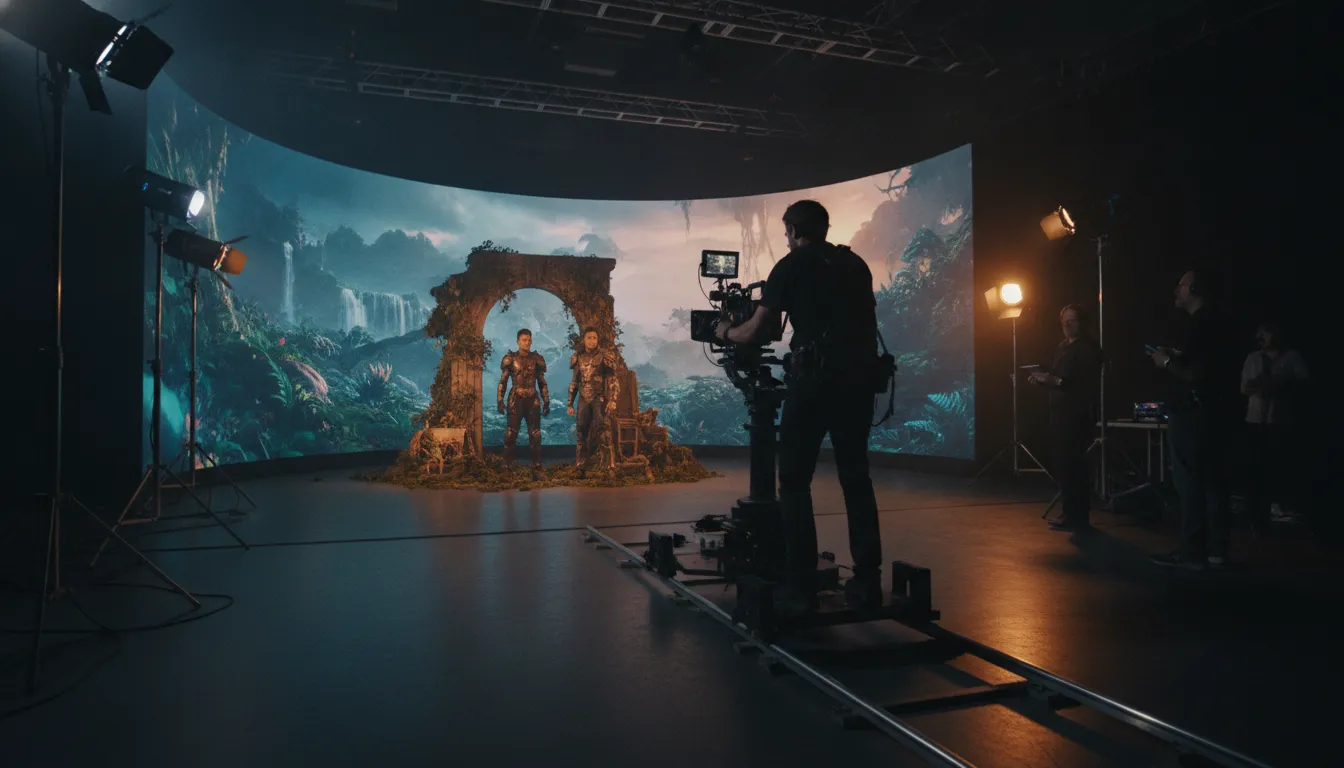
Then evaluate the image, not just the hardware specification. LED displays can be considered through black levels, reflections, brightness, color gamut, and refresh rate. Those qualities matter because the digital environment is also part of the lighting design. A convincing stage should contribute responsive illumination and reflections while leaving room for practical sources, physical set pieces, atmosphere, and performance-driven choices. The goal is not to make every element digital. It is to decide deliberately where practical and virtual elements carry the scene.
Creative control also depends on the workflow around the stage. Can directors and cinematographers review previs, scout digital locations, adjust the environment in real time, and understand what will remain flexible in post? A useful partner explains the tradeoffs in plain language and connects art direction, technical direction, camera work, and production planning. Virtual Art Department benefits can provide useful context for assessing that coordination layer.
Finally, request evidence of collaborative decision-making. The partner should show how creative approvals are recorded, how asset changes are versioned, and how the team protects the intended look when a technical constraint appears. A stage is valuable when it expands the creative choices available to the production. It is not a substitute for a partner who can guide those choices.
Can the Partner Integrate the Technical Pipeline?
A credible virtual production partner should demonstrate how camera, tracking, game engine, color, assets, LED display, and post-production handoff operate as one controlled system. Do not evaluate isolated equipment lists. Ask the team to walk through signal flow, test failure points, and show how decisions made on set remain usable in dailies, editorial, VFX, and later platform work.
The core test is integration. Virtual-production pipelines must allow cameras, trackers, game engines, and LED walls to communicate reliably, while preserving the creative intent established during previs. Sony describes a complete system that synchronizes cinema-camera sensors with LED panels, and its tracking architecture includes a sensor unit, processing box, and lens encoder. These details matter because a stage can look impressive while still creating avoidable downstream problems if lens data, perspective, or timing is inconsistent.
| Pipeline area | What to test | Evidence to request |
|---|---|---|
| Camera and tracking | Confirm sensor, lens, tracking, timecode, and display synchronization across the intended camera package. | A live camera move, tracking data review, and a documented fallback when tracking or sync fails. |
| Game engine and render | Trace how the engine renders the environment, responds to camera movement, and manages scene changes during a take. | A previs-to-stage demonstration, version-control process, and named owner for engine-side troubleshooting. |
| Color and LED display | Check black levels, reflections, brightness, color gamut, refresh behavior, moire risk, and the relationship between display output and camera capture. | A calibrated test image, on-set review process, and dailies comparison. Sony's Color Calibrator is one documented example of matching pre-shoot visualization to dailies. |
| Assets and optimization | Assess whether environments, textures, characters, and lighting are optimized for the volume without losing continuity with other formats. | Asset specifications, optimization checkpoints, naming conventions, and an approval path for creative and technical changes. |
| Post handoff | Verify that camera metadata, tracking data, color decisions, plates, renders, and edit references transfer cleanly to post. | A sample handoff package, editorial and VFX responsibilities, and a clear process for correcting a shot after the stage day. |
This review should also cover the people around the tools. The team needs shared terminology and clear ownership across cinematography, virtual art, engineering, VFX, production, and post. A partner that can explain both the technical dependency and the creative consequence is more valuable than one that simply supplies hardware.
For a deeper benchmark, compare the proposed workflow with this guide to the unified game and virtual production pipeline. The goal is not to demand one prescribed stack. It is to establish whether the partner can make the chosen stack repeatable, reviewable, and adaptable as the IP moves between live-action, game, and immersive deliverables.
What Does a Commercially Viable Production Model Look Like?
A commercially viable production model starts before the stage is booked. It defines the creative objective, asset scope, technical requirements, stage strategy, crew responsibilities, travel plan, and review process in one shared brief. The result is not simply a day of LED shooting, but a controlled production system that reduces avoidable rework and protects the value of the IP.
Pre-production is where that control is earned. A credible partner should help lock storyboards, previs, digital location scouts, camera requirements, and the intended balance between practical and virtual elements. Detailed planning, asset creation, and storyboarding can make the shoot smoother and more cost-effective, according to Arctic7's guide to evaluating a virtual production company.
Define the digital asset scope before the shoot
Asset scope should be explicit rather than buried in a stage estimate. Identify the 3D models, environments, textures, characters, lighting states, variants, and optimization work required for the planned shots. Then distinguish reusable franchise assets from one-off production elements. That distinction matters when the same world may later support a film sequence, game content, marketing material, or immersive experience.
A strong virtual production partner will also define approval gates for those assets. Who signs off on the visual direction? When are environments performance-tested? How are late changes assessed against schedule and downstream deliverables? These decisions make the digital set a managed production resource instead of an expensive source of uncertainty.
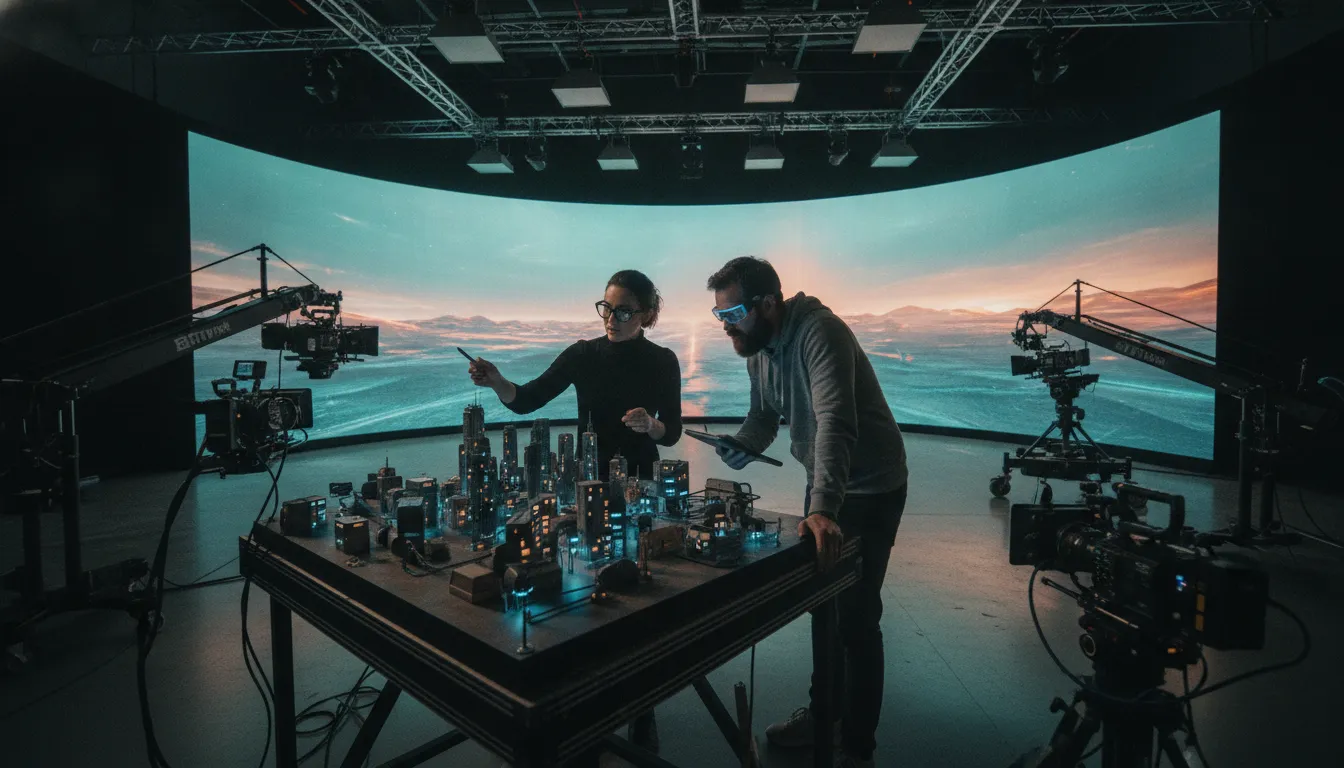
Choose the right mix of stage, location, and practical production
LED is not automatically the best answer for every shot. Use the volume where real-time perspective, interactive lighting, reflections, controlled weather, or location repeatability create clear value. Practical builds, location work, greenscreen, or a hybrid approach may be more efficient for scenes that depend on physical texture, complex stunts, scale, or uncontrolled movement.
Stage configuration is equally important. A fixed facility may suit a repeatable production base with established infrastructure. A mobile model can bring LED screens, servers, and expert crew to the production location. This may reduce travel for cast and department heads, but it introduces transport, setup, power, calibration, and local logistics requirements. The partner should show those trade-offs in the plan, not present mobility as a universal saving.
Finally, request a transparent cost breakdown by pre-production, digital asset development, stage and equipment, crew, travel, on-set operations, data management, and post-production handoff. You do not need a low headline number. You need to understand what is included, what triggers a change order, and which assets or workflows retain value after principal photography.
How Will the Partner Protect Franchise Continuity Across Platforms?
A capable partner protects continuity by turning the IP's narrative rules, visual language, and reusable digital assets into a shared production system. That system should support film, television, games, and immersive formats without forcing every platform to look or behave identically. It combines governance with enough flexibility for each audience and medium.
Start with narrative guardrails, not the stage. Before production begins, the partner should help identify the elements that define the world: canon, character logic, visual motifs, tone, technology rules, and boundaries for future expansion. Those decisions belong in a living production bible that creative, art, technical, and licensing teams can consult as the franchise develops. A transmedia universe strategy can provide the broader framework, while the virtual-production partner translates that framework into practical deliverables.
Build once, adapt deliberately
Continuity is not achieved by copying a film asset directly into a game or immersive experience. It depends on designing assets with reuse and adaptation in mind. Digital environments, 3D models, textures, characters, and camera-ready variations should be organized so teams can create platform-specific outputs while preserving the underlying identity of the world. The partner should document asset ownership, version history, approved variants, and dependencies, then make those records accessible to the teams that need them.
This is where a partner's game-engine and production expertise matters. Real-time graphics can support both animated content and live-action production, but the creative intent must remain legible across formats. Arctic7 documents capabilities spanning Unreal Engine and Unity development, tooling, production pipelines, narrative workshops, and post-launch content planning. Its stated method moves from making an IP transmedia-ready, to defining a unified strategy, to activating a production blueprint with platform-specific deliverables and creative alignment.
Use governance to manage change
A production bible is only useful when paired with governance. Establish who approves canon changes, how new assets enter the library, when creative reviews occur, and how platform teams escalate conflicts. A shared review cadence can prevent a game update, television episode, or immersive installation from quietly introducing incompatible details. It also gives production leaders a clear way to assess whether a proposed change strengthens the larger ecosystem or solves only a short-term delivery problem.
The Ant-Man and the Wasp: Quantumania virtual-production case study illustrates why this coordination must be operational, not theoretical. The documented work included more than 200 virtual stage walks, more than 45 virtual location scouts, and eight hero sets with more than 34 variants. That scale points to the value of structured reviews, reusable environments, and clear handoffs between creative and technical teams.
Finally, inspect the partner's bridge between formats. Narwhal Studios' virtual-production team is a relevant proof point for evaluating how a studio connects game, film, television, and immersive production knowledge. The strongest partner is not merely preserving yesterday's canon. It is giving each platform a controlled way to extend the world.
What Questions Should You Ask Before Signing?
Before signing, ask a prospective partner to make its responsibilities, technical workflow, production controls, handoff process, and commercial assumptions explicit. The strongest answers will show how the team connects creative intent with stage execution and reusable IP assets, rather than presenting an LED volume as the whole solution.
- What exactly is included in your scope? Ask whether the engagement covers strategy, previs, virtual art direction, asset creation, stage operations, capture, post-production support, and delivery management. Clarify which responsibilities remain with your internal team or other vendors.
- Which assets must we provide, and which will you create? Establish ownership, formats, approval checkpoints, revision limits, and reuse rights for 3D models, environments, textures, characters, scans, and other digital production assets. A clear asset plan protects continuity after the first shoot.
- How will you prove the technical workflow before production? Request a practical test covering camera tracking, lens data, engine integration, color, playback, and compositing. Ask what happens when a camera, tracker, render, or display falls out of sync. A credible partner should explain the test criteria, not just name its tools.
- How will you manage the stage and production logistics? Confirm stage availability, crew roles, load-in and strike requirements, power, physical set integration, location scanning, safety, scheduling, and contingency plans. Ask who has authority to make decisions when creative and technical needs conflict.
- Who governs creative, technical, and IP decisions? Define approval owners, escalation paths, version control, and the source of truth for world rules and approved assets. This governance is especially important when one production must support games, film, television, or future extensions.
- What will the handoff include? Ask for a written list of final files, metadata, scene versions, documentation, training, and post-launch support. Review a virtual production pipeline reference to test whether the proposed handoff connects previs, virtual art, stage work, production, and post.
- How is the cost model built and kept transparent? Request assumptions by phase, including labor, stage time, asset development, equipment, travel, revisions, overtime, and third-party services. Ask which items are fixed, variable, or excluded, and what approval is required before scope changes affect the budget. For further context, use this guide to evaluate a virtual production company against comparable criteria.
Why Arctic7 Is Built for Multi-Platform IP
Arctic7 approaches virtual production as part of a wider IP system, not as a standalone stage booking. Its documented capabilities connect narrative development, game-engine production, film and television, immersive experiences, and digital services. That combination gives IP holders a basis for evaluating one partner across strategy, creative execution, technical delivery, and platform-specific expansion.
The distinction matters because a multi-platform production needs more than convincing pixels on a volume wall. It needs a shared understanding of the world, repeatable workflows, and clear decisions about what should remain consistent across formats and what should be adapted for each audience. Arctic7's three-stage method is designed around that sequence:
- Make the IP transmedia-ready through workshops and narrative audits.
- Define a unified strategy with deliverables, workflows, and timelines.
- Activate a production blueprint with platform-specific deliverables and creative alignment.
This structure puts narrative guardrails and strategic alignment before stage execution. It also reflects the practical reality that a franchise may need to move between film. Television, games, immersive experiences, and digital platforms without treating each expansion as an isolated production. Arctic7 documents relevant capabilities in narrative and worldbuilding workshops, transmedia-aware development, Unreal Engine and Unity development, tooling, production pipelines, and post-launch content planning.
Its virtual-production background provides a concrete technical foundation for that broader model. Through Narwhal Studios' virtual-production team, Arctic7 established Virtual Art Department workflows in 2015. The company also documents early integration of game-engine workflows with traditional film production, early adoption of LED-volume technology for in-camera visual effects, and proprietary virtual-production workflows. These are relevant indicators for an IP holder assessing whether a prospective partner understands both the creative and operational sides of the work.
The documented record includes six ICVFX projects with Lucasfilm and work across major Star Wars productions, including The Mandalorian, Obi-Wan Kenobi, Ahsoka, Skeleton Crew, and The Book of Boba Fett. For Ant-Man and the Wasp: Quantumania, Arctic7's published experience includes more than 200 virtual stage walks, more than 45 virtual location scouts, and eight hero sets with more than 34 variants. Readers can examine the Ant-Man and the Wasp: Quantumania virtual-production case study for the documented project context.
For decision-makers, the takeaway is not that one portfolio guarantees a particular result. It is that Arctic7 presents a partner model spanning strategy, production, and cross-medium development. Explore Arctic7's virtual production capabilities alongside the team's broader services, then test the fit against your IP's continuity requirements, production scale, and platform roadmap.
Frequently Asked Questions
When should an IP holder bring a virtual production partner into the process?
Bring the partner in during development, before stage planning or final production decisions. Early involvement allows the team to clarify narrative guardrails, identify reusable assets, assess technical requirements, and align platform deliverables. It also prevents the stage from dictating creative choices that should be resolved at the franchise strategy level.
What should a production brief include?
A useful brief should define the IP's audience, story priorities, planned formats, creative references, delivery schedule, locations, existing digital assets, and approval structure. Include practical information about cameras, tracking, engine workflows, color management, asset ownership, and post-production handoffs. The clearer these dependencies are, the more accurately a partner can shape the production model.
How can a partner support both film and game development?
Look for a team that understands cinematic production and real-time game development, rather than one that treats either discipline as an afterthought. The right partner can establish shared worldbuilding principles, adapt assets for different technical requirements. And coordinate creative decisions across film, television, games, and immersive experiences without forcing every platform into the same format.
What are the main risks of virtual production?
Common risks include weak previsualization, incomplete digital assets, inadequate tracking or calibration, unclear ownership of technical decisions, and a workflow that separates the stage from post-production. These risks are manageable when the partner validates the pipeline early, assigns accountable leads, tests the creative plan in context, and maintains clear documentation throughout production.
New Immersive & XR Media Capabilities Added to Arctic7's Suite of Games, Film & TV and Digital Services

Arctic7 Shares Details of its Work on Skeleton Crew and Cinematics Partnership with Fateless

The Human Touch: Adding Personality to Project and Product Management
Whether it’s your team, your client, or your stakeholders, understanding the human dynamics is just as critical as hitting milestones.

McDonald's Case Study: Bridging Brand and Play | Arctic7
Bridging Brand and Play: An Interview with Lindsay Blenkhorn Daggitt


