


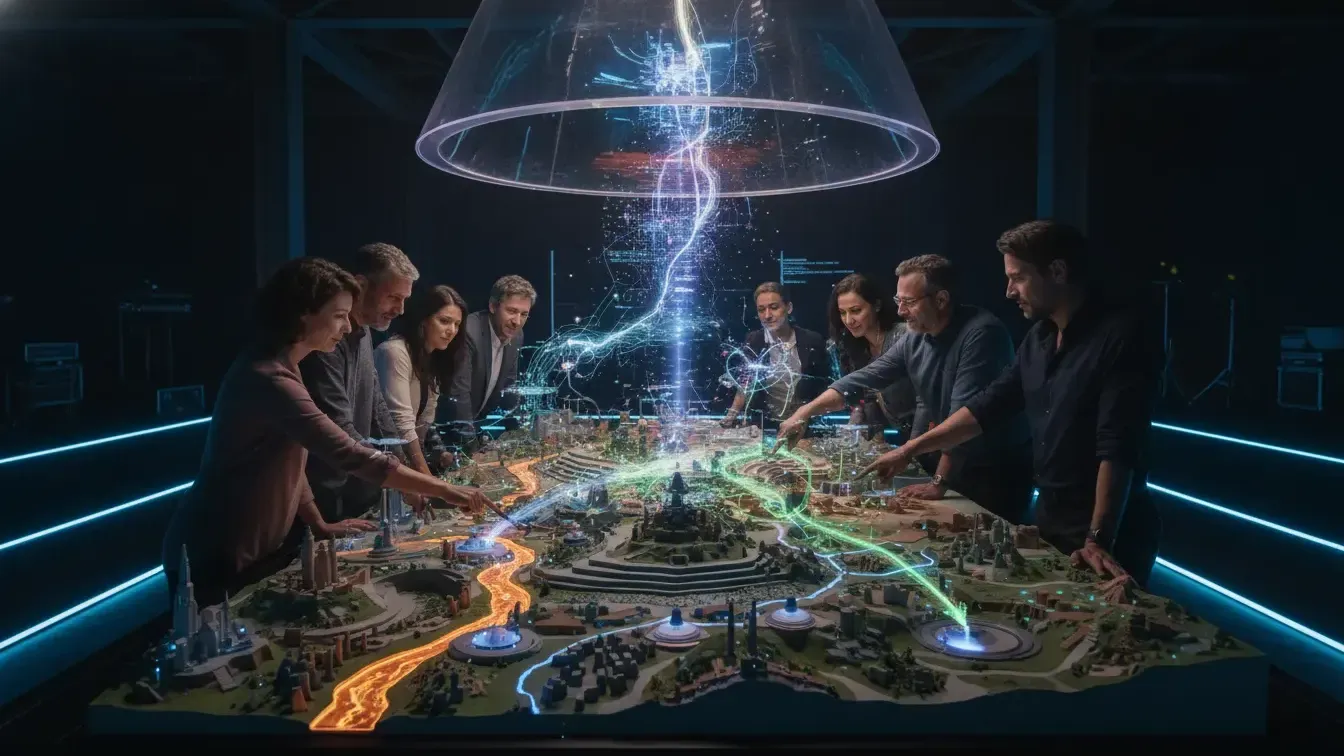

Branded Immersive Experience: Build a Connected World
A branded immersive experience should do more than surround an audience with impressive visuals. It should give people a meaningful way into an IP. It should create a reason to participate. It should establish a world that can continue beyond a single campaign window. For entertainment leaders, that means treating immersion as an ecosystem decision rather than a technology purchase.
The strongest experiences begin with audience insight and narrative intent. They then connect physical space, live performance, games, film, virtual production, XR, or digital content according to the role each format can play. The result is not a collection of disconnected activations. It is a coherent journey in which every touchpoint deepens the world and produces useful learning for the next decision.
Explore Arctic7's virtual production capabilities for connected entertainment experiences.
This guide outlines the practical path from campaign idea to connected world. It covers how to define the audience promise, design participation, choose technology, build the production foundation, measure what matters, and protect continuity across platforms.
What Makes a Branded Immersive Experience More Than a Campaign?
A branded immersive experience becomes more than a campaign when audiences do more than observe a message. They enter a coherent story system. They take meaningful action within it. They leave with a relationship to the world that can continue across formats. The experience is therefore a strategic entry point into a living IP ecosystem, not a one-time spectacle.
That distinction begins with participation. A spectacular environment can attract attention. Spectacle alone does not give the audience a role. In a meaningful immersive experience, people can explore, make choices, interpret clues, shape outcomes, or contribute to the way the story is encountered. The exact mechanism may be physical, digital, live, or interactive. What matters is that the audience's presence has a purposeful relationship to the narrative.
Research on immersive performance supports this emphasis on agency. A study of a virtual concert found that VR and active navigation produced a stronger sense of presence than computer delivery and passive navigation. The same study reported higher flow, satisfaction, concert-attending intention, and role identification under those conditions (the study's findings). Those results do not guarantee a business outcome for every project. They illustrate why the design of participation matters. Technology should serve the audience's role rather than decorate an otherwise passive message.
The boundary between a campaign and an ecosystem is continuity. A campaign usually has a defined launch window, a central message, and a finite set of deliverables. An ecosystem has narrative rules, reusable assets, and a clear relationship between experiences. One activation can introduce a character, place, conflict, or audience behavior that later appears in a game, film, live event, or digital extension. Each expression stands on its own while contributing to a larger world.
That requires strategy before production. Workshops, narrative audits, and discovery sessions can identify what makes an IP worth expanding and establish creative guardrails. A unified transmedia strategy then defines deliverables, workflows, and rollout timelines. A production blueprint translates the intent into platform-specific work. For a practical view of this distinction, explore what an immersive campaign agency delivers.
For IP holders, the question is not whether an experience looks impressive. It is whether the experience gives audiences a credible way into the world and gives the world somewhere meaningful to go next.
How Should You Start With Audience Insight and Narrative Design?
Start by understanding what audiences need from the world, what the IP must protect, and what kind of participation the experience invites. Audience insight should shape the narrative system before technology is selected. This creates a branded immersive experience that feels intentional for newcomers, rewarding for returning fans, and expandable beyond a single activation.
Begin with the audience, not the interface
Audience research should identify more than demographics. Ask what different people already believe about the IP. Ask what they want to explore and how much agency they expect. A first-time visitor may need clear context and a low-friction way to enter. A returning fan may want discovery, mastery, or a meaningful role in a familiar world. Designing for both requires layered participation rather than one fixed path.
Participation roles should be explicit. Someone might observe, solve, perform, collaborate, make choices, or influence what happens next. These roles can coexist. This allows people with different confidence levels, physical abilities, devices, and time commitments to share the same narrative space. Accessibility is therefore part of story design, not a final compliance pass. Provide readable cues, alternative interaction modes, sensory considerations, and enough orientation for audiences to understand their choices.
Protect the IP soul while creating room to play
Expansion begins with a clear understanding of the IP's soul. That includes its emotional promise, defining relationships, visual language, values, and boundaries. Arctic7's first Method stage uses workshops, narrative audits, and discovery sessions to uncover what makes an IP worth expanding and establish creative guardrails. Those guardrails protect continuity without prescribing every audience action.
From there, narrative design can distinguish canon from possibility. Define what must remain true. Define what can be interpreted. Define what audiences can influence. This avoids a common failure mode in immersive work: impressive interaction that could belong to any franchise. The experience should offer agency that reveals something essential about the world, rather than adding choices merely because the platform allows them.
Turn insight into an ecosystem plan
The Arctic7 Method then moves from readiness into a unified transmedia strategy. It sets deliverables, workflows, and rollout timelines that align stakeholders. That sequence connects audience needs to a practical production blueprint and platform-specific roles. It also helps teams see the experience as part of an interconnected world, not an isolated campaign. Explore this broader approach in entertainment ecosystem strategy.
Which Technology Choices Serve the Story?
A strong branded immersive experience starts with the audience role and the story's demands, not with a fashionable platform. Physical environments can create shared presence. AR, games, virtual production, and digital extensions can deepen participation or carry the world beyond a single moment. The right mix makes continuity possible without forcing every audience member into the same format.
Think of technology as a set of narrative instruments. A live installation may make the audience part of a scene. An interactive game can give them agency and a reason to return. AR can layer the fictional world onto an existing place. Digital extensions can keep discovery and participation active between larger releases. Research on virtual concerts found that VR combined with active navigation produced a stronger sense of presence than computer delivery with passive navigation. This reinforces the value of matching interaction to the intended experience (academic research on VR presence).
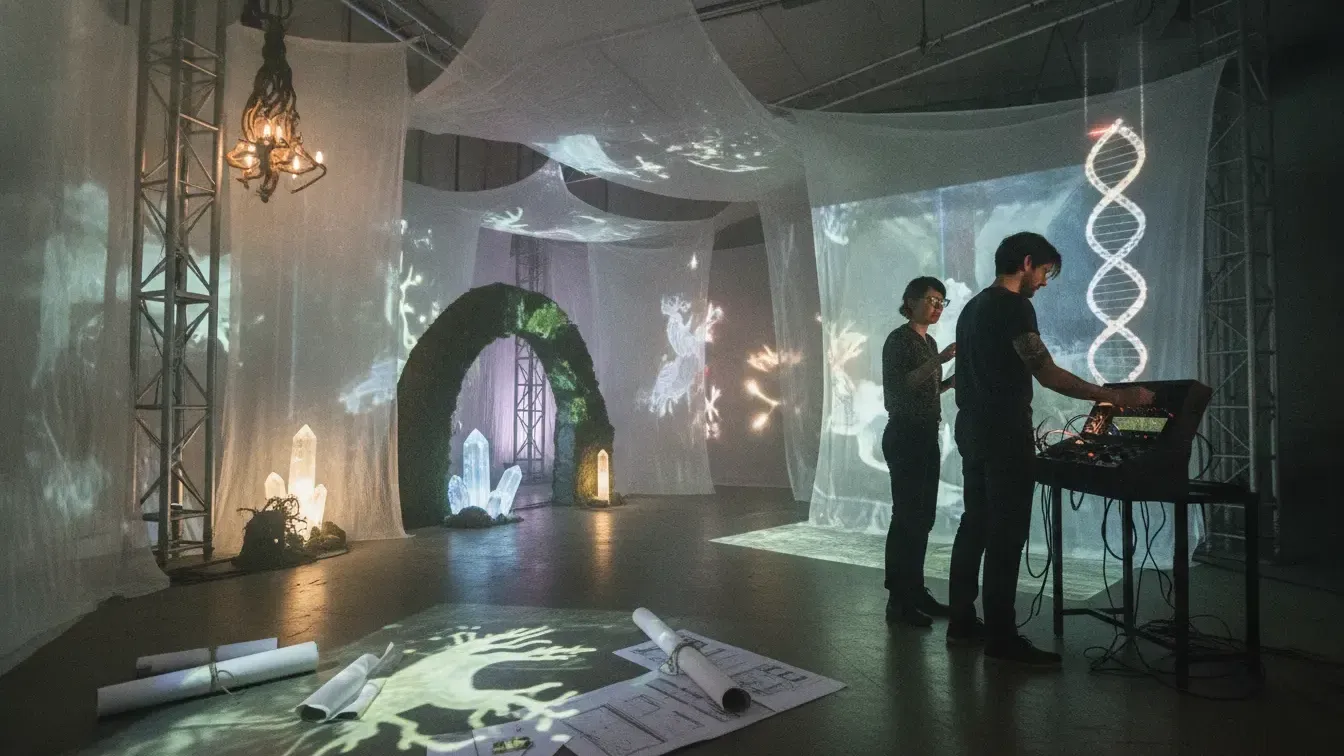
| Format | Audience role | Production implication | Continuity value |
|---|---|---|---|
| Physical or live | Visitor, participant, or co-present audience member | Requires venue, performers or facilitators, access planning, safety, and reliable live operations | Creates shared memories, rituals, and locations that can anchor the wider world |
| AR or XR | Explorer who sees, enters, or influences an expanded layer of reality | Needs experience design across devices, spatial conditions, interaction testing, and accessibility | Lets characters, places, and story clues travel into audiences' existing environments |
| Games or interactive | Player with meaningful agency and repeatable goals | Demands systems design, prototyping, progression logic, content pipelines, and platform support | Turns world rules into repeatable participation and creates reusable systems for future content |
| Virtual production | Viewer or participant experiencing a controlled, cinematic world | Connects real-time engines with previs, virtual scouting, live compositing, or in-camera VFX | Builds consistent visual assets and production language across film, television, broadcast, and live experiences |
| Digital extensions | Follower, collector, or community member between major experiences | Needs an editorial cadence, content governance, platform integration, and moderation where relevant | Maintains discovery, conversation, and lightweight participation between larger story moments |
These formats do not need to compete. Arctic7 documents capabilities across cross-format system design, game prototyping, Unreal Engine and Unity development, production pipelines, and post-launch content planning (Arctic7 services across games, Film & TV, Immersive/XR, and Digital). Its extended reality development for connected worlds perspective is useful when deciding which interactions deserve a dedicated platform and which should remain a lighter digital touchpoint. The decision is ultimately editorial. Select the technology that gives the audience the right role and gives the IP a credible path to continue.
How Do You Build and Produce the Experience?
Build the experience as a connected production system, not a collection of impressive moments. Start with a prototype. Translate the approved narrative into a practical production blueprint. Align creative, technical, and operational owners around shared assets, tests, launch decisions, and a plan for what the world can become after opening day.
Prototyping should answer meaningful questions early. Can the audience understand its role? Does the interaction support the story? Can the intended environment, character behavior, or spatial journey be delivered reliably? A prototype may be a game mechanic, a spatial interaction, a short scene, or a guided live test. Its value is not polish. It is the evidence it creates for the next creative and technical decision.
Once the core experience is proven, the team can establish an asset pipeline. A digital world depends on 3D models, environments, textures, and characters. Those assets need shared naming, versioning, review, and reuse rules. The pipeline should also identify which elements are canonical, which can adapt by platform, and which need to be optimized for real-time performance. This is where a virtual production workflow can connect story requirements with production planning.
The production blueprint then turns intent into ownership. It should define deliverables, dependencies, approval gates, technical tests, staffing, rollout timing, and escalation paths. Cross-functional ownership matters because cameras, trackers, game engines, and LED walls must work together when a production uses virtual production. Testing should cover calibration, rendering, interaction, accessibility, safety, queueing, and recovery from technical failure, not just the ideal demonstration.
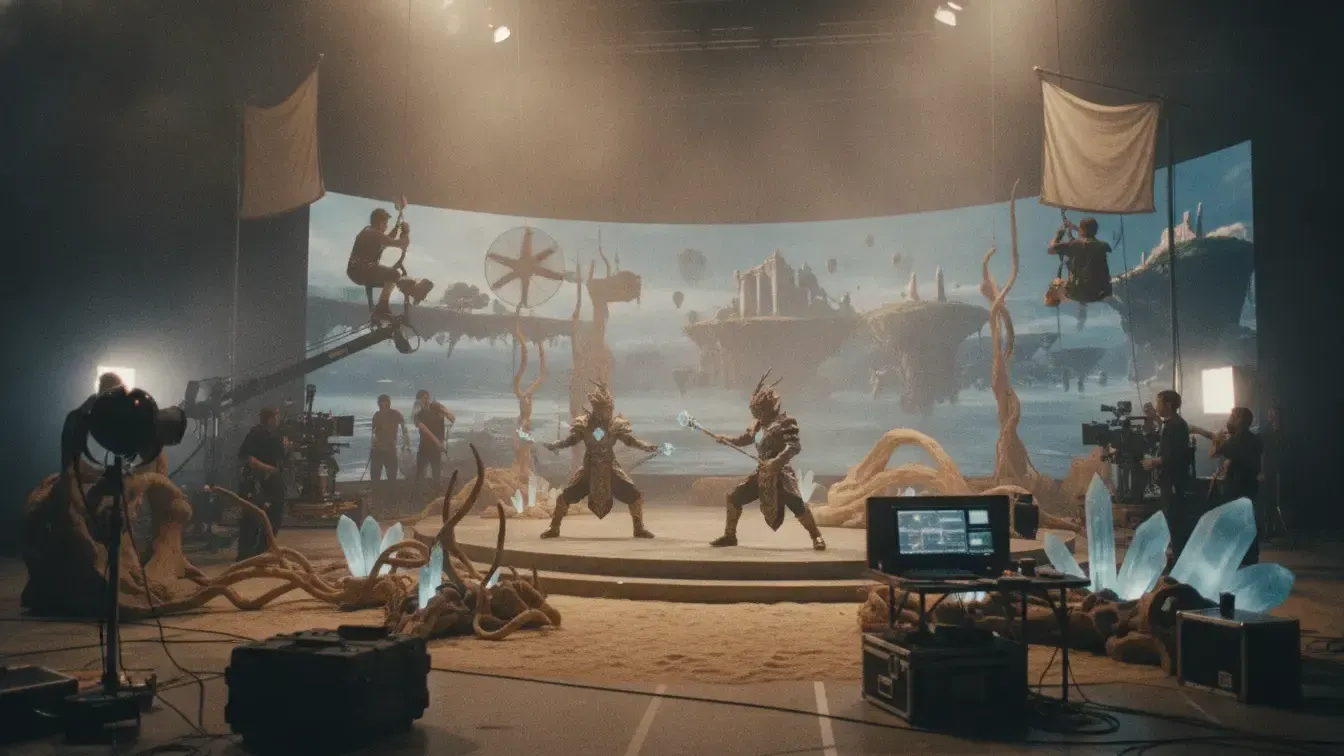
Practical and digital elements should be selected for what each does best. An LED volume can provide dynamic environments, lighting, and reflections. Practical sets support tactile, human-scale scenes. A hybrid workflow might use digital environments for complex sequences and practical sets for dialogue. This approach keeps technology in service of the audience's experience rather than treating it as the attraction.
Launch operations deserve the same attention as creative development. Define staff roles, content-monitoring routines, audience support, maintenance windows, and incident responses before opening. Post-launch planning should reserve capacity for new scenes, seasonal variations, asset reuse, and measured refinements. A branded immersive experience becomes more valuable when its production system can support the next chapter, platform, or audience interaction without rebuilding the world from scratch.
What Should You Measure After Launch?
A branded immersive experience should be measured as an evolving part of an IP ecosystem, not as a one-time activation. Define the signals before the build begins. Then balance audience behavior, narrative response, operational performance, and business relevance. The goal is not to promise a universal ROI formula. It is to create evidence for better creative and strategic decisions.
Start with the behavior that shows how people actually participate. Track entry points, completion patterns, time spent where meaningful, choices made, content shared, and the points at which visitors disengage. The right measures depend on the role the audience is meant to play. A discovery experience may prioritize exploration. An interactive story may examine choices, return visits, and the depth of participation.
Behavioral data becomes more useful when paired with qualitative feedback. Interviews, moderated sessions, observation, post-experience conversations, and open-ended responses can reveal whether the world felt coherent. They can show whether the audience understood its invitation to participate. They can identify which moments carried emotional or narrative weight. Activity alone does not prove that an experience strengthened a relationship with the IP.
Narrative measures should ask whether the experience expanded the world without weakening its identity. Look for recognition of characters, themes, rules, and tone, while leaving room for audience interpretation. Compare first-time and returning participants where appropriate. Repeat participation can indicate that the experience offers more than a single reveal. Interpret it alongside feedback about why people came back and what they did differently.
Operational measures protect the quality of the work behind the audience-facing layer. Review technical stability, queue or access friction, staff readiness, content moderation, production issues, and the time required to update or reuse assets. A well-planned set of Arctic7 services across games, Film & TV, Immersive/XR, and Digital can connect these considerations to the wider production blueprint.
Finally, establish decision gates before launch. Decide which signals support extending the experience, refining the narrative, repurposing content for another platform, or pausing an element that is not serving the audience or the IP. Measurement then becomes a planning discipline tied to engagement, reach, reuse, and business objectives, rather than a search for a single headline number.
How Do You Protect IP Continuity Across Platforms?
Protect continuity by defining what must remain true about the world, what can adapt to a platform, and who approves each change. A world bible, reusable assets, and clear governance turn a branded immersive experience from a one-off activation into a coherent extension of the franchise. Without forcing every audience to experience it in the same way.
Start with the IP's essential identity. The world bible should document its core themes, character motivations, visual language, rules, relationships, and unresolved possibilities. It should distinguish canon from flexible material. A character's history or a world rule may be non-negotiable. The route an audience takes through an installation, game, or digital story can remain open to interpretation.
Build assets for reuse, not repetition
Continuity becomes practical when creative decisions are connected to an asset strategy. A digital world is built from 3D models, environments, textures, and characters. Those elements should be organized with future formats in mind. Reusable does not mean copying the same content everywhere. It means creating a reliable foundation that can be adapted for a physical venue, an interactive experience, a cinematic sequence, or a later chapter.
Platform-specific roles should be explicit. A live environment may make the audience feel physically present. A game can give them agency and let their choices shape the encounter. Film and television can establish canonical events. Digital extensions can deepen context between major releases. Each format should contribute something it handles well, rather than competing to tell the same story.
Make governance part of the creative system
Assign owners for canon, character, design, technology, and production decisions before development begins. Establish an approval path for new story beats, adaptations of key assets, and audience-facing variations. This reduces the risk of fragmented IP, inconsistent quality, and siloed teams while preserving room for experimentation. The process should also record decisions. So a later team can understand why an element changed and whether that change is temporary, local, or part of the official world.
Arctic7's documented method moves from making an IP transmedia ready, to defining a unified strategy, to creating a production blueprint. That structure supports platform-specific deliverables while maintaining creative alignment across formats. Its work across games, film and television, immersive/XR, and digital services reflects the cross-functional coordination continuity requires. Narwhal Studios virtual production work illustrates how production capability can support a broader worldbuilding approach.
Continuity should extend beyond launch. Review audience feedback, asset reuse, operational lessons, and new narrative opportunities at each release gate. Arctic7's documented case study on cinematic production and the Quantum Realm shows why the relationship between practical elements and digital environments matters. Production choices can reinforce the same world audiences recognize across future touchpoints.
What Does the Right Transmedia Partner Bring?
The right partner connects audience insight, narrative design, technology, production, measurement, and governance before any platform decision is made. It should help you protect the identity of the IP while creating a practical path from one branded immersive experience to a coherent, expandable entertainment ecosystem.
- Can the team explain who the experience is for and why they will participate? Ask for more than demographic profiles. A credible partner should identify audience motivations, levels of familiarity with the world, desired participation roles, and barriers to access. The objective is to make technology serve a meaningful audience relationship, not to add novelty for its own sake.
- How will you protect the soul of the IP while expanding its narrative? Look for a process that includes discovery workshops, narrative audits, and explicit creative guardrails. Arctic7 describes this as making an IP transmedia ready: understanding what makes the world worth expanding before defining new stories, characters, or modes of participation. This is where canon, flexibility, tone, and audience promise should be documented.
- Can the partner integrate technology choices with the story and the operating model? Ask how it will decide between immersive/XR, games, digital extensions, live production, and hybrid approaches. The answer should cover interoperability, asset reuse, accessibility, technical testing, and the role each platform plays in the wider world. Arctic7 combines Games, Film and TV, Immersive/XR, and Digital Services in one offering through its integrated services.
- Who owns the production blueprint, and how will creative and technical teams work together? Confirm responsibilities for prototyping, pipelines, approvals, schedules, vendor coordination, and launch operations. A partner should be able to move from strategy into production without losing intent. For experiences involving virtual production, review the team behind the Arctic7 virtual production capabilities, including its approach to real-time environments and practical-digital integration.
- What will be measured, and when will decisions be made from the evidence? Agree on behavioral, narrative, operational, and business measures before the build begins. Useful questions include whether audiences return, which story elements they understand, what assets can be reused, and which production assumptions need revision. Measurement should create decision gates, not promise guaranteed ROI.
- How are ownership, continuity, and partner governance handled after launch? Establish who controls source assets, documentation, approvals, data, and future adaptations. Ask how platform-specific work remains aligned with the broader world and how disagreements are resolved. Arctic7's perspective on entertainment ecosystem strategy is useful here. Expansion works best when creative, technical, and commercial decisions remain connected.
Why Arctic7 Is Built for Connected Entertainment Ecosystems
A branded immersive experience works best when it is treated as an entry point into a living IP, not as a self-contained activation. Arctic7 connects audience insight, narrative development, technology, and production planning so the experience can belong to a wider world. That approach gives each platform a clear role while protecting the creative identity that makes the IP worth expanding.
The Arctic7 Method provides a practical path from ambition to execution. First, workshops, narrative audits, and discovery sessions make the IP transmedia ready. They explore the soul of the world, identify its expansion potential, and establish creative guardrails. This is important for immersive work, where participation can expose gaps in character, story logic, or audience promise quickly.
Next, Arctic7 defines a unified strategy. The team maps the audience opportunity, chooses the right forms of participation, and translates the idea into deliverables, workflows, and rollout timelines. A campaign may begin with one highly visible experience. The strategy can also define how its characters, environments, mechanics, or story threads support games, film and television, Immersive/XR, and digital extensions. The goal is not to force every medium into the same format. It is to give each medium a meaningful contribution to the ecosystem.
The final stage is a production blueprint. Arctic7's documented capabilities include narrative and worldbuilding workshops, game prototyping, Unreal Engine and Unity development, flexible cross-format system design, production pipelines, and post-launch content planning. That combination helps creative and technical decisions happen in the same conversation. It also creates a clearer basis for deciding what should be built now, what can be reused, and what should remain open for future development. Explore the full range of Arctic7 services across games, Film & TV, Immersive/XR, and Digital.
Virtual production can be especially valuable when a concept needs cinematic scale with room for real-time iteration. Arctic7's virtual production capabilities and Narwhal Studios virtual production work provide relevant production context, without treating technology as the experience itself. The technology serves the world, the audience, and the intended continuity.
For leaders planning a campaign-to-ecosystem move, Arctic7's fit is therefore structural. It can support a focused proof of concept, co-development, or a broader development program while keeping strategy and production connected. Its perspective on an entertainment ecosystem strategy is designed to help one experience become part of a coherent, expandable relationship between IP, audience, and platform.
Explore Arctic7's virtual production capabilities for connected entertainment experiences.
Frequently Asked Questions
How is a branded immersive experience different from a traditional campaign?
A traditional campaign often concentrates on a defined release window and a message. An immersive experience gives audiences a role within an IP, while its narrative, technology, and production choices can support future extensions. The strategic goal is not spectacle alone, but a coherent entry point into a living entertainment ecosystem.
How do you choose the right technology for the audience?
Start with the intended audience behavior, not a preferred platform. Decide whether people should explore, perform, collaborate, watch, or return over time, then select the simplest technology that supports that role. Options may include live environments, AR or XR, interactive games, digital extensions, or virtual production. Accessibility, operational complexity, and continuity should shape the decision.
What should be planned before production begins?
Define the IP's creative guardrails, audience insight, narrative structure, platform roles, asset requirements, ownership, and measurement plan before building. A production blueprint should also clarify workflows, approvals, technical tests, and post-launch content. Detailed planning, asset creation, and storyboarding can make virtual production smoother and more cost-effective, according to Arctic7's production guidance.
How can leaders measure whether the experience is working?
Set measures before the build begins, combining behavioral signals such as participation and repeat visits with qualitative feedback, narrative comprehension, operational performance, content reuse, reach, and business objectives. These measures create decision gates for iteration and expansion. They should guide learning and investment choices, not serve as a promise of guaranteed ROI.
Ready to Bring Your World to Life?
A branded immersive experience works best when creative ambition, production planning, and technology choices move together. Exploring the right production partner can help you shape a connected experience that gives audiences meaningful ways to engage with your IP.
Explore Arctic7's virtual production capabilities and get started
New Immersive & XR Media Capabilities Added to Arctic7's Suite of Games, Film & TV and Digital Services

Arctic7 Shares Details of its Work on Skeleton Crew and Cinematics Partnership with Fateless

The Human Touch: Adding Personality to Project and Product Management
Whether it’s your team, your client, or your stakeholders, understanding the human dynamics is just as critical as hitting milestones.

McDonald's Case Study: Bridging Brand and Play | Arctic7
Bridging Brand and Play: An Interview with Lindsay Blenkhorn Daggitt


