
Extended Reality Development for Connected Worlds
Extended reality development is not simply the process of putting an entertainment property inside a headset. For IP holders, it is the work of turning a story world into a durable system of places, interactions, and participation that can travel across devices, venues, and content platforms. The strongest programs begin with an audience promise and end with an experience architecture that can grow without losing the identity of the world.
What makes extended reality development different for entertainment IP?
Extended reality development for entertainment combines narrative design, game development, spatial interaction, production planning, and platform strategy. A successful project must answer two questions at the same time: what does the audience do, and why does that action belong in this world? That makes XR development closer to ecosystem design than to a one-off technology demonstration.
The distinction matters because a technically impressive prototype can still fail as an IP experience. A headset demo may look compelling for five minutes but offer no reason to return, no path for people without the same device to participate, and no production plan for updating the world. Development should therefore establish the experience's role in the broader franchise before a team chooses an engine, headset, or venue format.
- Story value: the experience reveals, extends, or lets people influence a meaningful part of the world.
- Audience value: the interaction is understandable, rewarding, and appropriate to the user's context.
- Operational value: the content can be deployed, supported, measured, and refreshed.
- Ecosystem value: the experience creates a useful bridge to games, film, television, live events, or community participation.
Start with the audience outcome, not the device
Before selecting a headset or building a spatial prototype, define the audience outcome in observable terms. An IP owner might want fans to discover a hidden character perspective, collaborate inside a shared world, rehearse a story event, or carry a piece of the experience into a physical venue. Each goal implies different interaction, access, moderation, and measurement decisions.
A useful brief describes the audience, the moment of participation, the emotional payoff, and the next action. It also states what the experience is not. This prevents an XR initiative from becoming a feature hunt in which every available capability is treated as strategically necessary.
Use a simple outcome ladder:
- Reach: who should encounter the experience, and through which entry points?
- Engagement: what meaningful action should a participant take?
- Return: what changes, unlocks, or social reason brings people back?
- Conversion: how does participation deepen the wider relationship with the IP?
For an entertainment brand, conversion does not have to mean a direct sale. It may mean moving a viewer into a game, bringing a fan to a venue, increasing participation in a live event, or creating a stronger foundation for the next story release.
How do you translate a story world into an XR system?
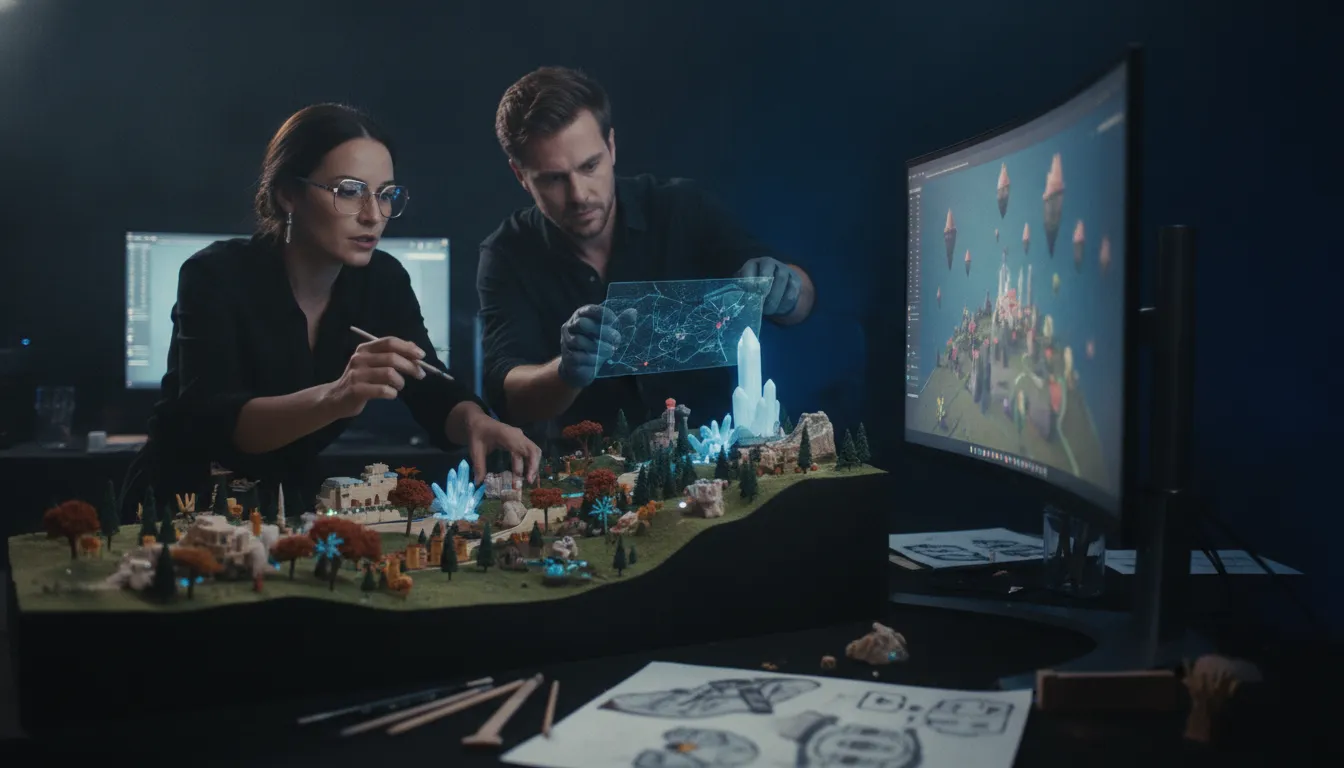
Translate the story world by identifying the rules that make it recognizable, then turning those rules into actions the audience can perform. Canon is not only a library of characters and settings. It can define how the environment responds, what kinds of cooperation are possible, which objects carry meaning, and how a participant earns knowledge or status.
A practical worldbuilding pass separates four layers:
- World rules: the physical, social, and narrative logic that must remain consistent.
- Participant role: who the audience is allowed to be, know, change, or protect.
- Interaction verbs: the small set of actions that make the role feel real, such as explore, assemble, negotiate, perform, or direct.
- Continuity signals: the visual, audio, character, and environmental details that connect the XR experience to the wider IP.
This approach keeps interaction design from becoming disconnected gameplay. It also makes the experience easier to extend. If a new venue, episode, game mode, or mobile layer can use the same world rules and participant role, the IP gains a reusable foundation instead of another isolated activation.
Arctic7's game development capability is relevant when an XR experience needs responsive systems, real-time content, or player-centered interaction rather than a passive visual layer. The same principle applies to real-time production workflows: technical choices should serve the experience's narrative purpose.
Design a device and venue ladder
A connected XR program should not assume that every participant owns the same hardware. Build a device and venue ladder that gives each audience segment a meaningful entry point, then decide which parts of the experience must be shared across those layers.
| Layer | Best use | Design question |
|---|---|---|
| Screen and web | Discovery, social participation, lightweight world access | Can someone understand the premise without special equipment? |
| Mobile AR | Place-based discovery, collection, and companion moments | What real-world context makes the interaction meaningful? |
| Headset or mixed reality | Embodied exploration, spatial puzzles, and presence | What does being inside the world enable that a screen cannot? |
| Venue or live event | Shared spectacle, guided participation, and premium social memory | How will staff, safety, throughput, and resets shape the experience? |
The ladder is not a quality ranking. A venue experience may be the deepest expression of the world, while a mobile layer may be the most effective way to reach a large audience. The important decision is to give each layer a clear role and a recognizable relationship to the others.
Cross-device planning also requires technical boundaries. The OpenXR standard is designed to reduce fragmentation across XR devices and runtimes, while the W3C WebXR Device API defines web interfaces for accessing VR and AR hardware. Standards do not remove the need for device-specific design, but they can help teams separate portable experience logic from platform-specific optimization.
Plan interaction around context and accessibility
Interaction design has to account for where, how, and with whom the experience is used. A participant standing in a venue has different attention, safety, and social needs from someone exploring alone at home. A person using a phone needs different controls from a person using hand tracking. Context should shape the interaction model before production begins.
Define the minimum successful interaction first. If the participant has only a few minutes, a weak connection, limited mobility, or no headset, what can still feel complete? Then add depth for people who have more time or more capable hardware. This graceful degradation makes the ecosystem more inclusive and protects the core story from being locked behind one device.
Good planning should cover:
- Clear onboarding that teaches one action at a time.
- Comfort, motion, lighting, audio, and physical safety requirements.
- Alternative input and viewing modes where the story permits them.
- Privacy, consent, identity, moderation, and data-retention decisions.
- Social rules for shared spaces, including staff interventions and participant boundaries.
Accessibility is not a final compliance pass. It affects scene scale, pacing, interface language, spatial audio, locomotion, and the amount of information conveyed through vision alone. The earlier these decisions enter the design, the more options the production team retains.
Build the production plan before the prototype scales
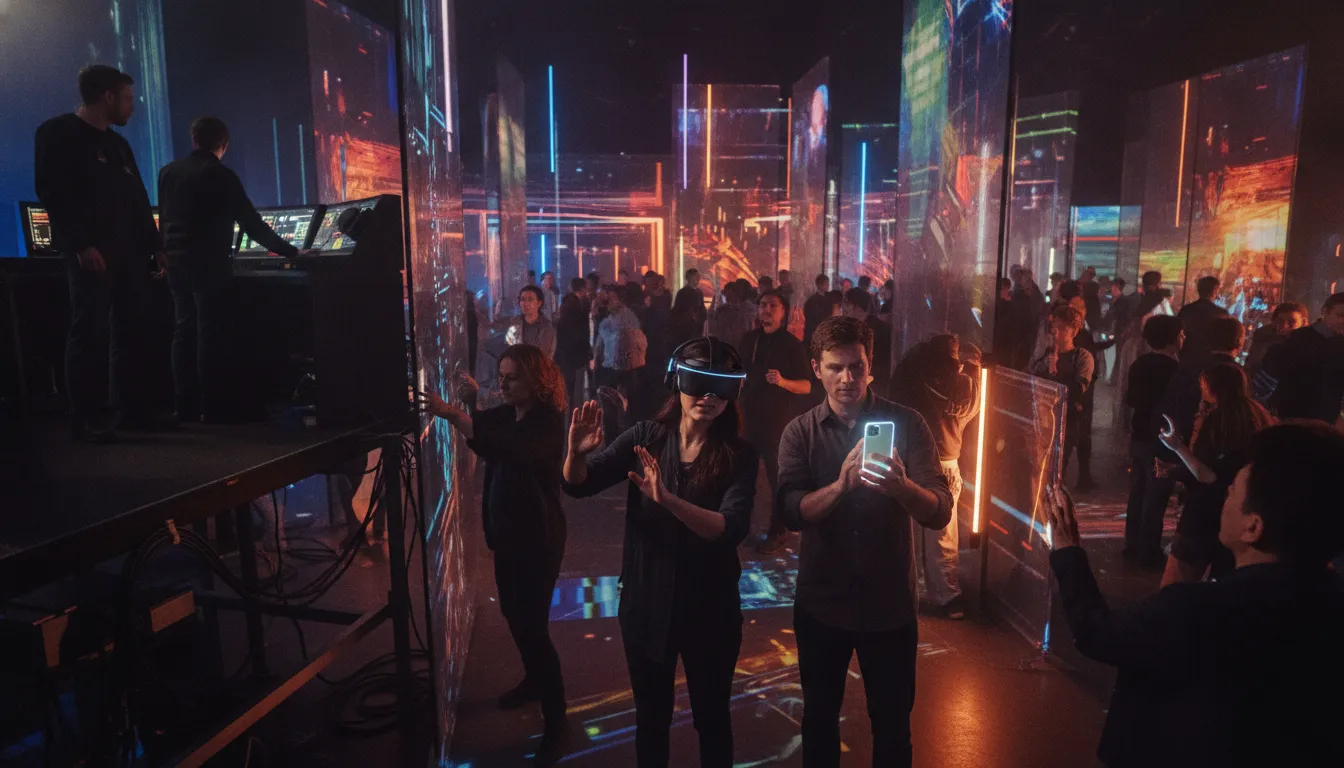
The prototype should answer a high-risk experience question, not merely prove that a technical feature works. Before scaling, map the production pipeline from concept art and interaction prototypes through real-time assets, testing, deployment, operations, and content updates.
For an entertainment IP, the plan usually needs five connected workstreams:
- Experience direction: define the participant journey, tone, pacing, and success criteria.
- World and content: create reusable environments, characters, audio, behaviors, and narrative states.
- Technology: select engine, runtime, devices, networking, tracking, and content-delivery architecture.
- Production and operations: establish staffing, venue systems, support, safety, moderation, and release management.
- Governance: assign ownership for canon, approvals, privacy, platform policy, and future extensions.
Virtual production can help when the concept depends on real-time environments, performance capture, live compositing, or fast visual iteration. Arctic7's virtual production workflow guide and pipeline guide describe adjacent production considerations. The XR project should borrow the planning discipline without pretending that an XR product is simply a film pipeline with a headset attached.
What should an XR pilot prove?
An XR pilot should prove that the audience promise, interaction loop, and delivery conditions work together. It should be small enough to change quickly and realistic enough to expose the constraints that a polished concept video hides.
Choose one audience outcome and one high-risk assumption. For example, the pilot might test whether visitors understand a character role without staff explanation, whether two participants can coordinate in the same space, or whether a mobile companion action increases return visits to a venue. Avoid testing every feature at once, because a broad pilot produces ambiguous results.
Set explicit evidence thresholds:
- Participants can begin without repeated intervention.
- The core action is completed within the intended time window.
- People can explain what they did and why it mattered in the world.
- Technical failures are recoverable without breaking continuity.
- Operators can reset, support, and update the experience predictably.
After the pilot, classify every finding as a story problem, interaction problem, technical problem, operational problem, or measurement problem. This prevents a team from trying to fix a narrative misunderstanding with more interface polish, or an operations bottleneck with another visual effect.
Measure ecosystem value, not only session volume
XR measurement should connect experience behavior to the audience and IP outcomes defined at the start. Session counts and dwell time are useful, but they do not explain whether the experience built a stronger relationship with the world or created a repeatable platform for future content.
Use a balanced scorecard:
- Experience: completion, comprehension, comfort, satisfaction, and voluntary replay.
- Participation: sharing, co-play, venue return, companion-layer adoption, and community activity.
- Business: qualified interest, event attendance, downstream game or content engagement, and partner value.
- System: crash rate, latency, reset time, support burden, content reuse, and cost per active participant.
Measurement should also respect the difference between a launch spike and durable behavior. Compare cohorts over time, document the context of each venue or platform, and record where participants dropped out. The aim is not to force every layer into one dashboard. It is to learn which parts of the ecosystem create durable value and deserve further investment.
That evidence can inform the next release: a new chapter, a seasonal venue layer, a game connection, or a more accessible entry point. In this sense, analytics is part of worldbuilding. It shows where the audience is finding meaning and where the design is asking too much.
Extended reality development works best as an ecosystem discipline
The strategic opportunity in extended reality development is not to chase every new device. It is to build a coherent world that can express its promise through the right combination of screen, mobile, headset, venue, and content experiences.
For IP holders, the practical sequence is clear: define the audience outcome, establish the world rules, design the interaction loop, create a device and venue ladder, plan production and governance, test one high-risk assumption, and measure behavior that matters beyond launch. That sequence turns XR from a technology experiment into an intentional part of an interconnected entertainment ecosystem.
Frequently asked questions about extended reality development
What is extended reality development?
Extended reality development is the process of designing and producing experiences that combine digital content with physical or virtual environments across augmented, virtual, and mixed-reality contexts. For entertainment IP, it includes narrative design, interaction, technology, production, operations, accessibility, and measurement.
How is XR development different from virtual reality development?
Virtual reality usually centers on an immersive headset experience, while XR development can include VR, AR, MR, web, mobile, venue, and screen-based layers. The broader approach plans how audiences move between those contexts and how the same world remains coherent across them.
Should an entertainment brand start with a headset experience?
Not necessarily. Start with the audience outcome and the role the experience plays in the IP ecosystem. A mobile, web, or venue entry point may reach more people or validate the story premise faster, while a headset layer can be added when embodied presence creates distinct value.
How do you measure an XR entertainment experience?
Measure the core audience action, comprehension, comfort, repeat participation, sharing, downstream engagement, operational reliability, and content reuse. The right scorecard connects those signals to the IP's goals instead of treating dwell time or launch attendance as proof of long-term value.
New Immersive & XR Media Capabilities Added to Arctic7's Suite of Games, Film & TV and Digital Services

Arctic7 Shares Details of its Work on Skeleton Crew and Cinematics Partnership with Fateless

The Human Touch: Adding Personality to Project and Product Management
Whether it’s your team, your client, or your stakeholders, understanding the human dynamics is just as critical as hitting milestones.

McDonald's Case Study: Bridging Brand and Play | Arctic7
Bridging Brand and Play: An Interview with Lindsay Blenkhorn Daggitt