
What Is an Entertainment Ecosystem? IP Holder Guide
An entertainment property no longer has to live inside one release window. For an IP holder, the strategic opportunity is to design a world that moves coherently through games, film, television, and brand experiences. Each expression can give audiences a meaningful reason to return while creating new options for the business.
What is an entertainment ecosystem? It is a connected operating model for developing, distributing, and extending an intellectual property across formats. It aligns canon, platforms, communities, creative teams, technology, and content pipelines around one expandable world.
This model is broader than launching the same story in several places. It requires decisions about what belongs to the shared world, how each platform contributes something distinct, and which production capabilities can support the vision repeatedly. The result is an IP architecture built for continuity rather than a sequence of disconnected campaigns.
Explore Arctic7's virtual production capabilities for connected entertainment worlds
What Is an Entertainment Ecosystem?
An entertainment ecosystem is a connected strategic and production system that allows an intellectual property to develop across multiple media formats without losing its identity. It gives a film, game, television series, live experience, or community activation a distinct purpose while keeping each expression connected to a shared world.
The word ecosystem matters because the model is about relationships, not simply volume. A collection of adaptations may place the same characters in different formats. An ecosystem defines how those formats work together, how audiences move between them, and how the organization learns from each experience.
Four components define the model
Canon is the foundation. It includes the rules, characters, history, themes, visual language, and unresolved possibilities that make a world recognizable. Canon is not a restriction on creativity. It is a shared reference point that lets different teams expand the IP without creating contradictions or weakening its identity.
Platforms are the environments through which people encounter and participate in the world. Each medium should use its native strengths. A series can develop character and emotion over time, while a game can give the audience agency. The objective is not to repeat one story everywhere, but to design meaningful paths through the wider world.
Community turns audiences into an ongoing part of the model. People interpret, discuss, share, create, and return to an IP in ways that influence its cultural momentum. Research from MIT on transmedia storytelling describes the relationship between distinct extensions and a broader world.
Content pipelines make expansion repeatable. They align strategy, writing, design, technology, production, distribution, and measurement around a common world. Arctic7's integrated entertainment services illustrate why these disciplines must be planned together. Without that operating layer, an IP may produce several impressive projects but struggle to maintain continuity, learn from audience response, or develop the next experience efficiently.
How is an ecosystem different from an adaptation?
A one-off adaptation transfers an existing property into another format. A transmedia campaign may extend a story across several channels for a defined launch. An entertainment ecosystem is broader and more durable. It establishes the conditions for multiple stories, products, and experiences to emerge over time.
That distinction begins with world design. A well-developed world can serve as a platform from which multiple narratives emerge logically and coherently. It gives creative and business teams a stronger basis for deciding what to make next, rather than forcing every new project to begin with an isolated concept.
Why Are Entertainment Ecosystems Important for IP Holders?
Entertainment ecosystems matter because they turn an IP asset into a connected relationship with audiences, rather than a sequence of isolated releases. Film and television can establish characters and emotional stakes. Games can create participation. Live or digital experiences can deepen community. Together, these pathways give an audience more than one way to enter and remain in a world.
Why it matters: A connected ecosystem gives audiences more meaningful ways to participate in an IP. It also gives leaders more options for developing stories, products, partnerships, and experiences without treating every launch as a standalone bet.
| Layer | Strategic role | Executive question |
|---|---|---|
| Canon | Protects the identity and rules of the world. | What must remain consistent? |
| Platforms | Give audiences distinct ways to encounter and participate. | Why does this format fit? |
| Community | Creates feedback, interpretation, and ongoing participation. | What are audiences telling us? |
| Pipeline | Connects teams, assets, technology, and future releases. | Can we extend with coherence? |
Engagement compounds when the world remains open
A single release creates a moment of attention. A connected ecosystem can create reasons to return. One audience member may discover a world through a series. Deepen their relationship with it through a game, and then follow a character, setting, or community into another format.
These paths should not feel like homework. Audiences should be able to enjoy each entry point on its own, while deeper participation remains rewarding. This is the difference between asking people to complete a content checklist and inviting them to explore a world with multiple points of access.
More formats create strategic optionality
IP holders also gain room to test and learn. A story may be best expressed as a premium series, while a different part of the same world may work better as an interactive experience or game. Building the connective tissue early makes those decisions more deliberate. It supports a transmedia universe strategy based on audience fit, creative purpose, and production realities.
Marvel demonstrates how characters, themes, and conflicts can move across films, series, games, and other audience experiences while retaining a recognizable identity. The Mandalorian offers a production-focused example of film, gaming, and real-time technology working together. These examples do not prove that every IP should copy the same formula. They show why leaders should design relationships between experiences before approving a long slate of disconnected projects.
How Do You Build a Connected Entertainment Ecosystem?
Build it as an operating model, not as a collection of platform launches. Test whether the IP can support expansion. Assign a strategic purpose to every medium. Establish rules that keep the world coherent. Create a production system that can learn from audience behavior.
- Assess whether the IP is ready for expansion. Begin with the strength of the core idea, the depth of its world, the questions it leaves open, and the audiences already showing interest. Audit the existing canon, characters, settings, themes, rights, and production assets. Identify ownership, approvals, talent, technology, and format constraints. If the IP has no clear point of view or expandable world, more platforms will multiply confusion rather than reach.
- Define the strategic role of each platform. Choose a medium because it creates a distinct audience experience or advances a business objective. A film might establish the central conflict, a game might let audiences exercise agency inside the world, and a community layer might sustain participation between releases. Map the audience pathway between experiences, but do not make every entry mandatory.
- Establish canon, tone, and audience navigation. Create a practical world bible that records what is true, what is flexible, and what remains deliberately unresolved. Set standards for character behavior, visual language, themes, and continuity. Add an audience map that explains where newcomers can enter, what prior knowledge each experience assumes, and which cues invite movement across platforms.
- Design the production blueprint. Translate the strategy into a sequenced roadmap with owners, dependencies, budgets, approvals, milestones, and reusable assets. Connect story development with game design, cinematic production, technology, distribution, marketing, and measurement from the beginning. Decide which work should be centralized and which can be developed by specialist teams.
- Launch, listen, and learn. Release the first experience with a clear hypothesis about the audience, the role of the platform, and the behavior you hope to encourage. Monitor completion, return visits, community response, discoverability, movement between experiences, and qualitative feedback. Use those signals to refine future stories, interfaces, release timing, and investment priorities without changing canon every time a short-term metric moves.
This five-step framework gives executives a disciplined answer to what is an entertainment ecosystem: a connected system in which IP, platforms, audiences, and production decisions reinforce one another. The strategic value comes from the relationships between experiences, supported by clear governance and a repeatable way to extend the world.
How Do Canon and Worldbuilding Keep Every Platform Connected?
A connected entertainment ecosystem depends on more than placing the same characters in multiple formats. It needs a shared canon and a designed world that can support different stories without contradiction. A living world bible gives teams a common reference for rules, tone, characters, settings, timelines, and unresolved questions. Each platform can still express the world in its native form.
Canon and worldbuilding turn expansion into a governed creative system. They protect continuity, clarify which elements are fixed or flexible, and help audiences understand how a film, game, series, or interactive experience relates to the larger world.
Build a living world bible
A world bible should be an active operating document, not a static archive produced once at the beginning of development. It can define history, geography, technology, social structures, character motivations, visual language, and rules of cause and effect. It should also record what is unknown, what is intentionally ambiguous, and which future story opportunities remain open.
Before approving a new extension, a team can test whether its premise fits the established world and advances the broader strategy. The team should also confirm that the extension gives audiences a meaningful reason to engage on that platform. The bible should evolve through controlled reviews as new material is approved, with clear ownership for resolving conflicts.
Let each platform express the world differently
Consistency does not mean repetition. A film may establish a character's dilemma, a game may let players experience its consequences, and an interactive installation may reveal the culture of a place through exploration. Each expression should contribute something that its medium handles well. The world bible protects the shared foundation, while platform briefs define what can be expanded, adapted, or left unresolved.
For practical grounding, review these transmedia storytelling foundations and the broader transmedia universe strategy. Arctic7 also shares a virtual production pipeline guide for teams connecting worldbuilding with production. Canon governance is the connective tissue that lets creative teams move quickly without losing coherence.

How Does Technology Connect the Entertainment Production Pipeline?
Technology connects an entertainment pipeline when the same world, characters, environments, and production logic can move between creative disciplines without being rebuilt from scratch. Game engines support real-time visualization. Shared assets give teams a common source of truth. Virtual production brings digital environments into live-action work. Distributed collaboration lets specialists contribute across locations.
For leaders asking what is an entertainment ecosystem in operational terms, the answer is partly a production question. A connected ecosystem is not several formats carrying the same logo. It is a coordinated system in which development decisions can support film, television, games, and future extensions while preserving the integrity of the world.
Answer digest: Game engines, virtual production, shared digital assets, and distributed teams connect entertainment pipelines by making creative information easier to visualize, reuse, review, and extend across formats.
Shared assets reduce creative and operational friction
When environments, characters, materials, and visual references are created with reuse in mind, teams can carry the world into different forms more efficiently. The benefit is not only speed. Shared assets also create a common visual language, make approvals more consistent, and help leaders see how one investment can support several future experiences.
Asset reuse still requires judgment. A model designed for a cinematic close-up may need different technical treatment for an interactive environment. A virtual production asset may need optimization for a game. The operating model should therefore define standards, ownership, naming, version control, and quality thresholds rather than assuming that every file is automatically portable.
Virtual production connects screen and game workflows
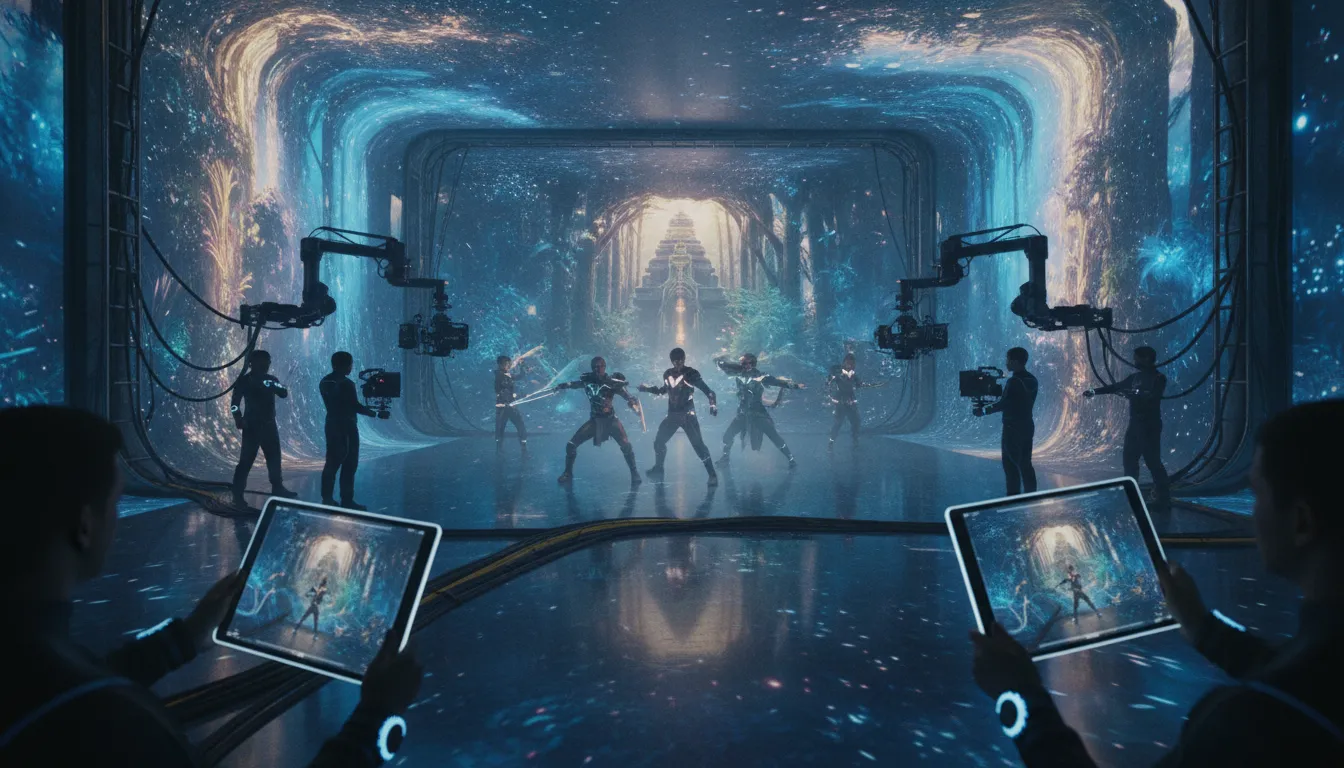
Virtual production demonstrates the value of cross-disciplinary pipelines. Real-time environments can support creative decisions before a shoot, give performers and directors a richer sense of place, and create digital materials that may inform later experiences. This does not mean one workflow replaces every other workflow. It means the organization can make connected decisions earlier.
Arctic7's virtual production workflow guide and Unreal virtual production studio guide provide related context for leaders evaluating this production model. The larger point is that technical excellence becomes strategically valuable when it supports continuity of the world and the reuse of knowledge between teams.
What Should Leaders Measure in an Entertainment Ecosystem?
Leaders should measure whether the ecosystem is becoming more coherent, useful, and valuable over time, not simply how many formats it contains. A meaningful measurement framework connects audience behavior to creative and operational decisions. It should show where people enter, what they do next, which experiences earn repeat participation, and where friction interrupts the journey.
Track four categories of evidence
- Audience movement: discovery sources, progression between experiences, repeat visits, completion, and participation depth.
- Community health: quality of discussion, creator participation, sentiment, recurring questions, and the strength of audience rituals.
- Creative coherence: canon exceptions, unresolved continuity issues, audience comprehension, and the consistency of the world across formats.
- Production leverage: asset reuse, review-cycle efficiency, handoff quality, delivery predictability, and the cost of rebuilding information that should already be shared.
These measures should inform decisions rather than become a dashboard for its own sake. A high number of releases may conceal weak audience movement. Strong community activity may not indicate that the world is easy for newcomers to enter. Efficient asset reuse may be offset by poor creative fit. The goal is to read the signals together and decide what the ecosystem needs next.
Leaders can also connect the framework to Arctic7's game development capabilities when interactive participation is part of the roadmap. The link should reflect a real strategic relationship, not a requirement to add a game to every IP.
Measurement also needs a time horizon that matches the IP. Short-term launch metrics can identify friction, but ecosystem health is revealed through repeated cycles of creation, participation, learning, and renewal. Leaders should protect long-term world value while remaining willing to change the roadmap when evidence shows that an experience is not serving its intended audience.
Talk with Arctic7 about designing a connected entertainment ecosystem for your IP
Frequently Asked Questions
What is an entertainment ecosystem in simple terms?
An entertainment ecosystem is a connected system for extending an IP across formats such as games, film, television, and live or digital experiences. It links the world, audience, platforms, and production teams so each expression has its own purpose while contributing to a larger strategy.
What is the difference between an entertainment ecosystem and transmedia storytelling?
Transmedia storytelling focuses on how a story or world unfolds across multiple media. An entertainment ecosystem includes that storytelling layer, but also covers canon governance, community, production operations, technology, distribution, and measurement. It is the wider operating model that makes transmedia expansion repeatable.
Does every entertainment ecosystem need a game?
No. A platform belongs in the ecosystem when it serves a clear audience or strategic purpose. A game may create agency and participation, while a series may deliver character depth and a live experience may build community. Adding a format without a distinct role can create cost and confusion rather than value.
How do IP holders protect canon across multiple platforms?
IP holders protect canon through a living world bible, clear ownership, review gates, version-controlled decisions, and rules that distinguish fixed facts from flexible details. Teams should also define how tone, visual language, audience entry points, and unresolved story opportunities carry across platforms.
How does Arctic7 help build an entertainment ecosystem?
Arctic7 helps IP holders connect transmedia strategy, ecosystem design, game development, cinematic storytelling, virtual production, and content optimization. The objective is to align creative and technical execution around an expandable world that can engage audiences across games, film, television, and related experiences.
New Immersive & XR Media Capabilities Added to Arctic7's Suite of Games, Film & TV and Digital Services

Arctic7 Shares Details of its Work on Skeleton Crew and Cinematics Partnership with Fateless

The Human Touch: Adding Personality to Project and Product Management
Whether it’s your team, your client, or your stakeholders, understanding the human dynamics is just as critical as hitting milestones.

McDonald's Case Study: Bridging Brand and Play | Arctic7
Bridging Brand and Play: An Interview with Lindsay Blenkhorn Daggitt