


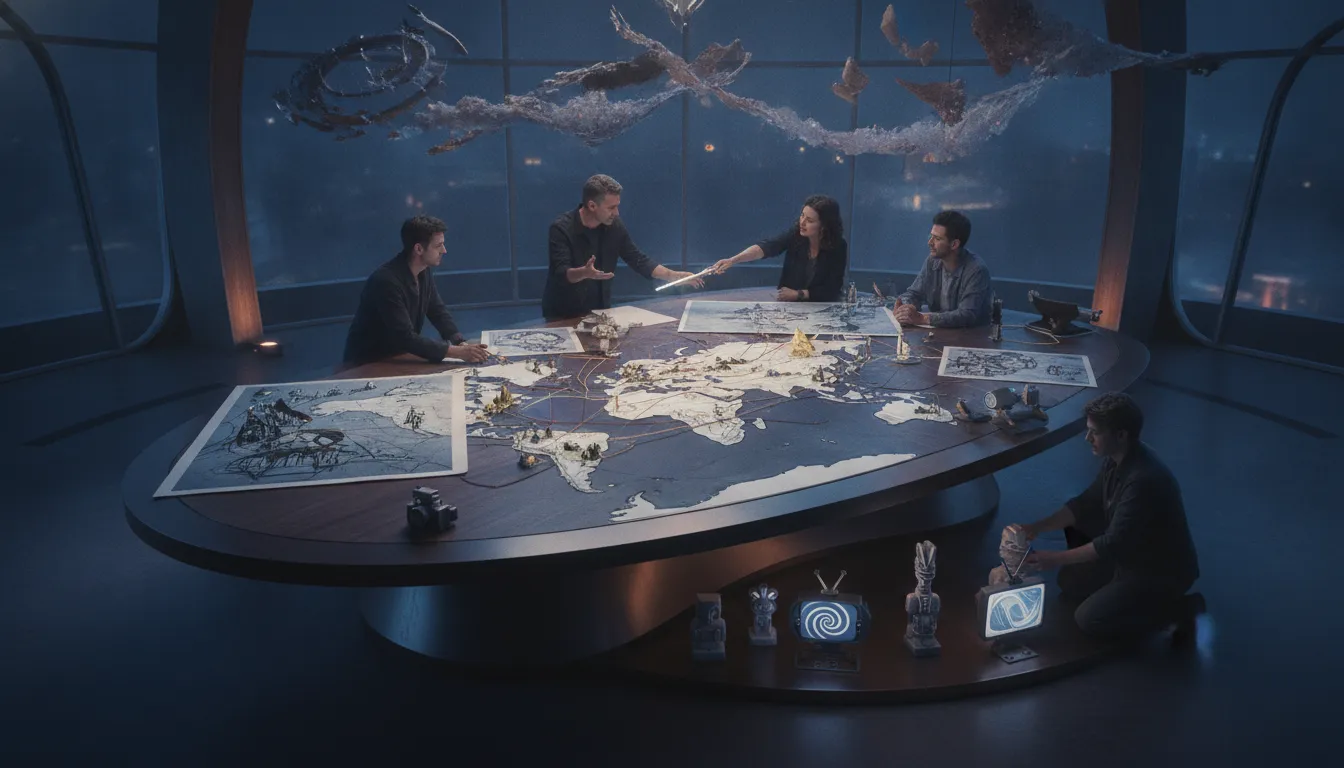

Transmedia IP Development: A Stage-Gate Framework
Expanding a property across film, television, games, or immersive experiences is not simply a matter of placing the same characters in new formats. The strongest franchises make deliberate choices about what belongs to the shared world. What each medium can uniquely express, and which decisions are ready to move from exploration into production.
Transmedia IP development is the disciplined process of preparing a property for expansion. Defining how its storyworld and formats work together, and turning that strategy into evidence-backed production decisions. It protects the core promise of the IP while giving each platform a meaningful role.
That discipline matters because interconnected ecosystems replace the assumptions of a single release with a sequence of creative, commercial, and operational choices. A practical framework begins by clarifying the property itself, then tests its rights readiness, world logic, format roles, and execution path before scale makes weak decisions expensive.
Explore Arctic7's transmedia and virtual production capabilities.
What Is Transmedia IP Development?
Transmedia IP development is the disciplined process of expanding a property into a connected storyworld across formats, with each medium contributing a distinct audience experience. It is more than adapting one story or distributing the same content in several places. The work aligns world logic, format roles, creative guardrails, and production decisions so the IP can grow without losing its identity.
At its foundation, transmedia storytelling creates a storyworld through documents in multiple media, rather than treating every release as an isolated project. The distinction matters for IP holders. A film adapted into a game may retell the same plot. A transmedia property might instead use the film to establish a central conflict. The game to let audiences act within that world, and another format to reveal a different character or period. Each expression remains coherent. None has to duplicate the others.
Academic discussions of transmedial storytelling identify expansion, modification, and transposition as core operations. In practical development terms, that means a team can extend the world, reshape an element for a new medium. Or move a story idea into a different context while preserving the property's underlying promise. The result is not a content list. It is an interconnected system. The relationship between formats is designed deliberately.
That system can include television, radio, fictional websites, and linked nonfictional texts, as one documented example demonstrates. The relevant question is not how many platforms an IP can occupy. It is what each platform is uniquely equipped to do for the world, the audience, and the long-term property.
ArtCenter describes transmedia design as the strategy needed to extend an existing property across multiple platforms. While UCLA Extension frames the modern entertainment landscape as interconnected ecosystems spanning film, television, digital platforms, games, and consumer experiences. Development therefore begins before production: teams clarify the core concept, voice, characters, worldbuilding, story engine, and expansion potential. This foundation supports extending IP across platforms without confusing scale with substance.
Academic research on transmedial storytelling describes a storyworld built through multiple media and identifies expansion, modification, and transposition as core operations.
How Do You Make an IP Ready for Expansion?
Make an IP expansion-ready by clarifying the rights position, defining the property's core promise. Documenting its world logic, and identifying a character or story engine that can generate meaningful experiences. Establish creative guardrails before choosing formats, while treating legal and rights questions as planning issues to confirm with qualified counsel.
Readiness begins with a disciplined inventory, not a platform wish list. Identify who controls the relevant copyrights, trademarks, likenesses, underlying works, and adaptation permissions. Record what is documented, what is licensed, what is unresolved, and which territories or uses may require additional review. This is general planning guidance, not legal advice or an Arctic7 policy.
An IP bible can turn that inventory into a shared working document. Columbia College Chicago describes an IP bible as a development tool for an original concept or previously undeveloped IP, with materials intended for film, television, and games. Read the source description for the academic framing.
Next, define the promise audiences should recognize wherever they encounter the property. UCLA Extension identifies core concept and promise, voice and tone, character and world-building, story engine, and expansion potential as foundational elements of an entertainment platform pitch. Its course outline offers a useful checklist for this stage.
World logic should answer what is possible, what is forbidden, and what consequences follow from the rules. The character engine should do more than preserve familiar personalities. It should create conflicts, choices, relationships, or mysteries that can sustain new stories without making every format repeat the same experience. This is where multi-platform narrative design becomes practical: each medium can contribute something distinct while remaining recognizably part of the same world.
Finally, write guardrails that protect the core without freezing interpretation. Define non-negotiable themes, visual or tonal boundaries, continuity principles, and approval responsibilities. Then distinguish those protections from areas where a game, series, film, or immersive experience should have room to use its own strengths. For a broader operational view, see extending IP across platforms.

Which Format Should Lead the Development Plan?
A lead format should earn its place by doing the first useful job for the audience and the property. Not by being the most familiar medium to the rights holder. Choose the format that best expresses the central story opportunity, matches production reality, and can generate evidence for the next decision. The lead is an entry point, not a permanent hierarchy.
| Format | Best role | Evidence to gather | Common risk |
|---|---|---|---|
| Film or television | Deliver a concentrated character and story experience with broad narrative visibility. | Story engine, character arcs, visual language, audience alignment, and a credible production path. | Reducing a rich world to exposition or treating expansion as a list of adaptations. |
| Game | Give the audience agency, repeatable interaction, and a way to inhabit the world. | Core player promise, interaction loop, world systems, team capability, and prototype findings. | Translating plot into gameplay without identifying what the player actually does. |
| Digital or interactive experience | Invite participation, discovery, or community behavior around a specific story element. | Audience behavior, interaction design, content cadence, technical requirements, and moderation needs. | Adding interactivity that does not deepen the story or serve a defined audience job. |
| Print, audio, or companion media | Expand context, voice, history, or point of view at a controlled production scale. | Distinct material, format-native strengths, editorial requirements, and connections to the core experience. | Repeating the primary story instead of contributing meaningful new information. |
The decision should be documented in an IP bible or equivalent development brief. Columbia College Chicago frames an IP bible as a foundation for platform-appropriate material across film. Television, and games, while ArtCenter highlights medium differences and platform planning as core transmedia design concerns. Those principles support a practical test: can the proposed lead format make a distinctive contribution while leaving room for other formats to do work only they can do?
That is the distinction between a connected system and a content queue. A television story may establish emotional stakes, a game may turn those stakes into agency, and an interactive layer may let audiences investigate the world. Review the choice alongside multi-platform narrative design before committing the development plan.
Sources: Columbia College Chicago; ArtCenter; UCLA Extension.
What Are the Stage Gates in Transmedia IP Development?
A stage-gate model gives an IP team a disciplined way to decide whether expansion is ready to advance. The four gates below are recommended operating checkpoints, not documented Arctic7 approval thresholds. Each gate produces evidence: rights clarity, a coherent world, a justified format plan, and a production path that stakeholders can evaluate together.
Gate 1: Rights readiness
Before creative expansion accelerates, document what the team can develop, in which territories and media, and under whose authority. The objective is not to provide legal advice. It is to make ownership, permissions, obligations, and decision rights visible enough for the creative and production teams to work from a shared brief. Record the relevant agreements, approvals, restrictions, and unresolved questions in a rights register. Identify who can approve changes to canon, characters, settings, and format-specific adaptations.
This governance emphasis matters because transmedia publishing can complicate assumptions about authorship and control. The Case Western Reserve University Journal of Law, Technology, & the Internet examines changing perceptions of authorship in transmedia publishing, a useful reminder to resolve responsibilities early: review the authorship discussion.
Gate 2: World readiness
Next, show that the property has enough internal logic to support more than one expression. The evidence pack should include the core promise, voice and tone, character motivations, world rules, story engine, and expansion principles. A concise IP bible or equivalent creative framework can make these decisions inspectable. The question is whether another team could develop a new installment without weakening the identity of the original property.
Use a narrative audit to distinguish essential canon from material that can evolve. Include examples of what the world permits, what it prohibits, and where platform-specific interpretation is welcome. A completed concept and pitch should demonstrate narrative design, audience alignment, and long-term story potential, rather than relying on enthusiasm alone. UCLA Extension identifies those qualities as outcomes for an entertainment-based IP concept and pitch: see the documented concept criteria.
Gate 3: Format readiness
Assign each proposed format a distinct job. Do not approve a film, series, game, or interactive experience merely because the property could technically appear there. For each format, document the audience experience, narrative contribution, creative requirements, production implications, and relationship to the wider story system. Test whether the choice expands the IP or simply repeats existing material in a different container.
Evidence can include a format rationale, audience hypothesis, experience outline, sample scene or mechanic, and a comparison of dependencies between platforms. Research on transmedia video games distinguishes IP-based games from native game IP and considers factors such as success conditions, market context, and free-to-play versus pay-to-play models. Treat that research as input to the decision, not as a universal approval rule: review the transmedia game framework.
Gate 4: Production readiness
The final gate converts the approved direction into a production blueprint. Assemble a platform-specific scope, sequence, ownership map, dependencies, creative guardrails, technical requirements, and review cadence. Include a risk register with named owners and clear decisions still required. The output should let partners understand what happens next, what must remain shared across formats, and where each team can work independently.
Use a prototype, concept reel, pilot materials, or other tangible sample to expose gaps before full production. A concept reel for Tainted is described as an early look at a transmedia IP in development, spanning live action, manga, augmented reality, and gaming. That example illustrates the value of showing the intended system early, not a prescribed Arctic7 threshold: view the development example.
How Do You Prove the Property Is Ready to Scale?
Readiness is demonstrated through evidence, not enthusiasm. A property is better positioned for expansion when its creative promise, audience fit, prototype, partner requirements, and unresolved risks are visible in one decision-ready pack. The goal is not to manufacture certainty. It is to show what is known, what remains untested, and what the next investment would clarify.
Build an evidence pack that brings five views together: the core property and its expansion logic, audience signals, a representative prototype, partner alignment, and a live risk register. This gives stakeholders a shared basis for deciding whether to advance, revise, or pause the next stage of multi-platform narrative design.
1. Make the creative case inspectable
Start with the promise of the property, its story engine, its world rules, and the role each proposed format would play. A pitch should demonstrate narrative design, audience alignment, and long-term story potential, rather than simply list possible channels. UCLA Extension identifies those elements as outcomes for an entertainment-based IP concept and pitch: the course description provides a useful reference point.
2. Pair audience signals with a prototype
Audience evidence can include observed engagement, partner feedback, community response, or other relevant signals, but avoid treating any single response as proof of demand. Pair those signals with something people can experience: a scene, playable slice, concept reel, interactive test, or other format-appropriate prototype. The early concept reel for Tainted is described as an early look at a transmedia IP in development, spanning live action, manga, AR, and gaming. It illustrates how a tangible creative artifact can make an emerging proposition discussable, not that it guarantees market success. The published example should be read in that limited context.
3. Test alignment and expose risk
Record what rights holders, creative leads, distributors, technology partners, and prospective production teams each need from the property. Then maintain a risk register covering ownership, continuity, format fit, audience assumptions, production complexity, and partner dependencies. Comparative research can sharpen questions without becoming a forecast.
Newzoo's transmedia games research is summarized by 80 Level. It examines success factors and compares transmedia IP with native game IP, including free-to-play and pay-to-play titles. Use the summary to frame diligence questions, not to import unsupported thresholds.
From Strategy to a Production Blueprint
A production blueprint turns an agreed direction into coordinated action. It identifies who owns each decision, what remains fixed across the ecosystem, how each platform expresses the property, and which technical dependencies must be resolved before production. The aim is creative coherence with enough flexibility for each medium to do its job.
Once the strategy is defined, the handoff should make ownership visible. Name the creative decision-maker, the people responsible for platform execution, and the stakeholders who approve changes to story, tone, world rules, and audience experience. Document deliverables, workflows, timelines, and dependencies rather than leaving alignment to recurring meetings. This is the practical purpose of Arctic7's Method Stage 2, Define the Strategy, which establishes a unified strategy and aligns stakeholders before execution.
The shared creative system is the bridge between formats. It can include the core promise, voice and tone, character logic, world rules, story engine, and expansion principles. UCLA Extension identifies these elements as foundations for an entertainment platform pitch, while ArtCenter places medium differences and platform planning alongside worldbuilding in transmedia design. Together, they suggest a useful discipline: protect the property's underlying identity, then specify what can change for film, television, games, digital experiences, or other formats.
Platform-specific execution should answer a concrete audience and production question. A television series may deepen character arcs, while a game may create agency and repeatable interaction. A broader transmedia system can connect television, radio, fictional websites, and linked texts, as documented in a study of a German story system (source research). The blueprint should assign each format a distinct role, not ask every team to retell the same story.
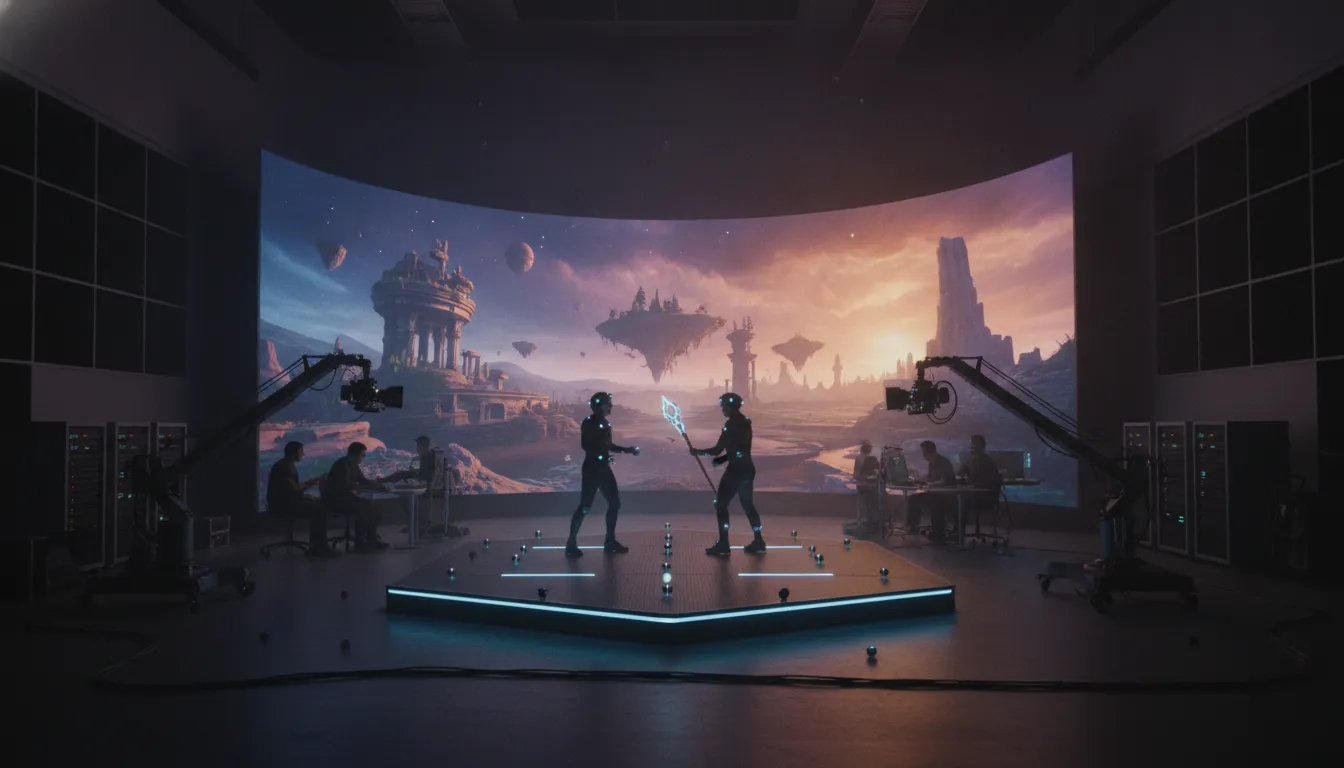
Technical planning belongs in the blueprint early. Define asset requirements, pipelines, handoff formats, review points, production constraints, and the systems that keep approved creative information current. Governance then protects the plan through change control: decisions are recorded. Conflicts are escalated to the right owner, and platform teams can adapt without quietly breaking the shared world.
Arctic7 describes Stage 3, Your Production Blueprint, as the translation of strategy into platform-specific production while maintaining creative alignment across formats. That structure is useful for any transmedia IP development program, whether the next step is a pilot, prototype, virtual production test, or full multi-format build.
Explore how virtual production can support a connected entertainment ecosystem.
What Does Good Transmedia IP Development Look Like in Practice?
Good transmedia IP development turns a property into a set of connected experiences, with each format contributing something it can do especially well. The strongest examples preserve coherent world logic while giving audiences a reason to move between formats. They also sequence development deliberately, testing the property and its audience relationship before expanding further.
For IP holders, the practical lesson is not to copy a franchise's media mix. It is to understand why each extension exists, what creative or audience problem it solves, and what evidence supports the next investment.
Arcane: deepen the world, not just the brand
Konvoy describes Arcane as an opportunity to extend League of Legends lore through a screen adaptation and further attach users to the IP. The lesson is that a new format can create value by making a familiar world more emotionally and narratively expansive. The series has a format-specific job: develop character and story dimensions that a competitive game does not deliver in the same way. Extending IP across platforms works best when every addition earns its place through a distinct audience experience.
Hogwarts Legacy: let the audience inhabit the world
The same analysis notes that the Harry Potter property later extended into a well-received game through Hogwarts Legacy. This illustrates a different pattern. A game can turn attachment to a fictional setting into participation, allowing audiences to explore and act within the world rather than only watch it. The development sequence matters: the format should be chosen for the kind of relationship it enables, not because another channel is fashionable.
Tainted: design the system before scaling it
A Bright Voxel post describes Tainted as a transmedia IP in development spanning live action, manga, augmented reality, and gaming. It is useful as an early-development example, rather than proof of commercial performance. Its stated multi-platform design suggests the importance of establishing a shared premise and format roles before production expands. In practice, that means defining the rules of the world, the audience's path through it, and the handoffs between experiences before treating the property as a full ecosystem.
Together, these examples point to a disciplined approach: build a coherent world, assign each medium a meaningful job. Create a stronger form of audience attachment, and advance only when the next stage has a clear creative rationale.
Frequently Asked Questions
What exactly does transmedia mean?
Transmedia means developing one property across multiple formats so each medium contributes a distinct part of the wider experience. A film, game, series, or immersive project should have its own reason to exist while remaining connected through shared world logic, character principles, and creative guardrails.
How do you make an IP ready for expansion?
Start by identifying the property's core promise, audience value, rights position, and boundaries. Workshops, narrative audits, and discovery can clarify what must remain consistent and where new formats can contribute. The result should be a usable creative framework, not simply a list of possible adaptations.
Which format should lead transmedia IP development?
The lead format should be chosen according to the audience job, story opportunity, production reality, and evidence available at that point. A game may lead when participation is central, while film or television may establish the world first. The decision should be tested rather than assumed.
What are the most useful stage gates for a transmedia project?
A practical model uses gates for rights readiness, world coherence, format fit, and production readiness. At each gate, decision-makers review the evidence, open risks, stakeholder alignment, and next investment before advancing. These are planning recommendations, not universal legal or approval requirements.
Ready to Turn the Blueprint Into Production?
Once rights, world logic, format roles, and stage gates are aligned, the next step is translating that shared direction into a practical production plan. Arctic7 can help connect the creative and technical decisions required to develop interconnected entertainment worlds across formats.
New Immersive & XR Media Capabilities Added to Arctic7's Suite of Games, Film & TV and Digital Services

Arctic7 Shares Details of its Work on Skeleton Crew and Cinematics Partnership with Fateless

The Human Touch: Adding Personality to Project and Product Management
Whether it’s your team, your client, or your stakeholders, understanding the human dynamics is just as critical as hitting milestones.

McDonald's Case Study: Bridging Brand and Play | Arctic7
Bridging Brand and Play: An Interview with Lindsay Blenkhorn Daggitt


