



Film Production Governance for IP Holders: Practical Guide
For an IP holder, film production governance protects creative intent as a project moves through development, prep, production, post, and delivery. It makes decision rights visible, gives teams a shared route for approvals, and creates a disciplined way to handle changes before they become expensive confusion.
Film production becomes harder to steer when creative, technical, commercial, and franchise decisions move through different teams. Without a shared operating model, approvals slow down, changes arrive late, and the people protecting the IP may not be the people empowered to resolve conflicts.
Film production governance for IP holders is the system that defines who can make which decisions. It controls how creative and production risks are managed, when work receives approval, and how accountability is maintained from development through delivery. It protects the integrity of the IP while giving each team enough clarity to execute.
The practical starting point is not another meeting. It is a visible framework of decision rights, creative guardrails, approval gates, and escalation routes. That framework connects stakeholder alignment to concrete deliverables, workflows, and timelines, creating a foundation for production that can adapt without losing narrative cohesion. The first step is distinguishing governance from adjacent functions and defining what it must control.
What Is Film Production Governance for IP Holders?
Film production governance for IP holders is the decision-making system that keeps creative intent, IP integrity, production realities, and stakeholder accountability aligned from development through delivery. It defines who can decide, who must be consulted, what evidence supports approval, and how exceptions are escalated when a production changes course.
Governance is broader than project management. A project manager coordinates schedules, resources, dependencies, and day-to-day delivery. Governance establishes the authority behind those activities: which creative choices require IP-owner approval. Who resolves conflicts between departments, and when a change is significant enough to reopen an earlier decision. The two functions work together, but they answer different questions.
It is also distinct from legal review. Legal teams may assess rights, contracts, permissions, or other legal questions. Governance does not replace that expertise. Instead, it creates a reliable path for routing legal issues alongside creative, technical, financial, and production decisions, so no single review function becomes an accidental substitute for the others.
Nor is governance the same as creative direction. A creative director may shape the story, visual language, or audience experience. Governance protects the conditions in which that direction can be developed consistently. It makes the decision rights visible without prescribing every artistic choice.
For an IP holder, this distinction matters because a film rarely exists in isolation. It may need to preserve established character logic, world rules, audience expectations, and future expansion opportunities while multiple studios, vendors, producers, and internal teams work under pressure. Without an agreed operating model, small ambiguities can become late revisions, fragmented approvals, or competing interpretations of the property.
A practical governance model usually begins with four artifacts: an IP and creative guardrail set, a decision-rights matrix, a milestone approval path, and a decision or change log. Together, they give teams a shared reference point while leaving room for informed creative judgment. Arctic7's documented approach similarly connects stakeholder alignment and creative frameworks with defined deliverables, workflows, timelines, and platform-specific execution.
For a broader view of how ownership, canon, and review points work across an interconnected property, see IP canon governance and decision rights. The purpose here is narrower: to give film stakeholders enough structure to make accountable decisions without turning governance into another layer of unnecessary bureaucracy.
Which Decisions Need Clear Ownership Before Production Starts?
Before cameras roll, every consequential decision should have one accountable owner, a defined group of contributors, and a visible route for escalation. Film production governance for IP holders works when creative intent, production realities, technical choices, and stakeholder expectations are connected through agreed decision rights rather than informal influence.
This does not mean removing collaboration. It means making collaboration legible, so teams know who decides, who advises, what evidence is required, and when a decision can be revisited.
Assign four decision lanes
Start with four practical lanes. The creative and IP lane owns story intent, character treatment, canon, and the boundaries that protect the property. A named creative or IP lead should have authority to resolve conflicts between an appealing idea and an established rule. A franchise rules and approval standards document can make those boundaries accessible to every department.
The production lane owns schedule logic, scope, resource coordination, and the practical consequences of changing an approved plan. The technical lane owns pipeline choices, visual effects dependencies, virtual production requirements, and the feasibility of proposed execution. The commercial and stakeholder lane gathers the priorities of rights holders, financiers, distributors, and other senior participants, then identifies which decisions require their approval.
Each lane needs a single accountable decision maker, even when several people contribute. A simple decision matrix can record the decision, accountable owner, required contributors, approval threshold, deadline, and escalation owner. Avoid assigning accountability to a committee. Committees can advise and challenge, but they rarely provide a clear answer when time is limited.
| Decision lane | Owner | Core question |
|---|---|---|
| Creative and IP | IP or creative lead | Does the work protect the property's approved boundaries? |
| Production | Producer | What are the schedule and scope effects? |
| Technical | Technical or VFX lead | Can the idea move through the selected pipeline? |
| Stakeholder | Authorized IP owner | Which changes require senior approval? |
Make escalation part of the design
Escalation should not be an emergency invention. Define which conflicts move upward, who receives them, and what information accompanies the request. A useful escalation packet states the decision in dispute, the available options, the impact on story, schedule, cost, or technical delivery, and the recommendation from the accountable owner. Set a response window appropriate to the production phase, then record the outcome.
Maintain a decision log from development through delivery. Capture the date, decision owner, rationale, affected departments, dependencies, and any conditions for review. This prevents teams from reopening settled questions because the original reasoning disappeared, while still allowing a documented change when new information genuinely alters the trade-off. The result is not bureaucracy for its own sake. It is a shared operating framework that protects creative alignment while giving production teams permission to move.
Build the Film Production Governance Framework Around Four Control Layers
Effective governance gives an IP holder a practical way to protect the property while keeping production moving. The framework should define creative boundaries, sequence the work, assign approval authority, and make risks or changes visible early. Together, these four control layers turn broad alignment into decisions, artifacts, and accountable owners.
1. IP guardrails
Start with a concise creative framework that distinguishes what must remain consistent from what teams can reinterpret. It may include character principles, world rules, tone, visual references, audience promises, and boundaries for adaptation. The useful artifact is not a long document that no one consults. It is a working set of guardrails, supported by examples, that creative leads can apply during development.
Give ownership to an IP or creative authority who can interpret the framework when a decision is unclear. That person should work with the producer and relevant department leads, rather than becoming a bottleneck for every creative choice. For a broader view of IP canon governance and decision rights, connect these film-specific guardrails to the wider property without turning this production document into a franchise bible.
2. Production plan
Translate the creative framework into deliverables, workflows, dependencies, and a synchronized timeline. The production plan should show who owns each major output, when other teams need it, and what information is required to approve it. Include creative, editorial, visual-effects, technical, and stakeholder responsibilities where they affect the same milestone.
This layer is especially valuable when multiple studios or specialist vendors contribute to one film. A shared plan exposes handoff points before they become schedule problems. Teams can use the film production workflow coordination guide as a related reference for mapping filmmaking stages and cross-functional dependencies.
3. Approval gates
Replace ad hoc review with a small number of explicit gates. For each gate, record the evidence required, the accountable approver, the people who must be consulted, and the consequence of a no-go decision. Typical evidence might include a concept package, approved script materials, a production-ready design set, a cut, or a delivery checklist. The purpose is not to add meetings. It is to prevent expensive downstream work from proceeding on unresolved assumptions.
4. Risk and change control
Maintain a decision and risk log throughout production. Each entry should state the issue, affected deliverables, owner, decision deadline, proposed response, and status. When a late creative or technical change is proposed, assess its impact on continuity, scope, dependencies, and timing before approval. The producer can coordinate this process, while the appropriate creative or IP authority owns the decision itself.
These layers work as one system: guardrails establish the boundary, the plan shows the route, approval gates confirm readiness, and change control keeps the route current. That structure lets an IP holder preserve creative alignment while giving production teams enough flexibility to solve problems and iterate.
How Should IP Holders Structure Approval Gates?
Approval gates turn creative intent into visible decisions at the moments when change is still manageable. For film production governance for IP holders, each gate should define the evidence required, the person accountable for approval, and the response when the work is not ready. That keeps creative alignment from depending on memory or informal consensus.
- Development gate. The purpose is to confirm that the project has a coherent story direction and a usable relationship to the wider IP. Evidence should include the creative framework, audience and format rationale, initial canon or continuity guardrails, and a decision-rights map. The accountable approver is the IP owner or delegated creative executive, with the lead producer confirming feasibility. If the gate is not passed, return the concept for clarification, record the unresolved decisions, and do not move into detailed planning.
- Preparation gate. This gate tests whether the approved direction can become an executable production plan. Evidence includes the principal creative deliverables, production workflow, collaboration framework, synchronized timeline, and an agreed review path for changes. The accountable approver is the producer or head of production, supported by creative, technical, and platform leads. If evidence is incomplete, hold the affected workstream, assign owners to the gaps, and set a new review date rather than allowing assumptions to become commitments.
- Production gate. The purpose is to verify that work in progress remains aligned with the approved story, quality bar, and production plan while leaving room for informed iteration. Review evidence might include milestone cuts, selected assets, continuity checks, and a decision log showing accepted changes. The accountable approver is the designated creative or IP authority, while production confirms the impact on schedule and resources. If the gate fails, classify the issue, approve a corrective pass, or escalate a material change before more downstream work builds on it.
- Post-production gate. This gate confirms that editorial, visual effects, sound, and other finishing work form a coherent final experience. Evidence should include the review cut, outstanding-notes register, resolved continuity decisions, and confirmation that required deliverables are complete. The accountable approver is the executive or creative owner named in the review path. If it is not passed, separate essential fixes from optional preferences, assign each note, and schedule a focused re-review.
- Delivery gate. The final gate confirms that the approved version, supporting assets, and handoff information are complete and traceable. Evidence includes the final approved master, delivery checklist, version record, and documented exceptions. The accountable approver is the IP owner or authorized release lead. If the gate is not passed, pause distribution or handoff, correct the specific exception, and preserve the decision record so the next team is not working from an outdated version.
What Are the Biggest Governance Risks in Film Production?
For IP holders, the largest governance risks are fragmented decisions, unclear canon, late creative changes, siloed vendors, and timeline drift. Each can be reduced by assigning decision rights, documenting creative guardrails, setting approval gates, integrating collaborators into one workflow, and tracking changes against a shared production plan.
Strong film production governance for IP holders is not about slowing creative work. It gives teams a dependable route for making decisions while preserving room to iterate.
Fragmented decisions and unclear canon
When creative, production, technical, and business stakeholders make decisions independently, teams can receive conflicting direction. The result may be duplicated work, delayed approvals, or a story world that no longer feels coherent. Establish a decision matrix before production begins. Name the accountable owner for each category, define who must be consulted, and record the rationale for decisions that affect the property.
Pair that matrix with a concise canon and creative framework. It should distinguish non-negotiable principles from elements that can change for the needs of a scene, format, or audience. A documented review path makes continuity decisions faster and more defensible. For a broader treatment of ownership and continuity, see this guide to IP canon governance and decision rights.
Late changes and siloed vendors
Late changes become expensive when they are approved without showing their effect on scope, dependencies, or delivery. Use milestone gates with defined evidence, such as an approved creative direction, locked requirements, or a reviewed production package. Any exception should identify its owner, downstream impact, and decision deadline.
Vendor silos create a related risk. A visual-effects team, virtual-production crew, and editorial team may each optimize its own handoff while the overall sequence suffers. A shared workflow, common asset references, and cross-functional reviews connect those handoffs. The goal is not to eliminate specialist autonomy, but to make dependencies visible early.
Timeline drift
Schedules drift when milestones describe activity rather than decisions. Tie each major date to an outcome, accountable approver, and escalation route. Review the plan at a consistent cadence, surface blocked decisions quickly, and rebaseline only when the trade-offs are understood. This creates the synchronized workflows and timelines needed to balance narrative cohesion with platform-specific production realities.
Use Governance to Connect Film Production to the Wider IP Ecosystem
Film production governance for IP holders creates the operating bridge between one production and the wider property. It preserves shared creative guardrails while giving each platform room to work in its own medium. The practical goal is not to make every format identical, but to align decisions, workflows, and accountability before differences become expensive rework.
That distinction matters when a film sits alongside games, television, immersive experiences, or other extensions. A production team should know which elements are fixed, which can evolve, and who has authority to approve a meaningful change. A concise decision matrix can cover character rules, world logic, visual language, technical dependencies, release timing, and audience-facing commitments without turning the film team into a committee.
The same framework should connect creative guardrails to production artifacts. Workshops and audits can establish the shared foundation, while deliverables, collaboration frameworks, and synchronized timelines translate that foundation into daily work. The film team may own scene-level execution, but cross-functional leads need visibility into decisions that affect future platform work. This is especially important when a design, asset, performance, or environment may be reused or adapted elsewhere.
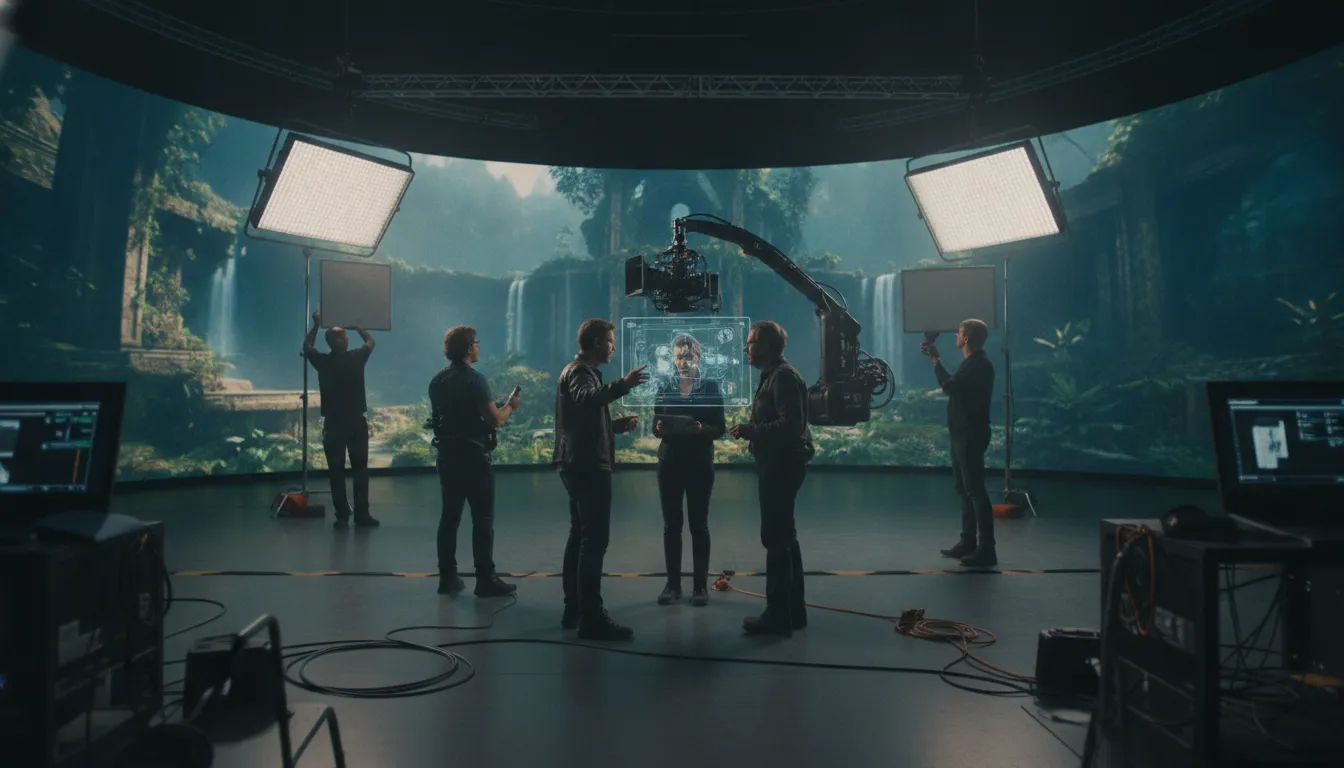
Virtual production makes this coordination more tangible. Real-time visualization, in-camera visual effects, and shared digital assets bring creative and technical decisions into the same workflow. They can also expose dependencies earlier, provided the governance model identifies who reviews changes and how approved versions are recorded. For a deeper look at film production workflow coordination, separate the craft of the workflow from the authority to change its inputs.
Governance should also define the handoff between film production and IP expansion. A film may establish a story, character, or visual system that another team later interprets for a different platform. Documenting the rationale behind key choices gives that team useful context, rather than a static list of restrictions. It supports IP expansion across entertainment platforms while keeping the original production accountable to its own creative and delivery goals.
In this model, coherence comes from shared decisions and traceable workflows, not from removing platform-specific innovation. The film remains a film, the game remains a game, and the ecosystem gains a reliable method for knowing where those experiences connect.
How Can IP Holders Make Governance Operational?
Film production governance for IP holders becomes practical when it is built into the weekly operating rhythm, not kept as a document that few people consult. Set clear meeting cadences, assign owners to key artifacts, record decisions, route exceptions to named authorities, and use retrospectives to improve the next phase.
Start with a short weekly production governance meeting for decisions that affect creative intent, schedule, budget assumptions, or cross-team dependencies. Keep it separate from status reporting. Each agenda item should have an owner, a decision required, the options considered, and a deadline. A smaller working group can resolve day-to-day questions, while a monthly steering review handles escalated issues and milestone readiness.
Ownership should be visible in the artifacts themselves. Assign one accountable owner for the creative framework, production plan, approval matrix, change register, and decision log. Contributors can review or advise, but accountability should not be shared so broadly that no one can close an issue. A decision log should capture the date, decision, rationale, approver, affected deliverables, and any follow-up.
Define an exception route before production pressure arrives. When a proposed change falls outside the agreed creative guardrails, timeline, or platform plan, the team should know where to send it, what evidence to provide, and who can approve it. This protects the project from informal decisions made in disconnected channels while preserving room for creative judgment.
At the end of each milestone, run a focused retrospective. Ask which decisions arrived too late, which handoffs created rework, and which assumptions proved wrong. Convert the answers into updates to the workflow, ownership map, or approval gates. A coordinated cross-functional production partner can help connect these practices across creative, technical, and production teams.
Use this checklist to make the framework operational:
- Weekly decision meeting and monthly escalation review are scheduled.
- Every core artifact has one accountable owner and named reviewers.
- Decision, change, and exception logs use a shared format.
- Escalation thresholds and approvers are documented before production.
- Each milestone ends with a retrospective and an assigned improvement.
Frequently Asked Questions
What are the core elements of film production governance for IP holders?
The core elements are clear decision rights, shared creative guardrails, defined approval gates, documented risks, and an escalation path. Together, these controls clarify who can approve story, production, technical, and commercial decisions while keeping teams aligned around the IP's integrity and the film's delivery requirements.
How do you develop a governance framework for an IP film?
Start by aligning stakeholders on the story world, audience, objectives, and non-negotiable IP principles. Then map decision owners, define the deliverables and workflows for each phase, set review gates, and establish a decision log. Test the framework against likely changes before production begins so the process is usable under pressure.
What challenges does production governance help prevent?
Effective governance helps prevent continuity disputes, fragmented ownership, duplicated work, late creative changes, and disconnected vendor decisions. It also makes timeline drift easier to detect because teams can see which decision or dependency is holding up a milestone. The goal is not to eliminate debate, but to resolve it deliberately.
How should governance connect a film to a wider IP ecosystem?
Define the film's role in the broader story world, identify which elements are fixed or adaptable, and assign ownership for cross-platform decisions. Shared standards, synchronized timelines, and regular feedback between film, game, publishing, and audience teams help each format contribute something distinct without weakening narrative cohesion.
New Immersive & XR Media Capabilities Added to Arctic7's Suite of Games, Film & TV and Digital Services

Arctic7 Shares Details of its Work on Skeleton Crew and Cinematics Partnership with Fateless

The Human Touch: Adding Personality to Project and Product Management
Whether it’s your team, your client, or your stakeholders, understanding the human dynamics is just as critical as hitting milestones.

McDonald's Case Study: Bridging Brand and Play | Arctic7
Bridging Brand and Play: An Interview with Lindsay Blenkhorn Daggitt


