
Cinematic Trailer Production Company Buyer's Guide
A cinematic trailer is rarely just a film delivered at the end of production. For a publisher or entertainment brand, it is often the first public test of a world. It is a promise to an audience and a launch asset that must work across channels, formats, and approval teams.
The right cinematic trailer production company connects narrative development, IP alignment, previs, production, finishing, and launch planning, so the trailer earns attention while protecting the larger franchise strategy.
That makes the buying decision less about comparing reels and more about defining ownership. Before reviewing production craft, buyers should establish who will shape the core hook. Test the creative direction, manage approvals, and translate the concept into a practical set of deliverables.
Explore Arctic7's transmedia production services
What should a cinematic trailer production company own at the concept stage?
A buyer-ready concept-stage scope should turn an initial brief into a shared creative direction. It should define the audience promise, central hook, relationship to the wider IP, approval responsibilities, and the deliverables required to move confidently into previs and production. The goal is not simply an attractive idea, but a decision-ready foundation for launch.
Start with the audience promise
The brief should establish who the trailer must reach, what that audience should feel, and what action or expectation the piece should create. A trailer combines promotional communication with narrative pleasure, so the concept has to work on both levels. It needs enough story intelligence to create curiosity without attempting to summarize the entire film, series, or game.
Audience definition should be specific enough to guide creative choices. An established fan base may want continuity, recognizable characters, and deeper world signals. A broader audience may need a clear genre cue, an accessible emotional premise, or a compelling visual entry point. Research on trailer reception supports treating audience response as a strategic consideration. The success of a trailer is moderated by how different audiences receive media (source research on audience reception).
Define the hook and protect the IP
The concept document should articulate one core hook in plain language. This is the idea that makes the trailer memorable and gives every subsequent creative decision a test. It might be a character dilemma, a threat, a world reveal, a tonal contrast, or a single image that promises a larger experience. If several ideas compete equally, the trailer is likely to feel visually busy but strategically unclear.
That hook must sit inside an agreed narrative spine. The production partner should identify canon requirements, non-negotiable character or world details, tonal boundaries, and any information that must remain protected. Arctic7 describes this early work through narrative and worldbuilding workshops, followed by a strategy that defines the roadmap, deliverables, workflows, and timelines (Arctic7's services). This approach helps keep cinematic storytelling aligned with broader IP strategy instead of treating the trailer as an isolated release.
Make approvals and deliverables explicit
Before production begins, the concept stage should name decision-makers and approval gates. Clarify who owns creative sign-off, who protects canon, who approves the marketing message, and how feedback is consolidated. A single accountable approval path reduces late-stage contradictions between the publisher, studio, agency, and production team.
The deliverable list should cover more than a one-line treatment. Depending on the campaign, it may include a concept treatment, audience and positioning statement, hook options. Tone references, key art, teaser directions, pitch materials, prototype moments, and a first map of post-launch content. It should also identify likely platform adaptations early, even if the final cutdowns are handled later. Arctic7's documented offering includes key art, teasers, pitch decks, prototypes, and post-launch content planning, alongside full-scale, co-development, or specialized engagements (engagement models).
That level of ownership gives buyers a practical test: can the partner explain what the trailer promises. Why it belongs to the IP, who approves it, and what the team will hand over next? If the answer is clear before a frame is produced, production starts with alignment rather than assumption.
How does narrative development protect an IP's identity?
Narrative development protects an IP by defining the creative boundaries that every trailer, game, series, and campaign must respect. A clear narrative spine connects character motivation, world rules, canon, tone, and audience promise, giving production teams room to innovate without turning each release into a disconnected interpretation.
Build a narrative spine before building spectacle
A trailer is not simply a sequence of impressive shots. It is a compact narrative that combines aesthetic, emotional, and commercial functions, helping audiences decide whether a story is for them. That makes the central question strategic: what must viewers understand, feel, and anticipate after watching?
The answer should be anchored in the IP's narrative spine. Workshops and audits can establish the essential conflict, character truths, world logic, and thematic signals that cannot be compromised. They also clarify which elements are flexible. A new visual language, gameplay moment, or cinematic device can then expand the world while remaining recognizably part of it.
This work is especially important when multiple stakeholders control different parts of a franchise. A shared foundation gives writers, directors, designers, VFX teams, licensors, and marketing leaders a common reference point for approvals. It reduces subjective debate and makes revisions more purposeful because teams can test choices against agreed narrative principles.
Use canon and tone as creative guardrails
Canon is more than a continuity archive. It is a working system for deciding what the audience should believe about a world, its characters, and its consequences. Worldbuilding documentation should distinguish established facts from open story territory, while tone defines how those facts are experienced. The same premise can feel intimate, comic, ominous, or operatic depending on the tonal frame.
That distinction matters in a trailer, where compression creates pressure to explain too much or exaggerate too far. A disciplined team can select a single hook, reveal only what serves that hook, and preserve mystery without contradicting the broader story. Research on trailers reinforces why this balance matters: anticipating target-audience response before release is critical, while traditional screenings and questionnaires have limits in predicting population-wide response. Narrative clarity therefore needs to work alongside informed audience learning, not replace it.
Design the trailer for the ecosystem, not the moment
The strongest trailer is planned as one expression of a wider transmedia system. Its characters, locations, symbols, and story questions should be usable across key art, teasers, gameplay, series promotion, and post-launch content. Arctic7's model connects early narrative development, worldbuilding, strategy, and platform-specific production rather than treating the trailer as an isolated handoff. Explore this approach in the transmedia production partner guide.
For buyers, the practical test is straightforward: can the proposed cinematic asset strengthen the IP's identity now and create useful continuity for what follows? A production partner should be able to show how narrative decisions, approval gates, and deliverables support that answer. The trailer then becomes more than promotion. It becomes a controlled entry point into an interconnected entertainment ecosystem.
What belongs in previs before production starts?
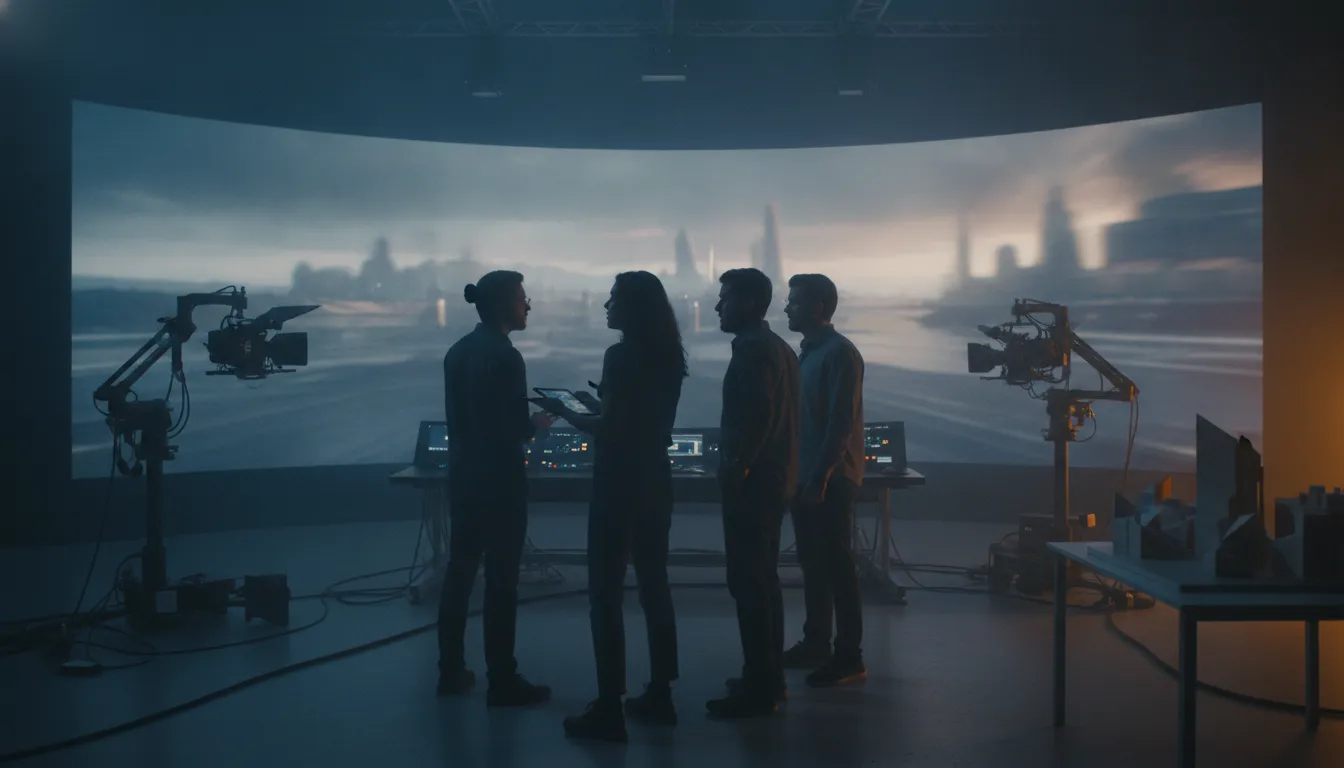
Previs should turn an ambitious trailer concept into a shared production decision. Before cameras, performers, or render time are committed, the team needs a visual plan for the story. Mood, key moment, virtual space, camera language, technical demands, and approval gates. That clarity protects the IP while giving every department a practical route from intention to execution.
Build the narrative and shot logic
A storyboard is more than a sequence of attractive frames. It should show how the trailer earns attention, what information is withheld, and where the audience encounters the central emotional or dramatic turn. The shot plan then translates that intent into coverage: framing, lens or virtual-camera perspective, movement, duration, transitions, performance beats, and dependencies between shots.
Previs should also document the trailer's mood and tone. Is the piece intimate, ominous, kinetic, playful, or mythic? Those choices affect lighting, pacing, sound design, color, animation, and editorial rhythm. A useful plan identifies one key moment that carries the promise of the trailer, rather than allowing spectacle to replace meaning. This reflects a broader truth in trailer craft: the format combines promotional purpose with narrative pleasure, so every image must work both as story and invitation. A structured trailer process can help teams pressure-test these choices before production expands.
Plan the world, camera, and technical approach
Virtual location planning should establish where the action happens, which environments must be built or adapted, and how the spaces support the intended camera paths. The team can identify hero locations, repeatable assets, practical elements, and areas that need additional design work. Camera planning should test composition, eyelines, scale, blocking, and transitions between physical and digital elements.
Technical feasibility belongs in the same conversation. Previs should surface questions about real-time rendering, LED-volume or ICVFX requirements, motion capture, rigging, effects, simulation, asset readiness, and final-resolution delivery. Narwhal Studios, Arctic7's virtual-production entity, specializes in ICVFX, real-time visualization, Unreal Engine, and LED-volume workflows. That capability is most valuable when it informs decisions early, before a creative ambition becomes a schedule or integration problem. For a useful related reference, see this virtual production workflow.
Make approval gates explicit
A previs package should give the right stakeholders something concrete to approve at each stage. The first gate may cover the narrative spine, genre promise, mood, and key moment. The next can address storyboards, shot priorities, virtual locations, camera blocking, and technical assumptions. A final pre-production gate should confirm the approved creative direction, asset list, dependencies, platform requirements, and ownership of open decisions. It should also identify how the trailer supports the wider franchise and rollout strategy, rather than treating launch planning as a late editorial task.
Arctic7's Ant-Man case study illustrates the value of structured visualization. The production included more than 200 virtual stage walks with the production designer. It also included more than 25 pre-light and camera-blocking sessions with the director of photography. These are not substitutes for judgment. They are mechanisms for bringing creative and technical decision-makers into the same frame before the cost of change rises. For major studios, publishers, and entertainment brands working across markets, the same gates should record platform and audience assumptions clearly. Research has found that EEG and eye-gaze metrics can provide predictive information about broader decisions to watch a movie. One study reported neural metrics predicting up to 72 percent of premiere-performance variance. Those findings support treating attention and response as inputs to refinement, not as a replacement for creative judgment. A strong previs process therefore leaves production with fewer surprises, faster feedback, and a clear record of what the team is making and why.
How should publishers evaluate cinematics and production craft?
A strong reel can demonstrate taste, but a publisher needs more than visual polish. Evaluate whether the partner can protect the IP while coordinating the creative, technical, and operational decisions that make a cinematic reliable at scale. The right review covers the complete pipeline, from the first environment blockout to the final rendered frame and mix.
Inspect the world and the performances
Begin with the foundation of the image. Ask how environments are created, how they are checked against established world rules, and whether locations can be adapted for future content. Environment creation should support composition and story, not simply provide attractive backgrounds. Review character art for silhouette, material, proportion, and continuity with approved designs. Then examine animation for weight, timing, facial intent, and the clarity of action at the trailer's actual viewing sizes.
Motion capture and rigging deserve the same scrutiny as the final animation. Ask to see how captured performances are cleaned, retargeted, directed, and revised. A capable team should explain where the performance comes from, which parts are keyframed, and how rigs accommodate both hero shots and repeatable production. These answers reveal whether a partner is presenting a finished look or has a dependable process behind it.
Review the image-making and finishing pipeline
Next, trace a representative sequence through VFX, composition, and rendering. Look for evidence that effects are designed around the narrative beat and remain legible under the grade, rather than competing with the subject. Composition should unify characters, environments, atmosphere, lighting, and effects into a coherent frame. Rendering decisions should be tied to the required quality, delivery formats, review cadence, and technical constraints.
Ask for the handoff points. Who owns scene files, rigs, materials, simulations, lighting setups, and approved renders? How are versions labeled and reviewed? What happens when a creative change affects animation, effects, or the edit? These are not administrative details. Clear ownership and disciplined iteration reduce the risk that a late approval creates inconsistent shots or stranded work.
Use a practical evaluation checklist
Make the review concrete by asking each shortlisted partner to show evidence against the same criteria. The checklist should cover the following:
- Environment: Can the team build locations that respect the IP, support camera choices, and remain useful beyond one trailer?
- Character: Are character models, materials, facial details, and costumes consistent with approved references and ready for close-up?
- Animation: Do performances communicate story and emotion without relying on exposition?
- Motion capture and rigging: Can the team combine captured movement with hand animation, retarget performances, and revise efficiently?
- VFX and composition: Are effects integrated into the shot's lighting, depth, camera language, and narrative purpose?
- Rendering and sound: Does the pipeline support dependable renders, editorial review, sound design, dialogue, music, and a final mix as one experience?
- Reusable assets: Will the publisher receive organized, documented assets that can support cutdowns, future cinematics, gameplay integration, or other transmedia work?
- Governance: Are approvals, stakeholder feedback, platform deliverables, timelines, and rapid iteration defined without lowering quality?
Arctic7 describes its cinematic pipeline as running from concept through final rendering and composition. With capabilities spanning environment creation, character art, animation, motion capture, rigging, VFX, composition, and rendering. Its end-to-end game cinematics case study gives publishers a useful reference point for assessing that breadth. The important question is not whether every partner uses the same tools. It is whether the production craft, review structure, and asset strategy can carry the IP forward after launch.
Which cinematic trailer production company model fits your launch?
The right engagement model depends on where your IP is defined. How much ownership your internal team wants to retain, and whether the trailer must support a wider ecosystem. Full-scale development suits teams seeking an accountable partner; co-development preserves shared creative control; specialized services add focused expertise to an existing pipeline.
Compare ownership, collaboration, and scope
| Model | Partner ownership | Best fit | Key buyer question |
|---|---|---|---|
| Full-scale development | Owns creative direction through delivery. | For a publisher or IP holder needing one accountable partner. | Can the partner protect our IP while owning the workflow? |
| Co-development | Shares responsibility with the internal team. | For a studio seeking additional creative or technical capacity. | Are roles, approvals, handoffs, and decision rights explicit? |
| Specialized services | Owns a focused discipline or deliverable. | For a team needing targeted support in one area. | Does the specialist integrate with our process? |
Choose the model that matches your internal operating reality
Full-scale development is useful when the brief spans more than a single film. A cinematic trailer production company may need to interpret the IP, shape the narrative, coordinate creative disciplines, and prepare assets for multiple platforms. In that context, a single accountable partner can reduce fragmentation between concept, production, finishing, and launch planning. Arctic7 describes this approach as combining strategy development, creative execution, and technical excellence to build interconnected entertainment ecosystems, rather than isolated releases. Arctic7's services outline that broader production and transmedia scope.
Co-development is different. It works when your team already owns the franchise strategy or has an established production culture, but needs a partner to extend capability without surrendering creative participation. Before work begins, define who owns the narrative spine, who approves character and world decisions, and who manages the final delivery schedule. Arctic7 supports early narrative development with transmedia in mind, including narrative and worldbuilding workshops, so those responsibilities can be clarified before production pressure increases.
Specialized services make sense when the core direction is settled and the gap is specific. That gap might involve key art, teaser development, pitch materials, prototypes, or post-launch content planning. Arctic7 lists these services alongside flexible system design, allowing a buyer to commission a discrete contribution while retaining control of the wider campaign. The important test is not the size of the vendor's menu. It is whether the specialist understands the IP context and can hand over work that remains coherent with the larger world.
Whichever route you choose, evaluate the relationship as an operating model, not simply a production quote. Look for clear ownership, disciplined approvals, shared language around the IP, and a plan for extending the work beyond the launch asset. The strongest fit is the one that gives your team the right level of control while preserving creative cohesion across every deliverable.
What should finishing and platform delivery include?
Finishing should turn an approved trailer into a controlled family of assets, not simply export one master file. The scope should cover editorial, sound, voice, color, VFX, mastering, platform formats, localization, cutdowns, metadata, end cards, and a documented approval process. That final governance protects creative intent while making each deliverable usable at launch.
Complete the creative and technical finish
The edit should receive a final editorial pass against the agreed narrative spine, ensuring the trailer creates momentum without compromising the IP's identity. Picture finishing may include VFX reviews, compositing, titles, graphics, and color work. For a game or hybrid production, the pipeline can extend from concept through final rendering and composition. With environment creation, character work, animation, motion capture, rigging, VFX, and rendering treated as connected inputs rather than isolated handoffs.
Sound deserves the same level of control. The finishing scope should identify music, sound design, dialogue, voice recording, language versions, mix reviews, and final loudness requirements. Voice direction and performance can change how a character, world, or promise is understood, so approvals should be explicit. Color review should also account for the intended screens and distribution environments, with a clear reference master retained for comparison.
Master for every intended audience and screen
A delivery plan should list the master specification and every derivative before the final session begins. Depending on the campaign, that may include widescreen, square, and vertical aspect ratios, plus short cutdowns for social, paid media, storefronts, or partner channels. Each version needs its own review for framing, readable graphics, pacing, safe areas, subtitles, and audio balance. Reframing is not a mechanical crop when a character, reveal, or key action drives the shot. It may require a distinct editorial or compositing decision.
Localization should be planned as a production requirement, not added after export. Confirm translated copy, subtitles, dubbed or recorded voice, cultural review, title treatment, and market-specific legal language. Target-group-specific trailer creation can help reach viewers outside a project's conventional audience, but only when the creative remains faithful to the central promise. Film and TV production services should therefore be assessed partly on how well they support these cross-market adaptations.
Make delivery governance part of the brief
Every file should have an owner, version number, approved language, aspect ratio, duration, destination, and delivery date. Metadata and end cards should be checked for current titles, platform requirements, rights, credits, calls to action, and regional differences. Keep a locked master, source project files, stems, captions, graphics, and approval notes in an organized handoff package.
Finally, define who can approve editorial, legal, brand, localization, and technical changes, and establish how late revisions are logged. Arctic7's production blueprint approach connects platform-specific assets with creative alignment, while its buyer guidance emphasizes stakeholder coordination, timelines, and rapid iteration without lowering quality. That discipline is what lets a trailer move from final pixel review to a coordinated release with fewer avoidable surprises.
How does launch strategy turn a trailer into franchise leverage?
A launch strategy turns a trailer from a single premiere asset into a coordinated system for building anticipation. Learning from audience response, and extending an IP beyond release day. It aligns timing, platform versions, measurement, reusable world assets, and post-launch content with the larger franchise roadmap, so every production decision supports the next audience touchpoint.
Plan the release as a sequence, not a single drop
The first question is not simply when the hero trailer should appear. It is what each audience needs to see, and when. A campaign may require a controlled reveal, a full trailer, character or world-focused cutdowns, social edits, creator-ready clips, and localized versions. Each asset should carry a distinct job while preserving the same narrative spine and audience promise.
Timing should also reflect the wider rollout. Arctic7 identifies franchise and rollout strategy as part of its film and television production services, and its production model includes platform-specific assets and creative alignment. That means the trailer can be planned alongside key art, teasers, prototypes, and post-launch content rather than handed to marketing as an isolated file.
Use audience response to sharpen the campaign
Trailer performance is shaped by how different audiences receive media. Research has found that modes of reception can support audience segmentation and that trailer success is moderated by those modes of reception (research on trailer reception). In practical terms, a publisher should define audience cohorts before launch and compare meaningful signals across channels, markets, and versions.
Measurement is more useful when it connects creative choices to decisions. Track which hooks earn attention, which cuts drive completion or discussion, and where viewers disengage. This is not a promise that one metric predicts a franchise outcome. It is a disciplined feedback loop for deciding whether to emphasize a character, clarify the world, adjust the edit, or change the next release beat.
Build assets that keep working after launch
A well-structured production preserves more than the final master. Environments, character art, animation, motion capture, rigging, VFX, and rendered elements can become building blocks for additional trailers, behind-the-scenes material, social storytelling, interactive experiences, or future narrative extensions. Arctic7's cinematic capabilities span these elements, while Narwhal Studios brings ICVFX, virtual production, real-time visualization, Unreal Engine, and LED-volume workflows to the wider ecosystem.
This is where a transmedia production partner creates value beyond delivery. By planning asset ownership, versioning, approvals, and future use early, the team protects consistency while reducing the need to rebuild the world for every new channel. The result is not simply a stronger launch trailer. It is a reusable creative foundation for continued audience engagement and franchise development.
Talk with Arctic7 about building a cinematic trailer for your wider IP ecosystem
Frequently Asked Questions
How can a trailer build anticipation without giving away the story?
Build curiosity around a central question, character desire, or unresolved threat rather than summarizing the plot. A strong trailer selects revealing moments carefully, then uses pacing, image, and sound to establish tone and stakes while preserving the audience's discovery of the full story.
What should a cinematic trailer production company own?
The partner should be accountable for the agreed creative and production workflow, from concept development and narrative alignment through previs, production, finishing, and platform-ready deliverables. Before work begins, confirm decision rights, approval gates, asset ownership, revision processes, and who coordinates launch versions.
When should previs begin for a cinematic trailer?
Previs should begin after the creative brief and narrative direction are clear, but before production commitments are locked. Storyboards, shot planning, camera design, virtual locations, and technical reviews let stakeholders test the idea early, identify risks, and approve a practical path to final execution.
How do I choose the right production engagement model?
Choose full-scale development when you need one partner to carry broad creative and production responsibility. Choose co-development when your internal team wants shared ownership and collaboration. Specialized services fit a defined capability gap, such as cinematics, virtual production, VFX, or finishing.
How can a trailer support a wider franchise strategy?
Plan the trailer alongside the launch roadmap, not after it. Define audience segments, platform versions, cutdowns, reusable world assets, and follow-on content early. This allows the trailer to introduce the IP's promise while creating coherent material for future campaigns and experiences.
Connect your trailer to the larger world
A strong trailer can do more than introduce a release. It can establish a narrative promise, support launch planning, and create creative foundations for the wider entertainment ecosystem. Explore Arctic7's services to see how transmedia strategy and production can work together from the earliest concept through delivery.
New Immersive & XR Media Capabilities Added to Arctic7's Suite of Games, Film & TV and Digital Services

Arctic7 Shares Details of its Work on Skeleton Crew and Cinematics Partnership with Fateless

The Human Touch: Adding Personality to Project and Product Management
Whether it’s your team, your client, or your stakeholders, understanding the human dynamics is just as critical as hitting milestones.

McDonald's Case Study: Bridging Brand and Play | Arctic7
Bridging Brand and Play: An Interview with Lindsay Blenkhorn Daggitt