
What Is a Virtual Production Studio? An Executive Guide
Film and television production are no longer separated cleanly from game development. Real-time 3D technology now allows creative teams to design, light. And capture elements of a world while production is still underway, rather than waiting for every major decision to reach post.
Put simply, what is a virtual production studio is a production partner that combines physical filmmaking with real-time game-engine environments, often displayed on large LED walls. It brings producers, directors, cinematographers, virtual art departments, and technical specialists into one connected process, creating usable footage, digital environments, previs, and other production assets.
That makes the studio more than a soundstage with advanced equipment, and more than a post-house that receives footage after the shoot. Its value lies in bringing creative and technical decisions closer together, so teams can evaluate the world, performance, lighting, and camera choices in context. Understanding that operating model is the first step toward judging where virtual production can strengthen a project and where a traditional approach remains the better fit.
What Is a Virtual Production Studio?
A virtual production studio is a filmmaking environment where physical production and digital world-building happen together, in real time. Instead of treating the digital environment as something added weeks or months after a shoot. The creative team can see the setting, lighting, and perspective while the camera is rolling.
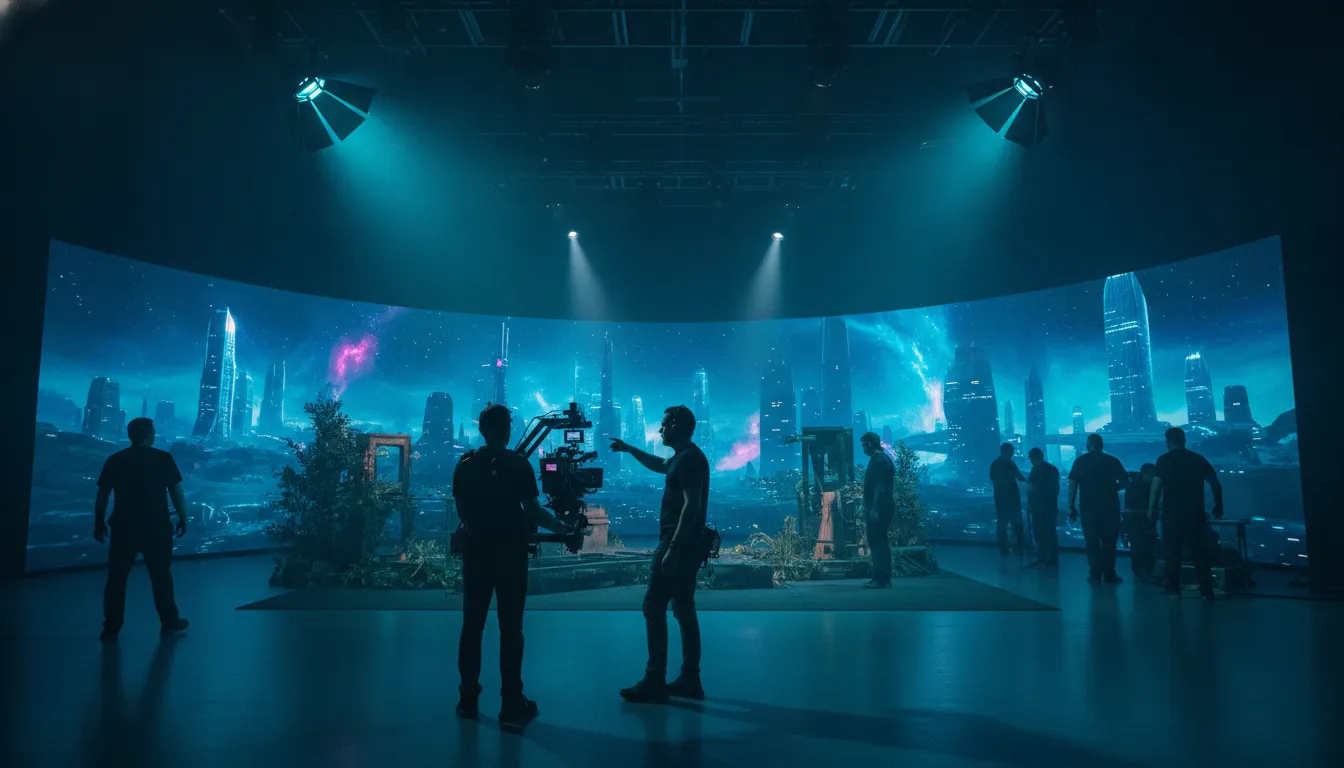
At the center of the studio is often an LED volume: a stage surrounded by large LED walls that display a photorealistic digital environment. That environment is created and rendered through a real-time 3D game engine. According to NYU Tisch, virtual production combines physical and virtual filmmaking techniques, using game engines to create photorealistic sets for display on large LED walls.
In practical terms, the camera, the physical set, and the digital world are designed to operate as one live system. Camera tracking tells the virtual environment where the lens is looking, so the background can respond with the correct perspective as the camera moves. The result is not simply a video wall placed behind performers. It is a responsive visual environment that gives directors, cinematographers, actors, and producers a shared view of the scene they are creating.
This changes the decision-making process. A director can evaluate a composition on set rather than imagining how a green-screen replacement might look later. A cinematographer can assess the interaction between the subject and the environment while the scene is still in front of the team. Producers can make informed creative choices earlier, when changes are generally easier to plan and execute.
That makes a virtual production studio different from a traditional soundstage or a post-production house. It is not only a physical location, and it is not only a technical service. The strongest studios bring together stage operations, virtual art direction, real-time rendering, camera tracking, cinematography, and production planning. For an executive or producer, the value lies in having these capabilities coordinated around the story, the schedule, and the wider needs of the intellectual property.
Explore our virtual production services
How Does a Virtual Production Studio Work?
A virtual production studio brings creative planning, digital environment building, cinematography, and real-time technology into one connected process. The goal is not simply to replace a physical set with a screen. It is to give the director and crew a live view of how the finished scene is taking shape. So important creative decisions can happen while the team is still on set.
- Build the scene before the shoot. The process begins with pre-visualization and environment creation. Artists and filmmakers define the location, scale, composition, lighting direction, and camera language in a digital space. This gives the production a practical plan before the cameras roll. It also moves creative iteration earlier in the schedule. As NYU Tisch explains, the traditional idea of "fix it in post" is increasingly becoming "fix it in pre." That shift changes how teams approach virtual production, because questions about framing, mood, and world design can be addressed before they become expensive post-production problems.
- Prepare the LED volume. The approved digital environment is displayed inside an LED volume, a large curved screen wall that surrounds the stage. Instead of filming against a flat green or blue backdrop, performers and cameras can work against a visible world. The volume provides background imagery and can contribute interactive light to the physical set, while production designers add practical foreground elements where needed.
- Sync the camera with the rendered world. Camera tracking tells the system where the camera is, how it is moving, and how its lens is behaving. The rendered environment then adjusts in real time as the camera moves, preserving the correct perspective. This is what makes a nearby digital object appear to respond naturally to a change in angle or focal length. Cameras synced with game engines can create greater depth of perspective and realism, according to NYU Tisch.
- Render the environment in real time. A game engine drives the digital world as the scene is captured. The engine responds to camera movement, updates the perspective on the LED wall, and supports live control over elements such as lighting and atmosphere. The team is therefore working with a responsive environment rather than a pre-rendered background that can only be evaluated after the shoot.
- Iterate while the crew is still on set. The director can review the scene through the camera and make informed changes immediately. The team might adjust the environment, timing, lighting, camera position, or performance, then see the effect without waiting weeks for a visual-effects pass. For a deeper look at the connected stages, explore this deep dive into the virtual production pipeline. The studio's value lies in this shared visibility: creative and technical departments can solve problems together while the work is still in motion.
Virtual Production Studio vs. Traditional Soundstage
For an executive comparing production models, the distinction is less about choosing a newer piece of equipment and more about deciding where creative decisions happen. A traditional soundstage provides a controlled physical shell. A virtual production studio adds a real-time digital environment that can be revised while the camera is still rolling.
A recessive soundstage is an empty stage where practical sets are built, dressed, lit, and removed for each shoot. That approach remains effective when the setting is best expressed through physical materials, extensive interaction, or a contained environment. A virtual production studio can replace much of that set construction with a real-time digital world displayed on an LED volume. The environment can change in minutes, without a company move or a new physical build.
| Dimension | Traditional soundstage | Virtual production studio |
|---|---|---|
| Set construction | Physical sets are designed, built, dressed, modified, and stored or struck for each production. | Real-world elements can be combined with a real-time 3D environment on an LED volume, reducing the need for complete physical location builds. NYU Tisch describes this combination of physical and virtual filmmaking. |
| Location flexibility | Changing the setting may require a new build, company move, location permit, or additional travel. | Multiple locations can be prepared digitally and selected on the same stage, limiting travel exposure and location-related risk. |
| On-set revision | Changes to architecture, scenery, or time of day can require practical work before the next take. | The environment is immediately revisable. Creative teams can evaluate alternatives in context and make decisions before the schedule moves on. |
| Lighting and sun control | Lighting is shaped with fixtures, practicals, rigging, and physical set conditions. | The digital environment contributes interactive light and reflections. Game engines can let cinematographers control lighting and test lenses before filming. |
| Reshoots | Rebuilding or returning to a location can add cost, availability constraints, and continuity risk. | Digital environments can be recalled and adjusted, making continuity easier to manage when the stage, assets, and production plan are maintained carefully. |
| Post-production fixes | More visual decisions may be deferred to compositing, visual effects, or editorial. | Iteration moves earlier in the process. The familiar "fix it in post" mindset becomes "fix it in pre," as teams resolve more choices before capture. NYU Tisch identifies this shift in virtual production practice. |
The practical advantage is not that every project should abandon physical sets. It is that a virtual production studio gives decision-makers another production architecture: one that can reduce location dependency. Preserve creative flexibility, and expose problems while they are still relatively inexpensive to solve.
Virtual Production Studio vs. Traditional Post-House
A traditional post-house and a virtual production studio may work with many of the same disciplines, including visual effects, compositing, color, and digital environments. The difference is when those capabilities shape the production. A post-house primarily works after principal photography. A virtual production studio brings critical parts of that visual decision-making onto the stage while photography is still underway.
The post-house model: solve the image after the shoot
In a conventional workflow, the director and director of photography capture performances against a physical set, a partial set, or a green screen. VFX artists, compositors, and colorists then build the intended world around the footage. This approach remains valuable for complex shots and highly controlled finishing, but it can leave important creative questions unanswered during production. The scale of an environment, the interaction between light and subject. And the final relationship between foreground and background may be difficult to judge from reference images or an uncomposited monitor.
That uncertainty can create a familiar pattern: make the best decision possible on set, then fix it in post. If the result does not support the story, the team may need additional visual effects work, alterations to the edit, or even a reshoot. Each revision can affect schedules, budgets, and the availability of cast, crew, and locations.
The virtual production model: make more decisions during photography
A virtual production studio renders the environment live through a real-time game engine and displays it on an LED volume or comparable in-camera system. Camera tracking allows the digital world to respond to the physical camera's position, creating a composite that directors and DPs can evaluate as they shoot. The team can adjust the environment, lighting, framing, and performance context while the creative decision is still immediate and visible.
This changes the timing of iteration from fix it in post to fix it in pre, or at least fix it during principal photography. It does not eliminate post-production. Cleanup, compositing, color, and visual effects remain part of many projects. It does, however, move more of the expensive creative uncertainty to a point when it is easier to resolve.
For executives, the distinction is operational as much as technical. A post-house is typically a finishing partner brought in to complete or enhance captured material. A virtual production studio is a production partner involved earlier, helping align creative, technical, and schedule decisions before they become costly downstream changes. The right model depends on the project, but productions that need visible creative iteration and tighter coordination across film. Game, and digital-world development may benefit from that earlier collaboration.
What a Virtual Production Studio Produces
For an executive or producer, the value of a virtual production studio is not the LED wall alone. It is the complete set of creative, technical, and production outputs that move a project from concept to finished media. You should leave with usable footage, tested visual decisions, and digital assets that can support the next phase of the IP.
Production-ready footage and digital worlds
The most visible output is final in-camera footage, including the live-action plates captured against a real-time environment. Instead of treating the digital set as a temporary background, the studio builds a responsive world that can be adjusted while the crew is shooting. Those real-time 3D environments may include landscapes, architecture, vehicles, interiors, skies, and lighting conditions designed for a specific story.
A virtual art department develops the assets behind that world. Its work can include digital set design, environment modeling, asset preparation, look development, and the files needed to operate the environment reliably on the stage. These assets can also become a foundation for trailers, games, interactive experiences, or future episodes, giving the IP more continuity across media.
Game engines make that iteration practical. They allow cinematographers to control lighting and test lenses in a virtual environment before filming begins, as documented by the National Film and Television School. The result is a more informed set of creative choices before the camera rolls, rather than a sequence of visual decisions deferred entirely to post-production.
The people behind the output
The studio's operating model brings together specialists who connect creative intent with stage execution. The Virtual Art Department, or VAD, prepares and maintains the digital world. In-camera visual effects, or ICVFX, operators manage the real-time imagery displayed around the performers. LED and screen technicians keep the physical display system calibrated and production-ready.
Camera-tracking specialists ensure the environment responds convincingly to the camera's position and movement. Motion-capture teams may record performances or movement data for digital characters and doubles. Techvis artists translate shots into practical plans, testing camera paths, lens choices, blocking, and stage requirements before the shoot.
The tangible handoff can therefore include previz and techvis, digital doubles or characters, final plates, and reusable real-time assets. To learn how the virtual production workflow fits together, look beyond the stage setup and consider how each output supports the wider production and the IP's next expression.
Cost, Timeline, and Whether a Virtual Production Studio Fits
How much does a virtual production studio cost? There is no responsible single figure. The investment depends on the LED volume, stage time, environment complexity, camera and tracking requirements, crew, and the amount of work handled by the virtual art department. It is a premium production capability, not a low-cost substitute for every soundstage or post house.
The better financial question is what the production needs to achieve. Real-time environments can reduce location moves, physical set construction, and some reshoot or post-production costs. They also allow the creative team to see and refine the scene while the cast and crew are still on set. That can shift expensive decisions earlier, when changes are generally easier to make. The familiar principle is simple: fix it in pre, rather than discovering fundamental problems after principal photography.
Timeline gains come from earlier creative decisions
A virtual production studio can compress the path from concept to usable footage because previs. Environment design, lighting, lens choices, and blocking can be reviewed together before and during the shoot. Instead of waiting weeks to see whether a digital environment supports the intended performance. Directors, cinematographers, and producers can evaluate the result in context and iterate in real time.
That advantage is most valuable when the production involves complex worlds, repeatable locations, demanding continuity, or an IP that must extend across film, television, and games. It does not mean every project becomes faster by default. Strong preparation is essential, and late changes to an environment or technical setup can still affect schedule and budget.
The trade-offs producers should weigh
- Stage availability: LED volumes are specialized facilities. Availability, travel, load-in requirements, and stage time can shape the schedule.
- Up-front environment work: Digital sets, assets, lighting, and technical tests must be developed before the shoot. This moves effort earlier rather than eliminating it.
- Technical coordination: Tracking, real-time rendering, color, lighting, and performance must work together reliably on the day.
- Creative fit: A practical location may provide the best texture and scale for a grounded story, while traditional post may be more economical for a small number of visual-effects shots.
The right choice is therefore strategic. A virtual production studio fits when real-time iteration, controlled environments, and reusable digital assets create value beyond a single shoot. For executives, the decision should compare the full production lifecycle, including revisions, reshoots, post work, and future uses of the assets, rather than comparing stage rates alone.
Narwhal Studios: A Proven Virtual Production Studio
For an executive evaluating what is a virtual production studio, the most useful distinction is between a technology demonstration and an operating partner with production experience. Virtual production depends on more than an LED volume or a real-time engine. It requires filmmakers, technical artists, production designers, and engineering specialists to coordinate creative and technical decisions from development through delivery.
Arctic7's Narwhal Studios provides that kind of concrete reference point. Its positioning is grounded in Disney and Marvel production heritage, giving prospective partners a meaningful proof point without reducing the studio to a list of equipment. The relevance of that heritage is practical: teams accustomed to high-stakes entertainment production understand the demands of visual continuity, collaborative decision-making, schedule discipline, and creative ambition.
Experience that connects the stage to the wider production
A first-time executive should ask whether a virtual production partner can translate a creative brief into a workable production system. That includes planning the environment, preparing real-time content, coordinating the LED volume, supporting camera and lighting decisions, and helping the director make informed choices on the day. Narwhal Studios is positioned around this complete relationship with production, rather than treating the volume as a standalone rental.
This matters when the project is part of a larger intellectual property strategy. The same world may need to extend across a feature, series, game, trailer, or interactive experience. A studio that understands both cinematic storytelling and game development can help teams make those worlds more coherent, reusable, and adaptable. It also gives creative leaders a shared language across departments that have traditionally worked in sequence or in isolation.
Through Narwhal Studios, Arctic7 brings virtual production into its broader role as a transmedia partner for IP holders, publishers, and entertainment brands. If you are assessing how a real-time stage could support a specific production or a longer-term content ecosystem, explore Arctic7 virtual production services to understand how the capability can fit your creative and operational goals.
See how a virtual production studio supports your IP
Frequently Asked Questions
How much does a virtual production studio cost?
There is no universal price. Cost depends on the project brief, stage and LED requirements, virtual environment development, crew, shooting schedule, and finishing needs. Request a scoped estimate after the creative and technical requirements are defined.
What are the disadvantages of virtual production?
The approach shifts more creative and technical planning into pre-production. That can be an advantage, but it requires the environment, camera approach, and lighting decisions to be prepared before the shoot. The guiding principle is often to move from "fix it in post" toward "fix it in pre," as NYU Tisch explains: https://tisch.nyu.edu/virtual-production/faq.
How does a virtual studio work?
A virtual production studio combines physical filmmaking with real-time 3D environments displayed on large LED walls. Cameras are synchronized with the game engine so perspective and lighting respond realistically as the camera moves. This lets the production team evaluate creative choices while filming, rather than waiting for every decision to be resolved in post-production. NYU Tisch outlines the core process here.
What is the difference between a virtual production studio and a soundstage?
A traditional soundstage provides a physical space where the production builds or dresses sets and controls the shooting environment. A virtual production studio adds a real-time digital environment to that physical space, using LED walls, game-engine rendering, and camera tracking. The result is not simply a stage rental. It is an integrated production capability that brings environment development and on-set iteration into the filmmaking process.
Ready to Explore Virtual Production for Your IP?
A clear production conversation can help you determine where real-time environments, creative planning, and on-set collaboration fit your next project. Arctic7 can discuss your goals and outline a practical path from concept to execution.
New Immersive & XR Media Capabilities Added to Arctic7's Suite of Games, Film & TV and Digital Services

Arctic7 Shares Details of its Work on Skeleton Crew and Cinematics Partnership with Fateless

The Human Touch: Adding Personality to Project and Product Management
Whether it’s your team, your client, or your stakeholders, understanding the human dynamics is just as critical as hitting milestones.

McDonald's Case Study: Bridging Brand and Play | Arctic7
Bridging Brand and Play: An Interview with Lindsay Blenkhorn Daggitt