


Visual Development for Film: From Concept Art to Production Readiness
Visual development for film is often described as the work of imagining a world before it is built. For an IP holder, it has a second job: turn creative possibility into a set of decisions that directors, production designers, cinematographers, VFX teams, and future partners can use. That means moving from exploration to a production-ready visual language without narrowing the property’s potential too early.
Explore a production partnership for your IP
By Andrew MacLusky, CPO
A disciplined pipeline does not prescribe every image in advance. It establishes what must remain consistent, what can change, and what evidence is needed before a team commits to expensive production choices. The framework below treats visual development as a sequence of useful approvals, not a pile of attractive concept art.
What should visual development for film make production-ready?
Visual development is production-ready when a project can make repeatable creative and practical decisions from its visual work. A concept image alone is not enough. The team needs a shared point of view, clear rules for the world, a record of approved choices, and usable handoffs that help departments understand what to build, photograph, or extend.
That outcome has four parts:
- A visual thesis. A concise explanation of the world’s visual identity and the audience experience it should create.
- Rules, not just references. Guidance on shape, scale, material, color, light, and technology, including where exceptions are allowed.
- Production implications. Enough information to evaluate locations, sets, props, costumes, effects, and digital environments as connected choices.
- A traceable decision record. A way to distinguish approved direction from exploratory work, so teams do not build from an outdated image.
Visual development has overlap with production design, but the terms are not interchangeable. Production design carries the visual world into the practical design of a production. Visual development can help establish the world earlier, test alternatives, and communicate how design choices relate to the story. The Academy of Art University describes visual development as designing characters, environments, and concepts for film, games, and new media, while its archive describes developing animated and live-action films from idea to completion. Those descriptions illustrate the breadth of the discipline; the specific division of responsibilities depends on each production.
The Academy of Art University’s visual development program overview and its visual development archive offer useful context on the range of media and development work involved.
How does visual development for film move from exploration to approval?
Use gates that answer a different question at each stage. Early reviews should protect discovery; later reviews should reduce uncertainty. If every review asks whether the art is beautiful, the process can reward polish before the story, scope, and production method are clear. Instead, agree on the decision each gate must unlock and who has authority to make it.
Gate 1: Define the brief and the boundaries
Start with the story and the rights position, not a mood board. Identify what the audience must understand, what emotional response the film should create, and which elements belong to the core IP. Record known constraints such as format, intended audience, schedule assumptions, and rights or partner approvals that could affect the design. Mark uncertainties honestly rather than disguising them as settled facts.
A useful brief distinguishes three categories:
- Must preserve: defining characters, places, symbols, relationships, or rules that make the IP recognizable.
- May reinterpret: elements open to a new visual treatment, provided the core promise remains intact.
- Must resolve: open questions whose answers would materially change the design, budget, workflow, or audience comprehension.
This is also the time to establish decision ownership. A creative lead may own the look, while an IP holder or rights stakeholder must approve protected elements. Production leadership needs a voice when a creative direction has material schedule or execution consequences. If those roles are unclear, teams can mistake feedback for approval and repeat work later.
Gate 2: Explore a small number of meaningful directions
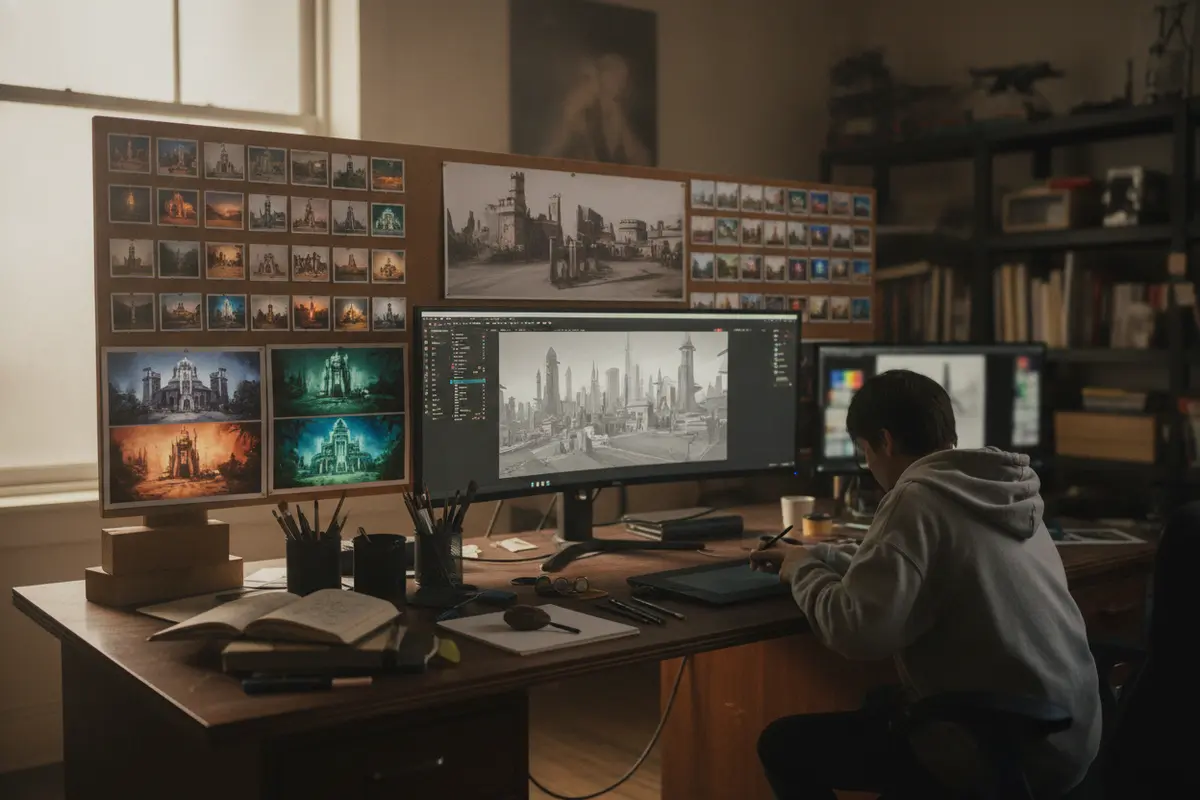
Do not commission a broad set of images that all make the same argument. Build a few contrasting directions around a question the project actually needs to answer. For example: should an unfamiliar world feel intimate or monumental? Should a technology feel handmade, institutional, or almost invisible? Each direction should express a coherent set of choices rather than changing one color at a time.
Keep exploration inexpensive and legible. Use sketches, rough environment layouts, reference comparisons, silhouette tests, and color studies before asking for detailed finish. Each board should state the hypothesis it is testing, the story beat it serves, and what would count as a reason to keep or reject it. That makes review more productive than a vote on personal taste.
Gate 3: Select a direction against agreed criteria
Compare alternatives using criteria established in the brief. A decision matrix can keep the discussion grounded. It is not a substitute for creative judgment; it makes the trade-offs visible and records why a direction won. If a direction scores highly on atmosphere but creates a difficult production problem, the team can decide whether to adapt it, test it, or accept the implication consciously.
| Review criterion | Question for the team | Evidence to request |
|---|---|---|
| Story clarity | Does the design support the intended story beat? | Key-frame or sequence test tied to a specific moment |
| IP coherence | Does it preserve the property’s core promise? | Comparison with approved canon and protected elements |
| Production feasibility | Can the idea be delivered within the project’s chosen approach? | Set, location, effects, asset, and workflow implications |
| Distinctiveness | Can viewers recognize the world without relying on exposition? | Shape, palette, material, and silhouette tests |
| Expansion potential | Can the visual rules serve more than one story or format? | Examples of how the rules adapt while remaining coherent |
| Approval readiness | Can the responsible stakeholders make a clear decision now? | Open issues, named approvers, and a recorded recommendation |
The matrix should not turn creative work into a false numerical science. Use simple ratings such as strong, mixed, or unresolved, then explain the evidence. A disagreement about a “mixed” result often points to a missing test. For instance, if production feasibility is uncertain, commission a representative asset or technical review rather than arguing from assumption.
Build tests around the decision’s real context. A design that reads well as a full-screen illustration may lose its identity in a wide shot, in low light, or beside a performer. A location concept may feel compelling in a single frame but fail to explain how characters move through it. A technology design may look distinctive but be difficult to recognize at the scale or duration in which the audience encounters it. Tests should expose those differences while changes are still relatively inexpensive.
A compact test package can include a wide view, a close detail, a sequence or storyboard frame, and one note about the production question each image addresses. Invite relevant department leads to review the package together. The production designer may focus on material and space, the director on the story beat, and the VFX or camera lead on what the image implies for execution. Ask each person to identify the evidence behind a concern and a practical next test. This keeps a review from dissolving into disconnected preferences.
Record the decision in plain language immediately afterward: the chosen direction, the reasons for choosing it, what was not selected and why, which details remain open, and who owns the next action. Link the record to the approved source files. This small practice reduces the chance that a later stakeholder sees an old board without context and reopens a decision the team believed was settled.
Which visual-development decisions affect production readiness most?
Three decisions tend to have wide consequences: how the world is organized, how it will be made, and how much the design must accommodate change. Resolve them before polishing large volumes of assets. The goal is not to eliminate uncertainty; it is to expose the uncertainties that can affect schedule, cost, performance, or continuity while changes are still manageable.
World rules and continuity
Define the visual logic behind recurring places, objects, creatures, and technologies. A rule might describe how a society signals status through materials, how a landscape changes under a particular condition, or what distinguishes everyday technology from a rare invention. Record the principle and show examples at different scales. This gives artists room to create within a recognizable system.
Separate continuity-critical elements from details that can vary. A film may need exact continuity for a hero object, while background architecture can allow controlled variation. A design guide should show those differences explicitly. Without that distinction, teams often over-control incidental details and under-specify the elements that carry story meaning.
Design choices and the production method
Every visual ambition implies a way of making it. A location-based design, a stage-based environment, and a fully digital world create different questions for production. The visual development team should work with production, art, VFX, camera, and technical stakeholders early enough to reveal those implications. This does not mean letting feasibility dictate the creative outcome. It means making a creative choice with a clear understanding of the method it requires.
When real-time environments, interactive planning, or on-set visualization are relevant, explore how the virtual production capability could inform the conversation. A virtual-production test may help a team evaluate scale, camera framing, color, or the relationship between performers and a digital environment. It should answer a defined question; it is not automatically the right solution for every film.

Handoff quality
A production handoff should explain what the image is for. Pair key art with annotations, scale references, views from relevant angles, material or lighting notes, and links to the decisions it represents. Identify whether the image is an approved target, a look-development test, a pitch image, or an exploratory option. Those labels prevent a polished presentation frame from being mistaken for a complete build specification.
For important assets, include:
- Asset name and version, with an owner and current status.
- Story or sequence context and the design problem it solves.
- Approved visual rules, references, and known exceptions.
- Relevant dimensions, camera or staging assumptions, and dependencies.
- Open questions, required reviewers, and the next decision date.
- Any production method being considered, with unresolved technical risks.
A handoff is ready when the receiving department can identify what it can act on and what still needs a decision. A drawing does not become production-ready just because it is detailed. Conversely, an intentionally rough layout can be highly useful if it resolves blocking, scale, or camera questions at the right time.
How can one film’s visual development support expandable IP?
Design for expansion by separating durable identity from format-specific expression. The visual development process should establish a stable core, such as a world’s design logic, recurring forms, or visual themes, while showing how those rules can flex for different stories and media. That approach preserves recognition without requiring every extension to repeat the same image or tone.
Think of the visual system in three layers:
- Core identity: the elements that make the IP feel like itself. These may include signature silhouettes, a consistent relationship between character and environment, or a distinctive use of light and material.
- Story-specific design: choices that serve this film’s characters, locations, and dramatic arc. These can evolve in another installment when the story justifies it.
- Format adaptation: choices that respond to a new audience interaction, camera language, production scale, or platform while retaining recognizable principles.
Do not assume a film design transfers directly into a game, series, or immersive experience. Each format asks for different kinds of clarity and interaction. Instead, document the underlying rule and invite the next team to solve for its own needs. This is one reason an IP holder may involve game development expertise during strategic planning, even when the immediate deliverable is a film: the purpose is to surface future design requirements, not force the film into a game pipeline.
Arctic7’s work across entertainment formats provides a relevant example of why those handoffs matter. The company describes a seven-year partnership with Disney Lucasfilm and work across six Star Wars projects through its virtual-production entity, Narwhal Studios. Those credentials do not establish that a particular visual-development method was used on any one project. They do show the kind of long-running, multi-project context in which continuity, repeatable decisions, and production communication matter. Learn more about Arctic7’s studio network and its project work.
For teams evaluating expansion, make the relationship between formats explicit. A visual bible can include a protected core, adaptation principles, and examples of questions future teams should answer before reusing a design. It should not attempt to pre-design every sequel, game, or series. The aim is to create a common foundation that supports new creative work without fragmenting the property.
How should IP holders govern visual development without slowing it down?
Set a clear approval path and match the level of review to the decision’s impact. Not every color study needs executive attention. Protected IP, major world rules, and decisions that affect production commitments may require formal approval; exploratory work can remain with the creative team. A tiered system protects the property while leaving artists and production leads room to solve problems.
At kickoff, agree on:
- Decision rights: who recommends, who approves, and who must be consulted for each type of choice.
- Review cadence: when stakeholders see work, how much context they receive, and how quickly they are expected to respond.
- Feedback format: one consolidated response where possible, with comments tied to the brief or a stated concern.
- Change control: how a decision can be reopened and what new evidence justifies doing so.
- Version ownership: where approved files live and who can mark a direction as current.
Ask reviewers to distinguish a preference from a risk. “I prefer the earlier palette” is useful feedback, but it is not the same as “the new palette makes the character difficult to read in this sequence.” Both can prompt discussion; the second identifies a testable issue. When feedback conflicts, the accountable decision-maker should state the trade-off and record the rationale rather than sending the team into an indefinite revision loop.
Arctic7 frames its approach to IP expansion around workshops and narrative audits, followed by a unified strategy and a production blueprint. For a visual-development effort, that sequence can help connect creative discovery to concrete deliverables: begin with what the property can support, agree a strategy across stakeholders, then define the format-specific work and approvals. See the broader transmedia perspective and film and television work.
What should a practical visual-development plan include?
A useful plan tells the team what it will decide, what it will make to support those decisions, and what production readiness means for this project. It also makes room for iteration without treating every round as a restart. Adapt the following sequence to the project’s scale and format; the timing and deliverables should follow the questions, not a generic checklist.
It helps to define readiness in levels rather than one final yes-or-no label. A direction can be creative-approved while its production method is still being tested. A design can be department-ready for further breakdown but not yet cleared for fabrication or final asset creation. A location or environment can be sequence-ready when framing and story function are understood, while background details remain open. State these limits in the review record so downstream teams know where they have latitude.
Readiness should also include a path for change. Scripts shift, schedules move, and new information can make a once-sound choice impractical. Decide which changes require a formal re-approval and which can be handled within the approved rules. If a core identity element changes, communicate the effect across connected designs. If a minor detail changes without affecting continuity or execution, record it without restarting the entire approval chain.
- Align on the brief. Confirm story purpose, core IP elements, audience experience, known constraints, and decision owners.
- Build the reference foundation. Gather relevant visual, historical, environmental, and production references, with notes on what each reference can and cannot inform.
- Explore distinct directions. Create economical alternatives tied to open creative questions. Keep status and rationale visible.
- Test the leading direction. Use a representative scene, environment, character, or asset to evaluate story clarity, continuity, feasibility, and format implications.
- Record the design system. Capture approved principles and show how they apply across key assets and scales.
- Prepare handoffs. Package the right views, context, dependencies, versions, and unresolved questions for receiving departments.
- Review readiness and adaptation. Confirm what production can act on now, what remains conditional, and which rules should guide future formats.
Teams can adapt this sequence with partners who understand creative development as well as production execution. Arctic7 brings together capabilities in strategy, creative execution, and technical production; the appropriate scope depends on the IP, format, and decisions the team needs to make.
Discuss the production needs behind your visual direction
Frequently asked questions
When should visual development begin for a film?
Begin once the project has a meaningful story or IP brief and before major visual commitments are locked. Early work can test directions and expose production implications. It should develop alongside script and production planning, with the level of detail increasing as decisions become more specific.
Is visual development the same as concept art?
No. Concept art is one possible output. Visual development is a broader process that can include research, visual exploration, design systems, narrative tests, approvals, and handoffs. Its value lies in helping a production make coherent decisions, not simply in producing finished images.
How much detail does a production-ready design need?
Enough to support the next department’s task and the decision being made. A camera or scale question may need a rough layout; an asset entering production may need views, materials, dimensions, and dependencies. Define readiness by the receiving team’s ability to act, not by image polish alone.
How can an IP holder protect continuity while allowing new ideas?
Identify protected elements, document the visual principles behind them, and distinguish those from details that can change. Give future teams the reasoning and examples, not only a set of fixed images. Then review adaptations against the core promise of the property and the needs of the new format.
What is the most useful first review question?
Ask what decision the work is meant to unlock. If stakeholders cannot answer that, clarify the brief before commissioning more finish. A focused question makes creative review, production analysis, and approval more actionable.
Visual development succeeds when its images lead to shared understanding and confident next steps. For IP holders, that means building a world that serves the film in front of you and gives future teams a coherent foundation to extend.
New Immersive & XR Media Capabilities Added to Arctic7's Suite of Games, Film & TV and Digital Services

Arctic7 Shares Details of its Work on Skeleton Crew and Cinematics Partnership with Fateless

The Human Touch: Adding Personality to Project and Product Management
Whether it’s your team, your client, or your stakeholders, understanding the human dynamics is just as critical as hitting milestones.

McDonald's Case Study: Bridging Brand and Play | Arctic7
Bridging Brand and Play: An Interview with Lindsay Blenkhorn Daggitt


