




Transmedia Franchise Strategy: A Practical Framework
A franchise rarely loses momentum because its team lacks ideas. More often, expansion begins before the world, audience promise, and production model are ready to support it. The result is a collection of disconnected releases rather than a growing entertainment ecosystem.
Explore Arctic7's integrated transmedia services
A strong transmedia franchise strategy sequences platforms, stories, and investment around a shared creative spine. Each format should contribute something distinctive, while readiness reviews, clear guardrails, and defined decision rights protect canon, tone, and audience trust as the franchise expands.
That discipline does not make a franchise less imaginative. It gives creative teams the clarity to develop platform-native experiences without asking every new project to solve the same structural problems. The work begins with the IP, not with a list of platforms, and turns discovery into a practical blueprint for deliverables, workflows, and rollout timing.
What Makes a Transmedia Franchise Strategy Different?
A transmedia franchise strategy is more than a plan to adapt one successful story into several formats. It defines how an interconnected world grows over time, what each platform contributes, which decisions must happen first, and who protects continuity as the franchise expands. It is an operating blueprint for creative, production, and lifecycle choices.
It designs a world, not a sequence of adaptations
A general transmedia explainer describes the principle: a story can move across games, film, television, and digital experiences, with each format adding a distinct part. A franchise-level strategy turns that principle into choices. It identifies the elements of the IP worth expanding, separates core canon from opportunities for discovery, and gives every extension a reason to exist.
Audiences should not receive the same story copied into different containers. A game might let audiences inhabit a world through systems and choices, while a film or series can establish a central narrative spine and deepen character perspective. These experiences are connected, but they are not interchangeable deliverables.
It assigns platform jobs across the franchise lifecycle
Strategy determines when a format enters the plan and what job it performs. One platform may introduce the world, another may invite participation, and a later extension may reward established fans with deeper context. Those decisions affect narrative dependencies, production workflows, rights conversations, and rollout timing.
Governance keeps those choices coherent. Teams need shared guardrails for canon, tone, audience navigation, and changes to the underlying world. They also need decision rights when game, film, television, and publishing teams have different workflows and priorities. This is why sequencing belongs at the center of franchise planning.
When Should a Franchise Expand Beyond Its First Medium?
A franchise should expand when its core IP has a durable world, a clear audience opportunity, and the operating discipline to support another format without weakening the first. The decision is not simply whether a second medium is available. It is whether the next extension can add a meaningful part of the world and remain understandable to audiences.
Test whether the IP is ready to carry another story
Start with the source material, not the platform opportunity. Identify the characters, conflicts, locations, rules, themes, and unresolved questions that can support a distinct experience. Workshops, narrative audits, and strategic discovery can uncover what makes the world worth expanding, then translate those findings into creative guardrails that protect the IP's identity.
Canon and tone are practical tests, not editorial details. The University of Michigan study on transmedia design identifies staying in canon, maintaining a consistent tone, and deciding carefully when to begin as explicit considerations. If the first medium has not established what is fixed, what can evolve, and what remains open, expansion is likely to create contradictions rather than depth.
Match the audience need to the format
The next medium should do work the original cannot do as well. A game may invite agency and repeat engagement. Film or television may sharpen character arcs and performance. Digital or immersive experiences may let audiences explore a world from a different position. Each extension should contribute something unique while giving audiences enough narrative cues to understand how it relates to the others.
Use audience and format fit as a stop or go question: Is there a specific experience people want, and is this medium genuinely suited to deliver it? If the proposed extension only repeats the first story, adds no new point of entry, or depends on audiences knowing too much, pause and redesign its role before approving production.
Confirm the operating model and stop or go signals
Expansion requires shared decision rights, realistic dependencies, and teams able to collaborate across different media cultures. Before committing, define who protects canon, who approves changes, which deliverables are needed, and how the rollout will be reviewed.
Go when the IP has a documented creative spine, the audience case is specific, the format has a distinct job, and the teams can execute against agreed guardrails. Stop when those conditions are unresolved, when the extension is justified only by trend pressure, or when the new production would overload the existing workflow.
How Do You Sequence Platforms, Stories, and Investments?
Sequence platforms, stories, and investments by readiness and dependency, not by whichever platform has the loudest demand. Start with the IP and its audience promise, define the shared framework, test one meaningful extension, activate formats whose production conditions are ready, and review evidence before committing to the next stage.
Start with dependencies, not release dates
A platform decision is also a decision about story, rights, production capability, audience access, and governance. The sequence should make ownership visible: who approves canon, who owns platform requirements, which assets must be created first, and what must be true before the next team begins.
- Assess. Identify what makes the IP expandable, which characters, conflicts, settings, or systems can support further stories, and where audience interest is strongest. Review canon, tone, rights, partner capability, and operational constraints.
- Define. Establish the central narrative spine, platform roles, creative guardrails, decision rights, deliverables, workflows, and rollout logic. Each extension should add a unique part rather than repeat the same story.
- Pilot. Test one contained extension or audience journey that exercises the most important assumptions. The pilot might be a script, prototype, lookbook, short-form experience, or platform-specific narrative sample.
- Activate. Move into coordinated production only when dependencies are explicit and the relevant teams share the same guardrails. Sequence launches around audience entry points and production realities, not an arbitrary requirement to appear everywhere at once.
- Review. Examine creative quality, audience behavior, operational health, and cross-platform movement before expanding the plan. Use stage reviews, audience signals, delivery evidence, and partner feedback to decide whether to refine, continue, pause, or retire the next extension.
Measure the handoffs as carefully as the outputs
Review should include more than reach or revenue. Ask whether audiences understand how extensions relate, whether each format delivers a worthwhile experience, and whether production teams have the information and authority needed to move forward. A balanced review keeps the sequence accountable without flattening creative judgment.
Which Job Should Each Platform Perform?
A platform earns its place in a transmedia franchise strategy when it contributes an experience that another format cannot deliver as well. The objective is not to retell the same plot in different media. It is to let each format deepen the world, reveal a different perspective, or invite a different kind of participation.
Match the format to the audience action
Start by naming the audience action you want each platform to support. Film and television can establish character, tone, and emotional stakes at scale. Games can give audiences agency, systems, and repeatable interaction. Books and comics can explore interiority, history, or side stories with a different production rhythm. Digital and physical experiences can create discovery, community, or presence.
The WPI transmedia storytelling guide uses worlds such as Harry Potter, Dragon Age, and Pokemon to illustrate how distinct formats can extend a larger ecosystem. The lesson is not to copy those franchises. It is to identify the audience action and world contribution that justify each addition.
Example platform jobs in a connected franchise| Platform | Job | Audience action | Test |
|---|---|---|---|
| Film or television | Set the dramatic spine | Watch and empathize | Does it create a clear entry point? |
| Game | Turn rules into agency | Play, choose, return | Is interaction better than retelling? |
| Book or comic | Deepen history or perspective | Explore at a personal pace | Does it reveal useful context? |
| Digital or physical | Make the world social | Participate and connect | Can audiences track its canon role? |
Design for complementarity, not dependency
Distinct jobs do not mean disconnected products. Narrative cues can guide audiences between platforms, but every entry point should provide a satisfying experience on its own. Adaptation should translate the source's underlying promise into the strengths of its new format, not reproduce its surface mechanics.
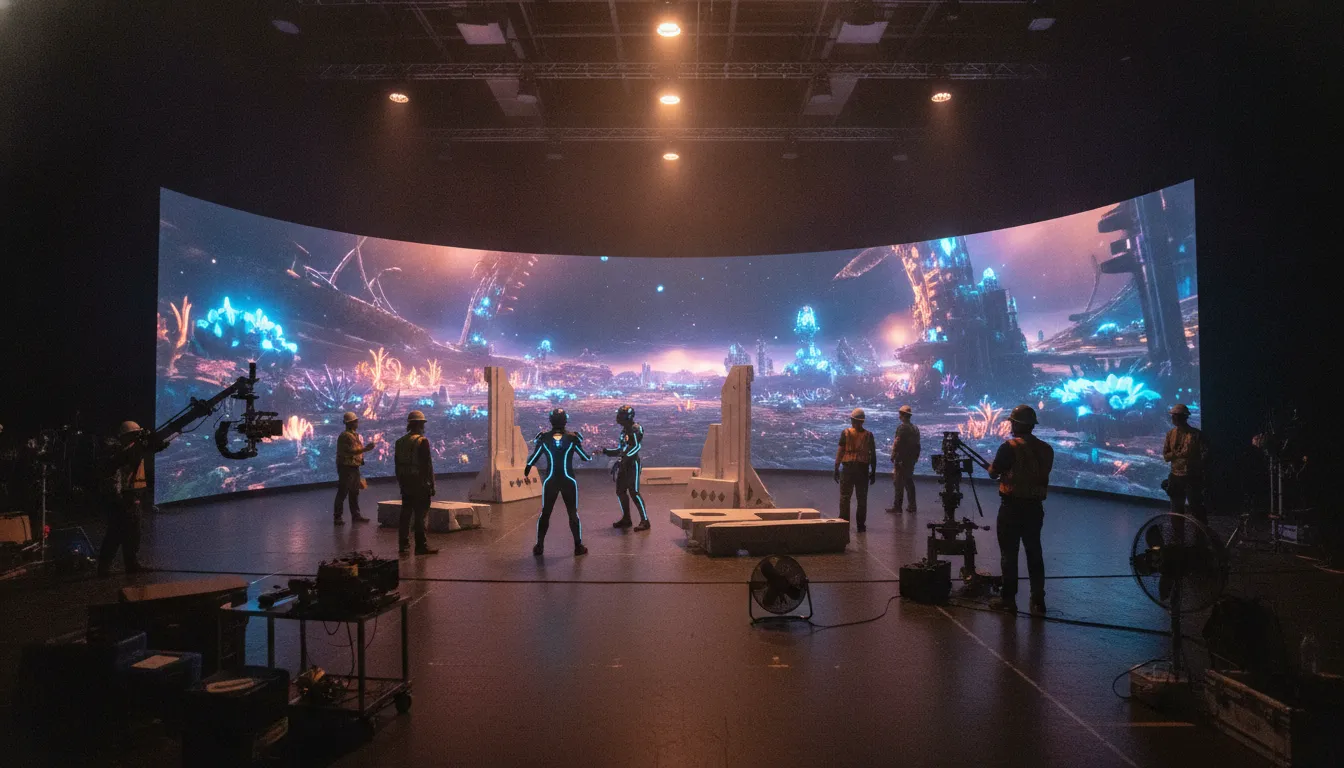
For practical planning, map each platform's audience, promise, canon contribution, production dependency, and success signal in one shared view. When the plan includes an interactive pillar, align narrative development and system design early through Arctic7's game development capabilities. For cinematic and virtual-world work, the virtual production team can support the technical and creative pipeline behind the experience.
What Governance Keeps a Multi-Format World Coherent?
Governance gives a transmedia franchise strategy enough structure to protect the world without freezing creative development. It defines what is canon, how tone carries across formats, who can approve a change, and how teams expose dependencies before they become expensive contradictions.
Protect canon while leaving room to create
Start with a living record of the franchise's non-negotiables: foundational history, character motivations, world rules, terminology, and unresolved questions. Distinguish fixed facts from flexible interpretation. If a new project changes a relationship, timeline, or world rule, the team should be able to see whether it creates a contradiction, opens a deliberate story question, or requires a broader update.
Make decision rights and dependencies visible
Multi-format collaborations bring together teams with different specializations, workflows, and working cultures. Assign clear owners for canon, format-specific execution, audience experience, legal or rights questions, and final escalation. Then map dependencies between scripts, game systems, character designs, production assets, release windows, and marketing claims.
Regular stage reviews should ask what has changed, which downstream deliverables are affected, and whether the intended audience journey still makes sense. Specialists also need a real opportunity to challenge a decision before it reaches production. That is governance as creative enablement, not bureaucracy.
Use living artifacts, not one-time approvals
Maintain a change log, decision register, dependency map, and versioned story documents alongside the production plan. These artifacts should connect narrative principles, platform plans, production assumptions, and business objectives in one evolving system.
How Should Leaders Measure Progress Without Flattening Creativity?
Leaders should measure whether each expansion is becoming more coherent, discoverable, and useful to its audience, not judge every creative decision by an immediate financial return. A balanced scorecard combines production readiness, audience behavior, cross-platform movement, and qualitative creative review.
Track signals before outcomes
Leading indicators reveal whether the strategy is working before revenue or large-scale reach can be assessed. Track whether teams are meeting dependencies, whether the narrative spine is understood across departments, and whether each platform is delivering a distinct contribution. Audience signals might include completion, repeat engagement, community discussion, movement between connected experiences, and the quality of feedback.
Use the evidence to make stage decisions. A pilot can proceed when its creative premise is clear, its production workflow is viable, and its audience response validates the next hypothesis. It may need refinement when interest exists but the platform role is unclear. A pause is responsible when canon, capability, or audience navigation problems remain unresolved.
Pair metrics with creative judgment
Quality checks belong beside dashboards. Review tone, canon continuity, character integrity, accessibility, platform fit, and whether the extension adds something audiences cannot get elsewhere. The University of Michigan study cited above notes that widely adopted methods for predicting cost and return on investment have not emerged for most transmedia projects. That finding is a reason to improve the decision framework, not abandon measurement.
For production teams, the review can also include technical readiness. A virtual production workflow may affect asset creation, continuity, and collaboration across film and game teams. Supporting references such as Arctic7's virtual production workflow guide, its virtual production pipeline guide, and the Narwhal Studios profile show how production capability can become part of a broader world-building plan.
Frequently Asked Questions
What is a transmedia franchise strategy?
It is a plan for expanding one intellectual property across multiple formats, such as games, film, television, and digital experiences, while giving each format a distinct contribution. The goal is to build a connected world rather than repeat the same story everywhere.
When should an IP expand into another format?
Expand when the IP has a durable creative spine, a specific audience opportunity, a distinct format role, and the governance and production capacity to support the extension. If those conditions are unresolved, a readiness phase or contained pilot should come before a larger commitment.
How do you keep a multi-format franchise coherent?
Document canon, tone, character rules, open questions, dependencies, and decision rights in a shared governance framework. Assign owners for continuity and approve major changes through defined stage reviews. This lets teams work independently without losing the central narrative spine.
How should transmedia franchise progress be measured?
Use measures that match the stage of the franchise, including readiness completion, audience movement between experiences, engagement quality, delivery health, and learning from pilots. Avoid presenting speculative return figures as certainty. Pair quantitative signals with creative and operational review.
What does each platform contribute to a franchise?
Each platform should have a clear job. A game may let audiences inhabit the world, while film establishes character or conflict. The important test is whether the experience is native to its format and gives audiences a reason to continue exploring.
New Immersive & XR Media Capabilities Added to Arctic7's Suite of Games, Film & TV and Digital Services

Arctic7 Shares Details of its Work on Skeleton Crew and Cinematics Partnership with Fateless

The Human Touch: Adding Personality to Project and Product Management
Whether it’s your team, your client, or your stakeholders, understanding the human dynamics is just as critical as hitting milestones.

McDonald's Case Study: Bridging Brand and Play | Arctic7
Bridging Brand and Play: An Interview with Lindsay Blenkhorn Daggitt


