Television Production Services for Expanding Story Worlds
Television is no longer only a destination for a finished story. For entertainment brands and production companies, a series can establish characters, places, and conflicts that later travel into games, film, or immersive experiences. The challenge is to build that world with enough creative consistency to support expansion, while keeping the production plan practical. Well-coordinated television production services connect development, design, production, and post so that decisions made for the screen can support a durable story world.
Discuss a production approach for your story world
Andrew MacLusky, CPO
What should television production services deliver for an expanding story world?
Television production services should turn a creative premise into a coherent, producible screen experience while protecting the choices that make its world distinctive. For an IP holder, that means connecting story development, design, production methods, and post-production to shared creative priorities—not simply completing a schedule of isolated tasks.
A useful way to assess a production partner is to ask what decisions it helps you make, when those decisions become difficult to change, and how the resulting work can remain consistent across formats. A series may need to work on its own terms first. Yet if the larger ambition includes games, film, or immersive experiences, the team should be alert to which elements of the world are foundational and which are specific to this season or episode.
That distinction matters. A recurring location might need a stable visual identity, while a one-off sequence can be designed around the episode’s immediate dramatic purpose. A character’s defining motivation may need to remain legible across every format, while the way that character is experienced can change with the medium. Production planning can make those distinctions visible before schedules and assets harden around them.
Arctic7 describes its work as connecting games, film, television, and immersive experiences through transmedia strategy and production. Its services overview describes the broader capabilities that can support a project, while the framework below is designed to help a production company or IP holder define what it needs from a television engagement.
Why should television production services begin with development?
Development sets the conditions for every production decision that follows. Before a team commits to locations, sets, a technology approach, or a visual language, it needs a shared understanding of the series’ dramatic engine and the rules of its world. That early clarity helps avoid designing an impressive environment that cannot serve the story—or a production plan that limits later creative choices.
Start by identifying the central promise of the series. What does the audience return to? Which relationships, conflicts, or mysteries can sustain episodes? What should feel consistent from one story to the next, and where is reinvention welcome? These are narrative questions, but they have practical consequences for locations, recurring sets, cast requirements, visual effects, and the amount of world-building the production must communicate.
An IP holder and production team can capture the answers in a concise development brief. It should include:
- Audience promise: the experience the series is meant to deliver, expressed in plain language.
- Story rules: the facts about characters, settings, history, and cause-and-effect that later stories must respect.
- Flexible territory: open questions, unexplored places, or character arcs that future storytelling may develop.
- Production implications: recurring environments, large-scale sequences, practical constraints, and elements that may require a repeatable pipeline.
- Decision ownership: who can approve creative changes and how cross-team questions will be resolved.
Do not treat a world guide as a substitute for dramatic development. The purpose is to help teams make decisions, not to document every imaginable fact. A compact, living reference is more useful than a large archive that nobody consults. It can identify confirmed story truths separately from concepts that remain provisional, reducing the risk that a draft idea is mistaken for established canon.
For a franchise, development may also include an IP or narrative audit: what is essential to the identity of the property, what can be adapted for television, and what should remain available for other formats? Arctic7’s transmedia strategy and storytelling work is positioned around preparing IP for expansion and shaping a connected vision. In practice, that kind of alignment should inform—not constrain—the choices of the television creative team.
How can production design make a story world feel coherent?
Production design gives the audience a visible system for understanding the world. It connects locations, architecture, objects, color, costume, and light to the tone and logic of the story. When those choices are coordinated early, production design can make a setting feel distinctive on television and easier for future teams to interpret without simply copying the same images.
Begin with a design brief that describes principles rather than a collection of disconnected references. For example, a world might feel resource-constrained, ceremonial, and shaped by a particular climate. Those principles can guide decisions about materials, scale, wear, and color. A director or designer can then choose what serves a scene while maintaining a recognizable overall identity.
Build a visual reference package around recurring elements: principal locations, important props, costumes, environmental details, and the visual treatment of technology or unusual phenomena. For each, record what is essential, what may vary, and who approves a meaningful departure. Keep the reference usable during production. A handful of clear, annotated pages that reach the relevant departments can be more effective than a dense document created after key choices have already been made.
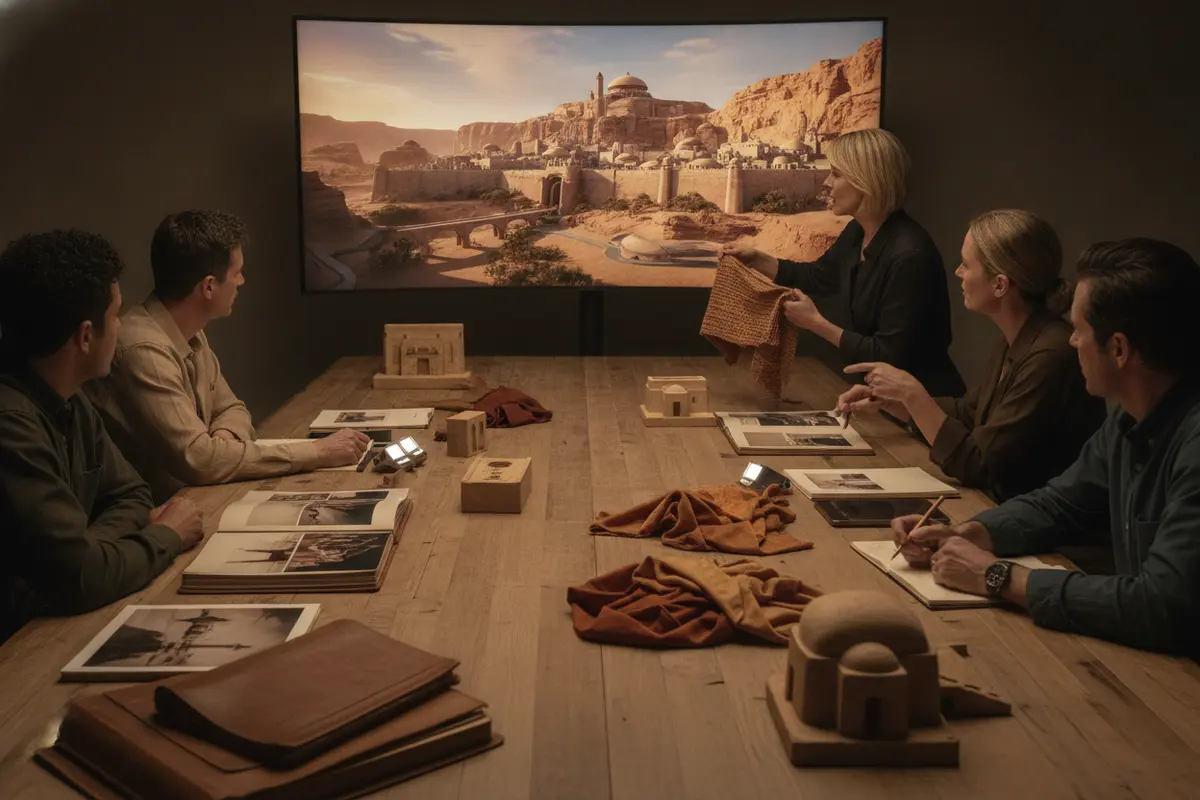
Continuity is not the same as sameness. A world should be able to develop. A location may change as a result of conflict; a character’s costume can reveal a shift in status; a familiar environment can feel different through a new point of view. The production design system helps distinguish intentional evolution from accidental inconsistency.
Use a practical approval loop. First, share the underlying design principle. Next, review how the proposed choice serves the scene and production. Then record any decision that changes an established visual or story rule. This makes it easier for later episodes, departments, and formats to understand the reasoning behind a choice rather than merely inheriting an image without context.
Which production decisions need to be made before the shoot?
The most important pre-production decisions are the ones that affect multiple departments, constrain later options, or create expensive changes if left unresolved. These often include the core visual approach, schedule logic, location and set strategy, technical requirements, asset ownership, and the route for approving creative changes. A production does not need every detail fixed at once; it does need to know which decisions are still open.
Translate the creative brief into a production plan. For each major sequence, ask what the audience must see, what the scene must accomplish, which environments it uses, and what departments or technologies are involved. Then identify dependencies. A complex environment may need design work before construction or digital build. A location change may affect schedule, lighting, sound, and continuity. A sequence planned for an LED stage may require decisions about camera, environment, and performance well before the shoot day.
A simple decision register can keep this work visible. Include the decision, the person responsible, contributors, the date by which it is needed, current status, and any assumptions. Separate decisions that are approved from those that are under review. When a choice changes, note the downstream departments and story references that need to be updated.
| Decision area | Questions to resolve | Useful output | Why timing matters |
|---|---|---|---|
| Story and canon | What is fixed, flexible, or still being explored? | Brief, world rules, approval route | Prevents conflicting assumptions in scripts and design. |
| Visual approach | What principles guide locations, sets, costume, and light? | Design references and review milestones | Lets departments develop a consistent visual language. |
| Production method | Which scenes are practical, location-based, effects-led, or virtual? | Sequence breakdown and technical tests | Reveals dependencies before schedule commitments. |
| Cross-platform continuity | Which story elements may later be used or developed elsewhere? | Rights and continuity notes, asset plan | Reduces avoidable rework when the world expands. |
| Change control | Who approves changes, and who must be informed? | Decision log and escalation path | Keeps late changes visible across teams. |
Use the table as a conversation starter, not a universal checklist. A contained character drama and a large-scale science-fiction series will have different dependencies. The objective is to surface the right questions for the project and make decision timing explicit. Introductory television-production teaching also treats camera, lighting, sound, and studio or field operations as connected parts of the work; a production plan should bring those disciplines into the conversation early. See the Television Production Guide for a teaching resource on preparing productions.
When does virtual production support television storytelling?
Virtual production can help a television team create and photograph environments through a coordinated mix of physical production and digital tools. It is most useful when the creative need, schedule, and technical workflow align. It is not a shortcut that automatically makes a scene faster or less expensive; the team should test the approach against the specific shot and performance requirements.
Consider virtual production when an environment needs to be present for actors and crew, when a location is difficult to access repeatedly, or when the camera’s relationship to a digital setting is central to the scene. A test can reveal practical questions about framing, reflections, lighting, movement, and how the environment will respond to camera decisions. It also gives departments an opportunity to collaborate before production depends on the method.
Compare it with alternatives at the sequence level. A practical set may offer tactile control and flexibility for close interaction. A real location may supply natural detail and scale. Green-screen or later visual effects may suit a shot that needs a particular level of digital control. A virtual production stage can be a strong option when its on-set visibility and camera-aware environment support the performance and image. The right answer may differ between scenes in the same episode.
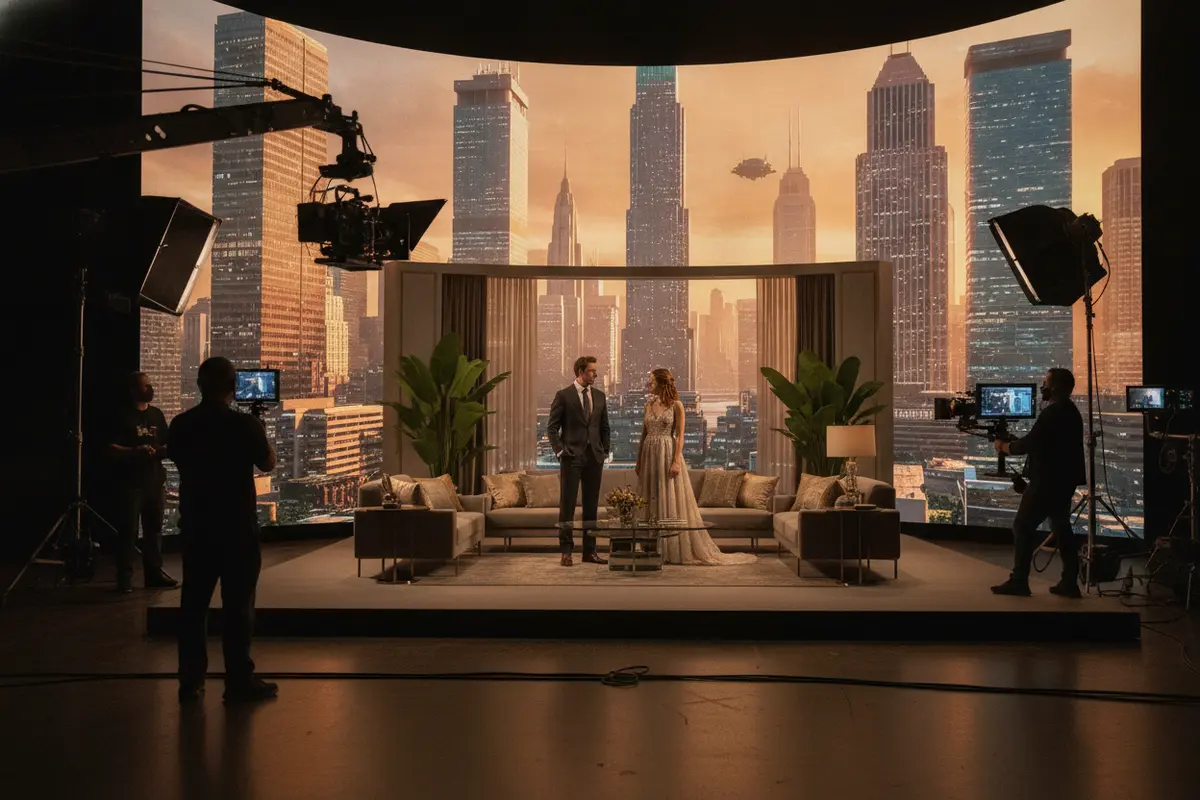
Before choosing the method, define a testable goal. Is the team trying to establish a specific lighting interaction, confirm that an environment reads on camera, or rehearse movement against a digital setting? Agree on who owns the environment, how changes are approved, and what files or references must be available to downstream departments. A test that has no decision attached can consume time without reducing uncertainty.
Arctic7’s virtual-production entity, Narwhal Studios, is one concrete example of a team operating in this field. Its virtual production services page outlines the company’s offering, while the broader project portfolio provides a place to review its work. For any partner, ask to understand relevant experience, the proposed workflow, and how the technology serves the particular story—not just which tools are available.
How do post-production and delivery protect continuity?
Post-production is where picture, sound, visual effects, music, and editorial choices come together into the audience’s experience. For an expanding story world, it is also a final opportunity to check that established details remain clear and that creative changes made during production are reflected in the reference materials used by future teams.
Plan post as part of the production workflow rather than a separate final stage. Establish how footage, visual effects plates, design files, and approved references will be named, stored, reviewed, and handed off. Identify who can make a change to a recurring environment or story detail and how that change reaches editorial, effects, sound, and continuity stakeholders.
In review, separate three questions:
- Does the scene work dramatically? The edit should preserve clarity, character intention, and pacing.
- Does the world read as intended? Check whether details needed to understand a place, rule, or relationship are visible and consistent.
- Does the approved change travel? If a choice alters a recurring element, update the relevant reference and notify the people who depend on it.
Delivery planning should also consider what is needed beyond the finished episode. The team may need approved design references, selected environment assets, production notes, or continuity information to support later work. The right handoff depends on rights, agreements, technical needs, and future plans; it should be agreed by the responsible parties rather than assumed.
For a television production partner, ask how it manages review cycles and decision records across production and post. Arctic7’s game development work is relevant to the wider challenge of building experiences in another medium, but television and games have different production needs. Cross-format continuity is strongest when each medium has its own creative logic and teams coordinate the facts and principles that must remain consistent.
How can a television series connect to other formats without repeating itself?
A connected story world does not require every format to retell the same plot. It requires a clear understanding of what belongs to the shared world and what makes each experience distinct. Television can provide a focused dramatic arc, while another medium may invite participation, exploration, or a different point of view. The connection should deepen the audience’s understanding without making one format feel like an instruction manual for another.
Start by separating continuity from content duplication. Continuity covers the shared rules, consequential events, and character facts that a project has agreed to preserve. Duplication happens when a new format repeats existing scenes or information without adding a meaningful perspective. A simple cross-format brief can identify:
- the story facts that are already established;
- the questions or parts of the world that remain open to interpretation;
- the audience experience that is distinctive to the television series;
- the kinds of extension that may fit another medium;
- the person or group responsible for resolving conflicts between projects.
Then design for the strengths of each format. A television sequence can control pacing and point of view. A game may give an audience agency within a designed system. An immersive experience may emphasize presence and spatial discovery. These differences should shape what is created, not be treated as distribution variations for identical material.
Coordination is especially important when multiple teams work in parallel. Establish shared terminology and a predictable review cadence, but do not require every creative decision to pass through a single bottleneck. Define which decisions affect shared canon, which are local to one production, and what happens when a project proposes a change to a foundational element. This protects both consistency and creative momentum.
What should you ask when evaluating a television production partner?
Choose a partner based on the work your project actually needs. A useful conversation should reveal how the team thinks across creative development, production design, execution, post, and any planned extensions. Ask for clear examples of process and decision-making, not only a list of services or tools.
- How will you learn the IP? Ask how the team distinguishes established story truths from new creative proposals.
- How do you bring departments into decisions? Request an example of how design, production, and post coordinate around a complex sequence.
- How do you decide whether virtual production fits? Look for a sequence-specific assessment and a plan for testing assumptions.
- How are approvals and changes recorded? Ask who has authority, how notes are resolved, and how updates reach affected teams.
- What assets or records are handed off? Clarify technical format, ownership, access, and the materials that future work can rely on.
- How will the series remain creatively complete? Confirm that its audience experience does not depend on consuming another format.
- What does success mean at each stage? Agree on practical review gates, responsibilities, and deliverables before work begins.
Review the proposed scope against the project’s needs. Arctic7’s team page introduces the people and experience behind its work, and its insights and articles offer additional perspectives on games and virtual production. These materials can inform an initial discussion, but they do not replace a project-specific assessment of creative fit, schedule, responsibilities, and deliverables.
What is a practical way to align the production plan?
A practical plan links creative intention to decisions, owners, and review points. It does not promise that production will be free of change. It gives the team a shared way to evaluate change and understand its effects on the story, schedule, design, and future continuity.
One workable sequence is to establish the series promise and world rules; identify the recurring elements that need a visual system; break down the major sequences and their production dependencies; test unfamiliar methods early; and define the post-production and handoff process before material begins moving between teams. Each step should produce an output the next group can use.
At each gate, ask whether the team has enough information to move forward. If a key decision is unresolved, record the options and the cost of waiting. If a choice is approved, make it easy to find and clarify who can reopen it. This is particularly valuable when a property has several stakeholders or when television work is part of a broader slate.
Not every production needs a dedicated transmedia plan, and not every series should be expanded. The discipline is to understand what the story needs now and to avoid closing off future possibilities by accident. When expansion is an actual objective, bring the relevant creative and production partners into the conversation early enough to influence the work—not after all foundational decisions are already fixed.
Explore a connected production and transmedia approach
Frequently asked questions
What do television production services include?
The scope varies by project. It can include development support, creative and production planning, production design coordination, production execution, virtual production, post-production workflows, and delivery planning. A clear engagement defines which services are included, who is responsible, and how decisions are approved.
When should an IP holder plan for story-world continuity?
Begin during development, when the team can distinguish essential story rules from choices that remain open. Continue tracking relevant decisions through production and post. Early planning does not require committing to future projects; it helps the television series establish a coherent world and gives later teams a reliable reference if expansion proceeds.
Does every television series benefit from virtual production?
No. The method should serve a specific creative or production need. Compare it with practical sets, locations, and visual effects for the sequences in question, then test the approach when technical or performance assumptions need validation.
How can a series expand into games without repeating its story?
Define what the formats share—such as world rules or established events—and what each format uniquely offers. A television series can deliver a directed dramatic arc, while a game can build around interaction or agency. Coordination protects continuity; format-specific design keeps each experience purposeful.
What should be included in a production handoff?
Agree on handoff needs with the people responsible for rights, production, and future use. Depending on the project, useful materials may include approved visual references, continuity notes, selected assets, file specifications, and the record of important decisions. Confirm ownership and access rather than assuming all materials can be reused.
Closing perspective
Television production services create the most value when they connect storytelling ambition with decisions a production can execute. For IP holders and production companies, the goal is not to make every format identical; it is to build a compelling series, protect the integrity of its world, and leave a clear path for future stories to grow from it.
New Immersive & XR Media Capabilities Added to Arctic7's Suite of Games, Film & TV and Digital Services

Arctic7 Shares Details of its Work on Skeleton Crew and Cinematics Partnership with Fateless

The Human Touch: Adding Personality to Project and Product Management
Whether it’s your team, your client, or your stakeholders, understanding the human dynamics is just as critical as hitting milestones.

McDonald's Case Study: Bridging Brand and Play | Arctic7
Bridging Brand and Play: An Interview with Lindsay Blenkhorn Daggitt