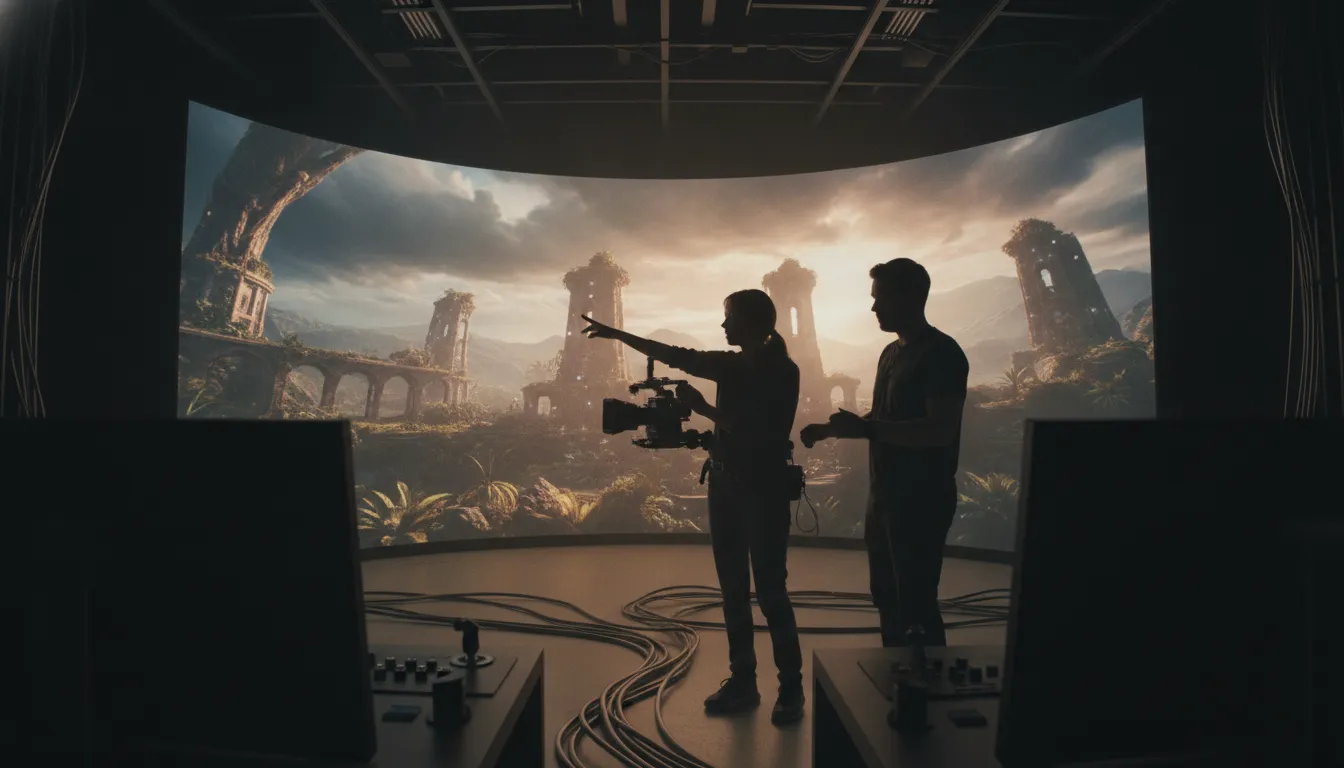

Real Time Cinematics for Connected Entertainment
Entertainment production is moving from a linear handoff model toward workflows where creative decisions can be tested, reviewed, and refined inside the same digital environment. That shift matters when a sequence must serve a film, a game, and a wider connected world without losing its identity.
Real time cinematics are engine-driven story sequences that let teams see performances, cameras, lighting, and environments update together as they work. They are valuable because they give directors, artists, and producers earlier visibility into creative and technical choices. That does not mean every project should abandon pre-rendered production.
The practical question is how this approach works, where it improves iteration, and when its demands are justified. Start with the production process itself, from assets and animation through camera decisions and final delivery.
Explore Arctic7's transmedia production services
What Are Real Time Cinematics?
Real time cinematics are cinematic sequences created inside a game engine, where animation, cameras, environments, lighting, and effects can be assembled and previewed as the scene is built. The workflow enables teams to evaluate story and shot decisions in context, while the final deliverable may still require a separate, higher-quality render and finishing process.
At its core, the method is engine-driven filmmaking. Instead of treating the cinematic world as a sequence of disconnected assets that only becomes visible after an extended render. A production team works inside an interactive digital scene. Characters, environments, animation, lighting, camera movement, and effects exist within the same production context. This creates a shared visual reference for directors, cinematographers, animators, VFX teams, and producers.
In Unreal Engine, Sequencer is the central tool for this work. Epic describes it as a multi-track editor for creating and previewing cinematic sequences in real time. Epic also identifies it as the primary tool for creating cinematic content in the engine. Tracks can organize elements such as character animation, camera cuts, transforms, effects, and scene timing. Teams can then adjust a shot and review the result without waiting for the entire sequence to be rendered before seeing whether the idea works.
That preview capability is particularly useful during blocking and previs. A director can test a camera position, alter the timing of an action, or compare the emotional effect of a lighting change while the scene remains visible. The result is not simply a faster version of traditional post-production. It is a different feedback environment, one that brings creative and technical decisions closer together. Epic's cinematics documentation also connects these tools with workflow guidance and real-world examples.
Working in real time does not mean that every final image is delivered directly from the interactive preview. A viewport preview is designed for responsive decision-making. The finished sequence may need higher-resolution output, motion blur, more complex lighting calculations, compositing, color work, or other finishing steps. Unreal Engine's Movie Render Queue, for example, can output cinematic scenes as an image sequence. The distinction matters because production leaders should assess both the review workflow and the intended delivery standard.
For teams building worlds across formats, the value is continuity as much as immediacy. A carefully developed environment, character setup, or camera language can support game cinematics, virtual production, and other screen experiences when the pipeline is designed for reuse. The technology does not remove the need for strong direction, disciplined asset management, or final-image quality control. It gives those decisions a more visible and collaborative place to happen.
Real Time Cinematics vs. Pre-Rendered Cutscenes: Which Fits?
Real time cinematics are usually the stronger choice when a team needs responsive iteration, shared assets, or versions that can change across platforms. Pre-rendered cutscenes remain valuable when the final image must be tightly controlled and interaction is limited. The right decision depends on creative intent, delivery conditions, and pipeline readiness.
| Consideration | Real-time cinematics | Pre-rendered cutscenes |
|---|---|---|
| How the scene is produced | Scenes are composed and previewed inside an engine, often through a multi-track tool such as Unreal Engine Sequencer. | Scenes are rendered to finished video or image sequences before delivery, with final compositing and finishing handled as a separate stage. |
| Creative iteration | Camera, lighting, animation, and environments can be reviewed together and adjusted without rebuilding the entire shot offline. | Changes may require another render and downstream finishing pass, but the process supports highly controlled final frames. |
| Runtime flexibility | Useful for interactive, variable, or multi-platform experiences where timing, viewpoint, or content may respond to the user or system. | Best suited to a fixed editorial experience with a known duration, playback path, and output specification. |
| Primary production risk | Performance, asset optimization, frame-rate consistency, and hardware requirements must be validated in the target environment. | Longer iteration cycles and larger versioning demands can become constraints when shots or story requirements change late. |
The distinction is not simply a choice between modern and traditional production. A real-time approach keeps the scene live inside an engine, which can give directors and technical artists a shared view of the work. Epic describes Sequencer as a multi-track editor for creating and previewing cinematic sequences in real time. That makes it useful for evaluating timing, blocking, camera movement, and scene relationships before committing to a final output: Epic's cinematic tools documentation.
Pre-rendering is often the better fit for a linear trailer or a story-driven cutscene with no runtime variation. It can also suit a hero sequence where the team has sufficient time for offline rendering, compositing, and review. Pre-rendered work can provide stable playback across devices because the audience receives a finished sequence rather than asking target hardware to calculate every frame.
Choose real time cinematics when the same world needs to support gameplay, virtual production, alternate versions, or frequent creative review. Choose pre-rendering when the editorial path is locked and maximum control over the final image outweighs runtime flexibility. Many productions combine both: an engine-based workflow for previs, virtual scouting, and approvals, followed by a final render for selected shots. Unreal Engine's Movie Render Queue can output cinematic scenes as an image sequence, creating a bridge between live scene development and finished delivery: Movie Render Queue guidance.
For decision-makers, the practical question is where change is most likely. If creative change, platform adaptation, and asset reuse are central to the project, an engine-centered pipeline can preserve options. If consistency, locked timing, and final-frame control define success, pre-rendered delivery may be the more dependable endpoint. Arctic7's Unreal Engine virtual production perspective treats that choice as part of a broader production strategy, not an isolated software decision.
How Do Real Time Cinematics Change Iteration?
Real time cinematics turn review from a late-stage approval event into an active production conversation. Directors can adjust camera language, artists can test performance and lighting, and technical teams can assess feasibility in the same scene. The result is not automatic speed, but earlier creative decisions, clearer feedback, and fewer surprises when shots move toward final output.
Camera control is the clearest example. Unreal Engine identifies the Cine Camera Actor as its primary camera type for filming cinematic content, giving teams a familiar foundation for lens, framing, focus, and movement decisions. Epic Games documents the Cine Camera Actor as part of its cinematic toolset.
From virtual cameras to repeatable camera language
A virtual camera can translate a director's physical movement or a designed control system into camera data inside the engine. Unreal Engine describes virtual cameras as using a modular component system to manipulate and output that data. This makes it possible to explore a shot interactively while preserving a recordable, repeatable setup rather than relying only on verbal direction or a one-off viewport preview.
Camera rigs extend that control into recognizable cinematography techniques. Teams can model crane, rail, handheld, or other movement patterns in a digital environment, then refine the timing and composition against the characters and world. Camera shake can be introduced deliberately as an effect, not as an improvised correction. Unreal Engine provides dedicated camera-rig and camera-shake tools for these purposes, allowing the creative team to distinguish intentional energy from technical instability.
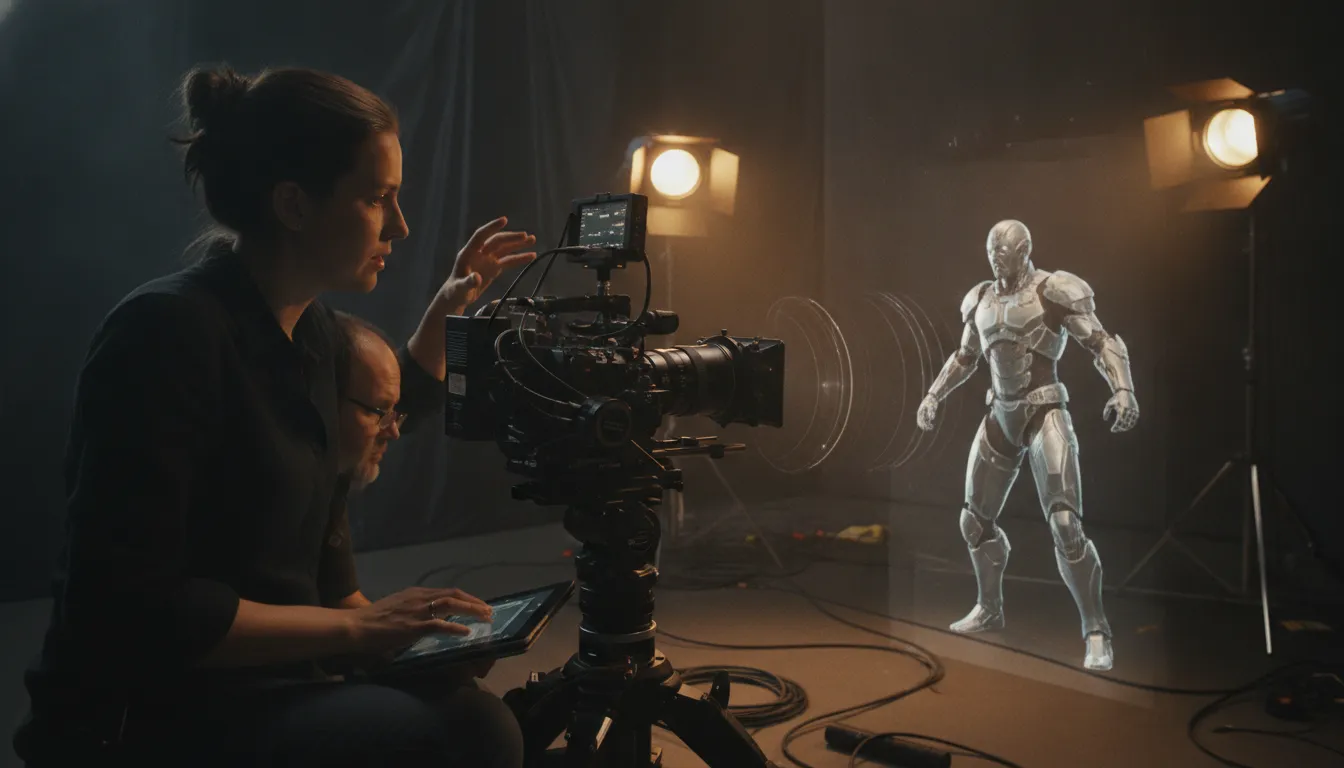
Review becomes a shared creative and technical loop
In a conventional sequence, creative feedback may arrive after animation, lighting, simulation, and rendering have each added cost and dependencies. An engine-based scene lets the team inspect a camera move, blocking pass, environment, and lighting direction together. A director can ask for a wider reveal while a cinematographer evaluates lens behavior and a technical artist checks whether the change remains stable in the target pipeline.
This shared view matters because creative and technical decisions are connected. A change in camera position can expose an asset that needs refinement. A lighting adjustment can affect material response, compositing, or virtual production color management. Real-time rendering research has also shown the value of interactive quality control, including advanced shaders that reveal features of visual data and support fast interaction with analytical tools. While that research concerns a specialized engine. The broader lesson applies to cinematic work: an interactive image gives teams more opportunities to see and resolve problems while decisions are still flexible.
For productions spanning film, television, games, or immersive formats, the workflow supports a more coherent review culture. The same scene can become a practical bridge between departments and platforms. Arctic7's real-time production pipeline approach provides useful context for how engine workflows connect virtual environments, camera tracking, and cross-medium production.
The strongest benefit is creative control with technical visibility. Teams can test intent, record decisions, and surface constraints together. That feedback loop helps protect the narrative and visual identity of an IP without pretending that every shot should be solved in real time.
What Does a Real-Time Cinematic Pipeline Need?
A dependable real-time cinematic pipeline connects approved assets, animation, cameras, lighting, performance checks, rendering, and production governance. The engine is only one part of the system. Teams also need clear ownership, consistent technical standards, and review points that protect creative intent from previs through final delivery.
The following requirements give directors, VFX supervisors, and heads of production a practical way to assess readiness:
- Prepare the asset foundation. Begin with production-ready environments, characters, props, materials, and lighting references. Establish naming conventions, version control, scale, texture standards, and performance budgets before shots multiply. A reusable asset is valuable only when its provenance and approved variations are clear. This is where a broader Arctic7 virtual production capability can connect art, technology, and production planning rather than treating assets as isolated files.
- Build animation and Sequencer structure. Unreal Engine's Sequencer is a multi-track editor for creating and previewing cinematic sequences in real time, and its documentation identifies it as the primary tool for cinematic content. Use it to organize shots, character animation, camera cuts, effects, audio cues, and editorial timing into a structure the team can review. Keep shot naming and sequence versions disciplined so creative changes remain traceable. Epic's cinematic documentation describes Sequencer and related workflow tools in detail.
- Define lighting and camera behavior. Camera decisions should be intentional, not merely a byproduct of a technical demo. The Cine Camera Actor is Unreal Engine's primary camera type for filming cinematic content. Camera rigs can model real-world filming techniques, while virtual cameras can manipulate and output camera data through modular components. Confirm lens language, exposure, movement, depth of field, camera shake, and continuity in review sessions. With the director of photography and virtual production team aligned on the same visual target.
- Validate performance and image quality. A shot that looks good in a local viewport may fail under a full sequence load. Test representative scenes for frame rate, memory, shader behavior, animation timing, color, tracking, and synchronization. Real-time rendering can also support interactive quality control, while advanced shaders and physically based rendering can reveal visual details that need attention. In virtual production, color matching deserves formal validation: research has compared rendered digital twins with real-life counterparts and used color-difference metrics to evaluate rendering methods. Including spectral approaches that reported higher material-color accuracy. The NSF-hosted color study provides useful context.
- Plan render and delivery paths. Decide early whether the sequence is being reviewed in real time, recorded for editorial, or rendered for final mastering. Unreal Engine's Movie Render Queue can output cinematic scenes as image sequences, and Movie Render Graph supports more structured cinematic rendering workflows. Define resolution, frame rate, color space, handles, file formats, naming, audio, and delivery destinations before final renders begin. These choices prevent a technically successful scene from becoming an unusable deliverable.
- Govern the pipeline. Assign approval rights for story, performance, camera, lighting, technical quality, and final delivery. Document change control, version ownership, backup procedures, review cadence, and escalation paths. Real-time cinematics create more creative visibility, but that advantage depends on disciplined collaboration. A clear governance layer lets teams iterate quickly without losing continuity, IP integrity, or accountability across game, film, television, and immersive deliverables.
Where Do Real Time Cinematics Create Strategic Value?
Real time cinematics create strategic value when one visual production workflow can serve more than one release, platform, or creative decision. For games, film, and television, the benefit is not simply seeing a scene sooner. It is the ability to test ideas, align teams, preserve continuity, and build assets that can support an interconnected entertainment ecosystem over time.
For a game publisher, an engine-based cinematic workflow can connect narrative development with game development and engine-based production pipelines. Characters, environments, lighting studies, animation, and camera language can be developed with a clearer view of how a cinematic moment relates to the playable world. That does not mean every asset should be reused unchanged. It means the team can make deliberate decisions about which elements should remain consistent. Which should be adapted, and which should be rebuilt for the needs of a particular format.
The same logic applies to film and television. Real-time scenes can support conversations between directors, cinematographers, VFX teams, production designers, and producers before a final shot is locked. Virtual scouting can make locations and set variations easier to review with stakeholders who may be working across regions. The result is a more visible decision-making process, where creative intent and production constraints can be considered together rather than passed between isolated departments.
Continuity across a growing world
Transmedia continuity is a production concern as much as a writing concern. A shared world needs repeatable visual rules, recognizable environments, coherent character presentation, and a reliable narrative spine across games, screen content, immersive experiences, and digital platforms. A real-time scene can function as a working reference for those choices. Helping teams discuss scale, tone, movement, and atmosphere with something more concrete than a written description alone.
That value becomes more significant as an IP expands beyond its original medium. Arctic7 combines strategy development, creative execution, and technical excellence to build interconnected entertainment ecosystems. In that model, the engine is not the strategy. It is one production capability within a broader plan for extending an IP while protecting its identity and quality.
Reusable assets and better production choices
Reusable assets can also improve the quality of production decisions. A well-structured environment may support a game prototype, a cinematic, a virtual scouting session, or a previsualization pass. Reuse still requires review for performance, licensing, art direction, platform specifications, and audience context. Treating it as automatic would create technical debt or visual inconsistency. Treating it as a governed opportunity can reduce duplicated effort and make future expansions easier to evaluate.
For decision-makers, the central question is therefore not whether real time cinematics are universally better than pre-rendered work. It is where real-time visibility and asset continuity create meaningful control over a project, a franchise, or a slate. The strongest use cases bring creative and technical stakeholders into the same conversation early, then carry the resulting decisions into production with clear ownership.
How Should a Studio Choose the Right Real-Time Approach?
The right approach depends on the audience experience, creative ambition, interaction model, asset strategy, team capability, and delivery environment. Treat real time cinematics as a production choice rather than a default technology decision. Compare in-engine, pre-rendered, live-action, and hybrid workflows against the demands of each sequence and the wider IP plan.
Start with the audience and interaction model. If viewers or players need to influence the camera, environment, character behavior, or sequence timing, an in-engine workflow may provide the control required. If the experience is a fixed trailer, film sequence, or story-driven cutscene, pre-rendered output may offer a more controlled finishing path. Some productions need both. REALTIME describes pipelines spanning pre-rendered, in-engine, live-action, and 2.5D approaches, including trailers and story-driven cutscenes. Which illustrates why the decision should be made at the sequence level rather than by adopting one method for the entire project.
REALTIME's production pipeline examples reinforce a useful principle: the format should serve the creative requirement. Ask whether the viewer needs responsiveness, or whether the priority is a locked composition with maximum control over final output.
Evaluate visual fidelity and iteration needs together
Visual fidelity is not simply a question of polygon count or render quality. Consider lighting consistency, material response, facial performance, motion detail, color management, and the final display format. A real-time workflow can expose creative decisions earlier, but it still requires disciplined look development and validation. For virtual production, the relevant question is whether the engine can maintain the required relationship between digital environments, physical photography, and final delivery.
Iteration needs are equally important. A project with frequent director reviews, multiple platform versions, or evolving narrative beats may benefit from an editable engine scene and reusable animation, camera, and environment data. A highly fixed sequence with minimal expected change may justify a more traditional finishing pipeline. Do not assume that real-time automatically means faster. Its value depends on how well the team has designed review, approval, asset, and version-control processes.
Test the asset and team strategy before committing
Map which assets must travel across formats. A shared environment, character, or prop library can support continuity between a game, cinematic, series, and immersive experience. Arctic7's game services include Unreal Engine and Unity development support, tooling, production pipelines, and post-launch content planning. That makes its game development and engine-based production pipelines a relevant reference when reuse across platforms is part of the brief.
Then assess team readiness. Identify who owns environment standards, camera language, technical art, lighting, animation, data management, and approvals. Arctic7 frames real-time workflows around iteration speed, creative control, risk management, efficiency, and cross-platform IP value, not around software selection alone. Its Narwhal Studios work includes LED-volume adoption and real-time collaboration protocols for global productions. While its Virtual Art Department experience spans six major productions over seven years with Lucasfilm and ILM. Those examples point to the governance question: can the studio coordinate creative and technical decisions across departments?
Match the approach to delivery constraints
Finally, define the delivery target before choosing the pipeline. Review resolution, frame rate, color requirements, platform specifications, live versus offline playback, localization, security, schedule dependencies, and the number of required versions. For a large virtual-production program, Arctic7 cites more than 200 virtual stage walks, 45 virtual location scouts, eight hero sets, and more than 34 set variants on Ant-Man and the Wasp: Quantumania. The lesson is practical: scale increases the importance of asset governance, repeatable review, and variant management.
Choose the approach that gives the project the necessary creative control without creating avoidable operational complexity. For teams weighing those trade-offs across film, television, games, and immersive formats, Arctic7's virtual-production capabilities offer a relevant basis for evaluating the wider production system, not just the engine.
Frequently Asked Questions
What are real-time cutscenes?
Real-time cutscenes are cinematic sequences assembled and previewed inside a game engine rather than played back solely as fixed video files. In Unreal Engine, Sequencer is the multi-track editor used to create and preview cinematic sequences in real time. Allowing teams to work with engine assets, animation, cameras, lighting, and effects in one production environment. Epic Games documentation describes Sequencer as the primary tool for cinematic content.
How do real-time cinematics differ from pre-rendered cutscenes?
A pre-rendered cutscene is rendered in advance and delivered as a finished video, while a real-time cinematic is rendered by the engine at playback or review time. The best choice depends on visual demands, interactivity, target hardware, and delivery constraints. Production pipelines can also combine pre-rendered, in-engine, live-action, and 2.5D approaches for trailers and story-driven cutscenes, rather than treating the decision as all or nothing. REALTIME outlines these production approaches.
Why are real-time cinematics useful during iteration?
They let creative and technical teams review changes in context, including camera placement, timing, animation, lighting, and effects, before committing to a final render. Unreal Engine's Cine Camera Actor is its primary camera type for cinematic filming, while virtual cameras and camera rigs support direct manipulation and techniques modeled on physical cinematography. Epic's cinematic tools documentation covers these capabilities.
What does a real-time cinematic pipeline need?
A dependable pipeline needs prepared assets, animation and Sequencer organization, cameras and lighting, performance testing on the intended hardware, review controls, and a defined final-render or delivery path. Movie Render Queue can output cinematic scenes as image sequences, so real-time preview does not prevent a carefully managed final-output process. Epic documents Movie Render Queue as part of its cinematic workflow.
Are real-time cinematics always better than pre-rendered work?
No. Real-time cinematics can improve review flexibility and support interactive or engine-connected experiences, but they still require disciplined asset, performance, and color management. Pre-rendered work may be more appropriate when a sequence demands a fixed, highly controlled output. Evaluate each shot against audience, fidelity, interaction, iteration, reuse, team readiness, and delivery requirements.
Ready to Explore Your Real-Time Production Options?
Real-time cinematics can support more informed creative decisions when the workflow is matched to your project's audience, delivery needs, and wider IP strategy. Arctic7 can help you assess where real-time production, virtual production, and connected storytelling fit together.
New Immersive & XR Media Capabilities Added to Arctic7's Suite of Games, Film & TV and Digital Services

Arctic7 Shares Details of its Work on Skeleton Crew and Cinematics Partnership with Fateless

The Human Touch: Adding Personality to Project and Product Management
Whether it’s your team, your client, or your stakeholders, understanding the human dynamics is just as critical as hitting milestones.

McDonald's Case Study: Bridging Brand and Play | Arctic7
Bridging Brand and Play: An Interview with Lindsay Blenkhorn Daggitt