

What Makes It a Game? A Practical Guide for IP Holders
A game is not simply a familiar character, recognizable setting, or story delivered through a controller. What makes it a game is meaningful agency: players make choices, act within a system, and experience outcomes shaped by those actions. For IP holders, that distinction is the starting point for deciding whether an idea can become a compelling game and how it can expand a wider entertainment world. The practical test is simple: what can an audience do here that it cannot do as a viewer?
Explore game development capabilities
What makes it a game rather than an adaptation?
A strong game adaptation translates the value of an IP into actions players can understand and enjoy. It does not merely retell screen scenes. The player needs a role, meaningful possibilities, and feedback that makes actions consequential within the design. A story can be linear or cinematic; interaction still has to do real work.
Start by describing what the audience can do that only this format makes possible. Agency, rules, feedback, and purpose connect an audience to the world as participants rather than observers.
- Agency: Players make decisions or execute actions that influence their experience.
- Systems: Rules, resources, challenges, and reactions shape how play unfolds.
- Feedback: The game communicates results clearly enough for players to learn and adapt.
- Purpose: Players understand what they are trying to accomplish, even when the path is open-ended.
A useful early test is to describe the player’s action without naming the franchise. “Investigate a suspicious room and decide which lead to pursue” is more actionable than “explore our beloved world.” If the concept loses all definition when the IP name is removed, the playable promise may need work. Conversely, a generic activity can become distinctive when the world changes its meaning: gathering evidence in a politically divided city may involve trust, reputation, and risk in ways a neutral puzzle setting would not.
How do you find the playable promise of an IP?
Begin with the experience the IP uniquely offers, then turn it into a promise expressed through verbs and choices. A detective world might invite players to gather evidence and test explanations. A science-fiction setting might make exploration, survival, or command decisions central. The promise should come from the world’s identity, not from a genre trend.
- What does the audience already value about this world?
- What role can a player inhabit that matters but is not already overdetermined by canon?
- Which verbs express that role: investigate, negotiate, build, evade, compete, or explore?
- Which choices should matter, and what must remain consistent with the wider IP?
- Would the experience still make sense to someone who has not seen every prior installment?
Imagine a fictional mystery franchise. Replaying a famous reveal may satisfy recognition briefly, but it gives players little room to contribute. A more playable promise could be to examine a new case, compare incomplete accounts, and choose which evidence to share. The IP supplies tone and expectations; the game supplies investigation, uncertainty, and consequences.
That distinction also helps teams protect continuity. A game might reveal a community’s perspective or let players explore a location that a screen story only glimpses. It can add a point of view without creating a major canon obligation the wider franchise must carry. The creative brief should say whether the game changes established events, fills a gap, or presents a parallel story. Each choice affects how much context newcomers need and what approvals the project may require.

What makes it a game in practical design terms?
Several connected design elements turn a concept into something playable. They are not a checklist that guarantees success. They are questions for testing whether the idea holds up when a player takes control.
Player role and agency
Define who the player is in the fiction and what power they have. They need not control a famous protagonist. A new recruit, investigator, rival, builder, or community member can give the audience room to participate while protecting the IP’s identity. Make the role’s limits clear: what can this person change, and what remains beyond their control? If a character is meant to feel vulnerable, for instance, avoid giving them effortless authority over every conflict.
Core loop
A core loop is the repeated pattern of action and reward that gives play its rhythm. One loop might be explore a location, notice a clue, make a choice, and unlock a lead. Another might be prepare a team, enter a challenge, adapt to the result, and improve the next attempt. The pattern should be understandable early, while offering enough variation to sustain attention. Teams can write it as four verbs and ask a tester to describe what they expect to do next.
Rules and consequences
Rules define what is possible and what actions cost. Consequences give those rules meaning. If a player chooses a risky route, the game should respond consistently and legibly. In a narrative experience, that response might alter relationships or available information. In a competitive experience, it might change position, resources, or tactical options. A choice need not transform the whole plot, but the player should be able to recognize its effect.
Feedback and progression
Players need to see what happened and why. Feedback can be visual, sonic, narrative, or mechanical. Progression gives them a reason to continue: deeper understanding, new mastery, tougher challenges, or access to another part of the world. It should reinforce the experience rather than bury it beneath unlocks. When players fail, communicate whether they need a different strategy, better timing, or a new piece of information.
Challenge and choice
Challenge asks players to apply what they have learned; choice makes room for different priorities or approaches. Not every decision needs to branch the entire story. A tactical choice, preferred play style, or small visible consequence can still make the experience feel responsive. The design question is not “How many branches can we build?” but “Which decision is worth the player’s attention?”
Turn these ideas into observable design tests. For example: “A player can infer why a clue matters before deciding whether to share it.” If the team cannot demonstrate the test in a prototype, the concept may still be too abstract. Keep the test narrow enough to run again after a revision, and note what changed between versions.
How should gameplay connect to the story world?
Story and gameplay should support one another, but they do not need to do the same job. Story can establish stakes, relationships, and context. Systems make those stakes tangible by asking players to act, prioritize, or take risks. When systems contradict the fiction, the disconnect can weaken both. A dangerous world should not feel harmless because failure has no cost; an alliance should not feel meaningful if the game never asks the player to rely on it.
Use an alignment map to surface mismatches while they are still manageable:
| Design question | Story contribution | Game contribution | Early test |
|---|---|---|---|
| What is at stake? | Establishes conflict and meaning. | Turns pressure into decisions or challenges. | Can a player explain what failure means? |
| What can the player do? | Defines role and boundaries. | Provides actions, tools, and systems. | Can a short prototype demonstrate the central action? |
| How does the world respond? | Maintains character and continuity. | Shows consequences through play. | Can the team explain why a choice produced its result? |
| Why continue? | Creates curiosity and evolving stakes. | Provides mastery, variation, or discovery. | Does the next loop add a new question or capability? |
The map gives narrative, design, production, and IP stewardship a shared way to discuss decisions. It also separates canon commitments from gameplay choices that can remain flexible. A team can decide, for example, that the protagonist’s identity is fixed while the route through a mission is open to player choice.
Try using the map on a single sequence rather than an entire game. Take a scene where a character must obtain access to a restricted archive. Story establishes why access matters; the rules determine which tools or relationships can help; the feedback shows whether the approach created trust, suspicion, or new information. If each column describes the same beat in different language, the design may lack a real interaction. If they support different experiences, revise the sequence until action and meaning connect.
Which game format fits the idea and audience?
Choose a format by matching the intended player experience to the audience, platform context, and production reality. Do not select a format only because it is familiar or another franchise used it. Each option asks for different commitments from players and the team.
- Short, focused experience: Fits a distinctive interaction or story question that can carry a compact concept.
- Premium narrative game: Suits an authored journey with deliberate pacing, character development, and defined scope.
- Ongoing service game: Requires a credible reason to return, continuing content planning, and operations beyond launch.
- Social or competitive experience: Depends on repeatable play, understandable rules, and a community proposition that lasts beyond novelty.
- Immersive experience: Can foreground presence and spatial interaction, but needs attention to access, comfort, and session length.
These are strategic distinctions, not rigid boxes. A project may combine elements, but each added mode or platform creates additional design and production demands. Start with the clearest audience benefit and add complexity only when it strengthens that experience. A compact investigative game, for example, might be a better expression of a world’s moral ambiguity than a vast map with many locations but few meaningful decisions.
Use a short format comparison in a planning meeting. For each candidate, record the player promise, the reason to return, the content burden, and the most uncertain assumption. If the promise is a single intense decision, an ongoing structure may add little. If the concept depends on evolving competition, a one-time authored arc may not support its intended rhythm. This conversation makes trade-offs visible without pretending that one format is universally best.
What should a production plan resolve before commitment?
A promising idea becomes a producible game when the team can describe its experience, boundaries, dependencies, and ways to test it. Before committing to full production, align decision-makers on scope, uncertainty, and ownership of creative and technical questions.
- Set the experience goal. Describe the player’s role, core activity, and intended emotional or intellectual payoff.
- Define the first playable proof. Choose a prototype that tests the riskiest assumption, not simply the easiest feature.
- Separate fixed canon from open space. Record what must remain consistent and what the game may interpret or extend.
- Map the content burden. List the environments, characters, systems, and narrative assets needed. A large world is not itself a production plan.
- Clarify stakeholders and approvals. Decide who reviews story, systems, visual identity, and release choices, and when feedback is needed.
- Choose measures that match the goal. Evaluate whether players understand the loop, value the decisions, or want to explore further—not simply how many features were built.
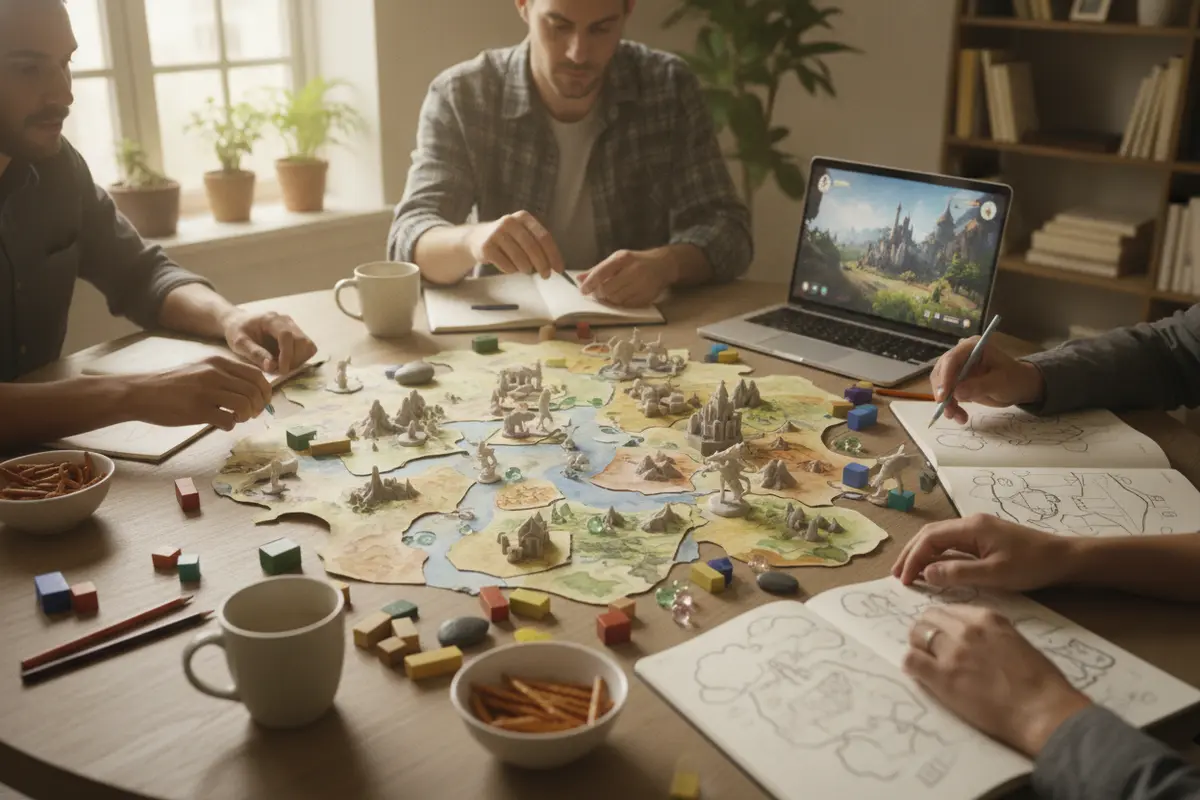
A first prototype can be modest. Paper exercises, gray-box environments, or a limited mechanic can test clarity and appeal before a team builds content at scale. For a mystery concept, a short paper exercise might present three clues and ask players to explain their reasoning. For an action concept, a gray-box encounter can test movement, threat readability, and the relationship between risk and reward.
Plan the review around decisions. Before a test, write down what result would support the concept and what result would trigger a change. If players repeatedly misunderstand the objective, revise its communication before adding more levels. If they understand the loop but find choices inconsequential, test stronger responses before expanding the world. This keeps a playtest from becoming an unstructured conversation in which every comment looks equally important.
Document dependencies as well as creative goals. A new location may require environment art, narrative review, technical support, and a continuity decision. A multiplayer feature may bring additional needs for matchmaking, moderation, and ongoing support. Listing dependencies early helps the team distinguish a compelling idea from the resources and coordination needed to deliver it. This is not a reason to avoid ambition; it is a way to make ambition legible and sequence the work.
How can a game expand an IP without repeating it?
A game can broaden an entertainment world by giving audiences a different role, kind of participation, or angle on familiar themes. The purpose is not to force every format to carry the same plot. Define what each experience contributes and what audiences gain from engaging with more than one format.
- Complementary perspective: Follow a character, community, or institution that the primary screen story cannot explore closely.
- Deeper participation: Let players investigate, shape, or navigate a setting rather than only observe it.
- Shared thematic question: Explore a common idea through distinct conflicts and mechanics, while keeping each installment understandable on its own.
A familiar world can have recognition and still lack a clear player fantasy. An unexplored corner may offer rich possibilities if it supports a compelling role, rules, and conflict. A practical cross-format test is to write one sentence for each installment: what does this format let the audience do, learn, or feel that another format cannot? If the answers repeat, the plan may be multiplying formats without adding experiences.
Interconnection should not make participation in one format mandatory for understanding another. A game can reward a viewer’s familiarity without requiring it; a new player should still understand the stakes. This balance makes each work accessible while allowing the larger world to feel richer to people who explore it across formats. In planning terms, identify the minimum context needed at the start, then reserve deeper references for optional discoveries that enrich rather than block the experience.
For example, a television story might follow a central conflict while a game lets players inhabit the work of a small response team dealing with its consequences. The game can echo the same themes and visual language, yet provide its own goals, decisions, and resolution. That separation protects the value of both formats: viewers do not need a controller to follow the show, and players are not simply replaying scenes they have already watched.
What evidence can help teams judge whether the game works?
Teams need evidence about the experience they intend to create, not only an attractive concept presentation. Early evaluation becomes more useful when the intended player, goal, and context are clear. The International Organization for Standardization’s ISO 9241-11 standard frames usability around specified users, goals, and contexts of use. That provides a useful reminder: define who the player is, what they are trying to do, and the context in which the experience should work before interpreting a test. Read about ISO 9241-11.
For an early game test, translate that framing into practical questions. Can a first-time player identify the objective? Can they tell which actions are available? Do they understand the response to a decision? Does the intended audience find the role appealing? Observations and short interviews can explain where confusion arose; they do not replace later testing of balance, accessibility, technical performance, or audience fit.
Separate evidence of comprehension from evidence of preference. A player may understand a loop but dislike it; another may enjoy a moment without understanding its rules. Record both. Make a brief decision log that links each observation to a design response, an owner, and a follow-up test. That creates a traceable path from feedback to iteration.
A practical test plan can fit on one page. State the question, the test activity, what the observer will record, and what the team will decide afterward. For a clue-sharing prototype, the question might be whether players understand the trade-off between revealing information and protecting an ally. The activity might involve a short scenario with two possible choices. Record whether players can explain the consequence they expect, then compare that expectation with what the game communicates. The goal is not to make every player choose the same option; it is to see whether the choice is clear and worth making.
What are common mistakes when turning an IP into a game?
Many adaptation problems begin when a team treats recognition as a substitute for design. A known brand can attract attention, but it cannot decide the player’s role, create a satisfying loop, or resolve production dependencies. These common mistakes are easier to prevent when teams test the experience early.
- Starting with scenes instead of play: Recreating memorable moments does not define what players do between them.
- Giving the player power without a reason: A role that conflicts with the world can undermine story and mechanics.
- Expanding scope before validating the loop: A large map or extensive content cannot rescue an unclear central activity.
- Adding ongoing operations by default: A continuing game needs a lasting player proposition and a plan for sustained support.
- Leaving approvals implicit: Unclear ownership of canon and feedback can cause late changes.
- Measuring the wrong outcome: Evaluation should reflect the purpose, not simply feature or platform count.
Another common misstep is treating a reference point as a design brief. A successful game in one genre offers a useful comparison, but its audience, production constraints, and player expectations may differ from those of a particular IP. Ask what principle is relevant—social cooperation, readable challenge, a strong fantasy—and then test how that principle translates into this world rather than copying the surface features.
When the concept is hard to explain, reduce it to a playable promise and test that promise. A focused prototype can reveal whether the idea has a distinctive interaction before the team commits to broad production.
Arctic7 approaches this work across game development and transmedia strategy, connecting format decisions with creative and production planning. Explore transmedia and production services, review the project portfolio, meet the team, and learn about the Ottawa studio and Europe studio. The broader insights blog explores related questions.
Frequently asked questions
Does a game need a story to be compelling?
No. A game can be compelling through mastery, competition, exploration, social play, or creative expression. For an established entertainment IP, story may be central to audience expectations, but it should work with player actions rather than simply interrupt them.
Can a linear game still give players agency?
Yes. Agency does not require a branching plot or open world. Players can feel agency through timing, tactics, skill, interpretation, and meaningful local decisions, even when the overall story follows a defined sequence.
What should an IP holder test first?
Test the riskiest assumption about the player experience. That may be whether the role is appealing, the core loop understandable, or the central action a fit for the IP. A small prototype or structured playtest can answer these questions before a large content build.
When should a game concept connect to other formats?
Make cross-format connections when they add audience value and are feasible for the teams responsible. Establish what the game contributes on its own, then identify optional links that strengthen the wider world without making one format necessary to understand another.
Closing perspective
What makes it a game is the purposeful relationship between player action and the experience that follows. For IP holders, strong concepts begin with a distinctive playable promise, test it early, and build production and cross-format plans around what audiences can do—not only what they already know.
New Immersive & XR Media Capabilities Added to Arctic7's Suite of Games, Film & TV and Digital Services

Arctic7 Shares Details of its Work on Skeleton Crew and Cinematics Partnership with Fateless

The Human Touch: Adding Personality to Project and Product Management
Whether it’s your team, your client, or your stakeholders, understanding the human dynamics is just as critical as hitting milestones.

McDonald's Case Study: Bridging Brand and Play | Arctic7
Bridging Brand and Play: An Interview with Lindsay Blenkhorn Daggitt