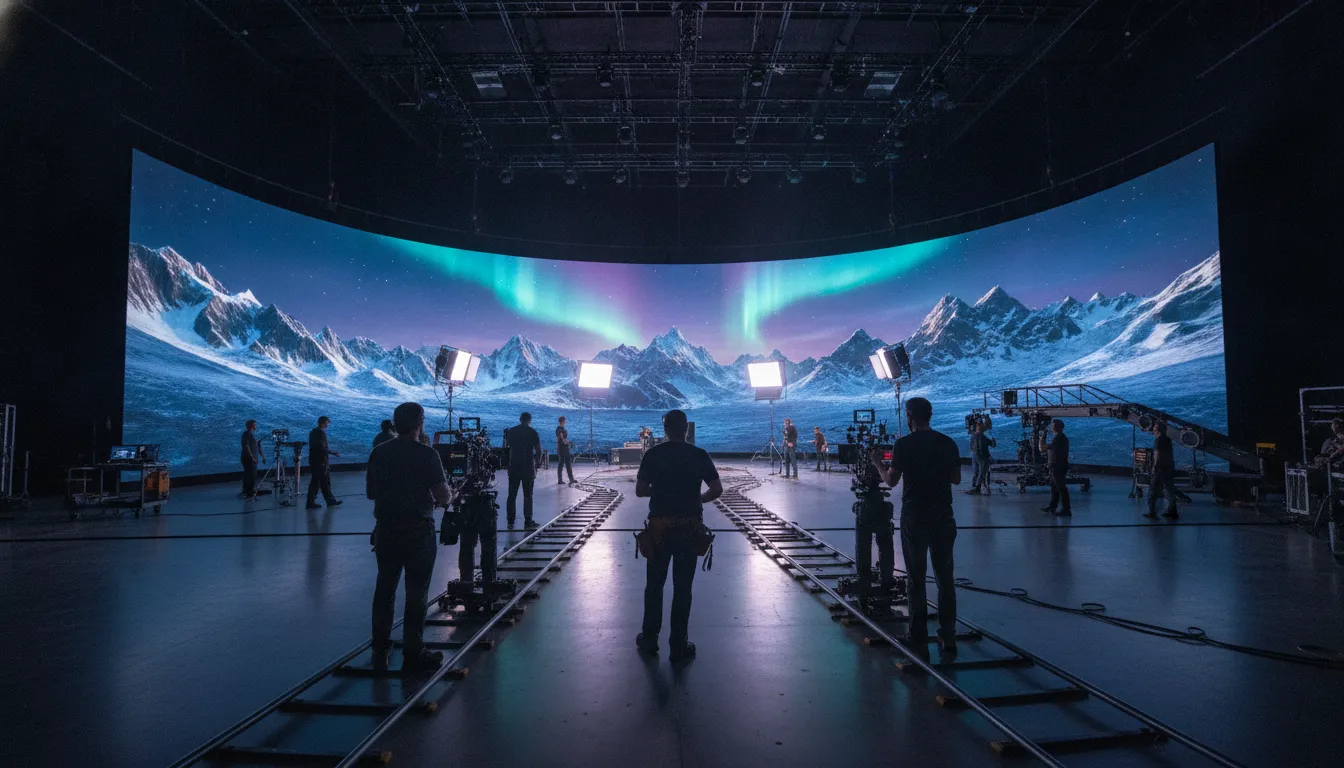

What Is an LED Virtual Production Stage?
Virtual production has moved from a specialist experiment to a serious production infrastructure decision. The Mandalorian helped establish LED stages as a landmark filmmaking tool. And the market expanded from three known stages in 2019 to around 300 by October 2022, according to Epic Games industry manager Miles Perkins, as reported in documented industry history.
An LED virtual production stage combines a large LED volume, real-time rendering, camera tracking, calibrated playback, and a crew that can operate the system as one creative environment. The wall is only the visible layer. Reliable results depend on the hardware, software, content pipeline, timing, and people behind it.
That distinction matters when a production is evaluating whether to build, rent, or partner for a stage. Before comparing deployment models, it helps to understand what the stage actually is and how its core systems work together.
Explore Arctic7's LED virtual production stage solutions and partner-led deployment.
What Is an LED Virtual Production Stage?
An LED virtual production stage is a physical sound stage built around a large LED display that shows a digital environment while a scene is being filmed. Instead of placing performers in front of a green screen and replacing the background later. The production team can capture the environment in camera as part of the live shoot. The result is a connected system of LED panels, real-time rendering, camera tracking, and film production equipment.
The display is usually configured as an LED volume. In industry terminology, a volume can include a curved wall, floor panels, and sometimes overhead panels that surround the action. The shape gives filmmakers more control over reflections, interactive light, and the visible environment from different camera angles. It also creates a physical space where performers, cinematographers. And directors can respond to the world around them rather than imagining a background that will be added months later. California State University, Northridge describes its LED production wall as a volume, reflecting the terminology used by production professionals. Read the CSUN overview of LED production walls.
Behind the wall, a real-time game engine generates and updates the digital environment. Unreal Engine is widely used for this work because it can render detailed scenes interactively, allowing the background to change as the camera moves. The engine receives information about the camera position and lens, then adjusts the perspective of the rendered environment so the background appears anchored to the physical set. Camera tracking is therefore not an optional enhancement. It is what keeps the virtual world aligned with the camera's position and preserves the intended sense of depth.
The scale can vary substantially by production. Rochester Institute of Technology, for example, describes a 32 by 16 foot LED wall with support for camera tracking. Virtual art department work, and real-time in-camera visual effects through Unreal Engine. A larger stage may add LED flooring, a ceiling, or additional technical infrastructure, while a smaller setup may focus on a single wall for specific shots.
For producers, the important distinction is that an LED volume is not simply a screen placed behind the actors. It is an integrated production environment. The wall, render system, tracking data, camera, lighting approach, and digital assets must work together in real time. Teams planning virtual production services should evaluate that full system, not just the visible panel surface, before choosing a stage or defining a shoot.
Core Hardware: LED Panels, Processors, and Tracking Systems
The visible wall is only one part of an LED stage. A dependable build treats the panels, processing, tracking, signal transport, power, and rigging as one coordinated production system. That integration determines whether the volume can support repeatable camera moves and whether the virtual environment remains convincing once the camera is close to the wall.
Panel selection begins with pixel pitch, the distance between adjacent LED pixels. A 2.8mm class pitch is a practical camera-ready specification for many on-set perspectives because it supports a relatively close camera position without making the panel structure visually dominant. One documented Universal Studios stage uses 200 ROE BP2v2 wall panels at 2.8mm, arranged as a 29-foot by 11.5-foot curved wall. The same stage specification lists a camera-ready viewing distance of six feet and a 7,680Hz refresh rate. Two details that illustrate why panel choice must be evaluated against lenses, shutter settings, and intended blocking, rather than by resolution alone.
Designing the volume around the shot
A curved wall creates a wider environment than a flat backdrop and reduces the risk that the camera will quickly see beyond the displayed world. For more demanding shots, the build may extend beyond the wall with LED floor or ceiling surfaces. Universal's listed configuration includes rolling LED floor walls, a motorized LED ceiling panel, and a static ceiling panel. Ceiling coverage can help control reflections and maintain the visual logic of an environment above the actors. But it also increases the demands on structural support, access, serviceability, and rigging.
That physical planning needs to happen inside a stage designed for production infrastructure. The Rochester Institute of Technology describes a 7,000-square-foot sound stage built specifically for film production and supporting workflows such as camera tracking. Motion capture, virtual art department work, and real-time in-camera visual effects. The lesson is straightforward: an LED volume needs more than wall area. It needs adequate clearance, load planning, power distribution, safe cable paths, lighting control, and room for the crew to work around the camera.
Processing, show control, and signal transport
LED processors translate the rendered image into the timing and data requirements of the panels. A Brompton SX40 class processor is a common example of the processing tier, and the Universal specification lists two SX40 processors alongside Brompton Tessera XD distribution boxes. The processor layer should be planned with the render system, camera outputs, monitoring, genlock, and failover strategy, not added after the panels are selected.
Show control then coordinates the practical operating state of the stage: panel power and routing, processor settings, display changes, camera feeds, playback, and monitoring. A 4K AJA router with multiviewer provides an example of the video-routing layer, while 10G networking supplies the high-bandwidth connectivity needed across stage systems. The final design should also account for electrical capacity, cooling, rigging certification, maintenance access, and testing before a shoot. Hardware earns its value when the whole chain behaves predictably, from the render node to the processor, across the network, and onto the camera-ready wall.
Real-Time Engine Platforms and Rendering Infrastructure
The LED wall is the visible surface of a virtual production system, but the image on that surface is created by an engine and a coordinated rendering pipeline. Unreal Engine is widely used as the primary digital technology for generating real-time visual environments in virtual production, as documented by California State University, Northridge. The university's account of LED production also reflects the industry's use of the term volume for the wall and its surrounding display system.
In practice, the engine does more than play back a background. It renders the environment from the camera's perspective, updates the scene as the camera moves, and sends the resulting frames through the display system to the wall. That is what turns a prepared digital asset into imagery that can sit behind an actor. Reflect in a practical surface, and respond to the shot rather than behaving like a fixed video plate.
GPU computation and render nodes
Real-time rendering is compute-intensive. B&H's overview of LED volume walls identifies NVIDIA GPU computation as essential to creating virtual production content from CGI platforms such as Unreal Engine. The choice of GPU architecture, render configuration, and data path therefore affects whether the stage can deliver stable, wall-ready imagery at the required resolution and frame rate. A powerful engine workstation alone is not a complete infrastructure plan. Production teams also need a reliable way to distribute, process, and monitor the rendered output.
A published Universal Studios Lot stage specification illustrates the scale of that backbone. Its listed technology includes two Unreal Engine 4K render nodes and two Unreal Engine Virtual Art Department workstations. The render nodes provide dedicated capacity for producing the wall image. While the VAD workstations allow artists and technical specialists to build, adjust, and manage the digital environment close to the stage. These are separate but connected responsibilities, and treating them as one generic computer setup can create avoidable bottlenecks. Universal Studios Lot's facility specification provides a useful reference point for the relationship between rendering and on-set VAD operations.
From engine output to in-camera VFX
The final connection is operational. The engine output must move through processors, networking, color and display controls, and the LED volume before it reaches the camera. The stage team then evaluates the result through the lens, not only on a computer monitor. In-camera VFX depends on this loop: the environment is rendered in real time, displayed on the wall. And captured as part of the shot while lighting and reflections interact with physical production elements.
For an LED virtual production stage, the engine layer should be designed alongside the wall, tracking system, processors, and crew workflow. Arctic7's Virtual Art Department perspective helps connect those decisions. So assets are not merely impressive in a scene file but optimized for the display, camera, and production conditions that make them wall-ready.
Creating Content for the LED Wall
The content shown on an LED wall is not simply a video plate placed behind the actors. It is a responsive environment that must hold up from the camera's perspective, react to movement, and remain useful throughout production. That changes how teams plan, build, and supervise every asset.
Build for real-time perspective
Game engines are central to this process because they can render environments as the camera moves, rather than displaying a fixed background. Unreal Engine is widely used as a primary digital technology for generating real-time visual environments in virtual production, according to California State University, Northridge. In practice, the engine receives camera position and lens information, then updates the visible world so foreground and background elements maintain a believable relationship.
This is where game content and cinematic environment work meet, but they are not identical. Game assets are often designed to support exploration from many viewpoints and may prioritize efficient interaction. A cinematic environment is designed around a specific shot, lens, blocking plan, lighting direction, and level of detail. The virtual art department, or VAD, translates those requirements into a scene that serves the production rather than an abstract game level. It may optimize geometry, materials, terrain, set extensions, and lighting for the exact camera move planned on the day.
Let the VAD connect creative and technical decisions
A strong VAD keeps directors, production designers, cinematographers, real-time artists, and technical teams aligned. It can prepare alternate looks, adjust the environment during rehearsals, and identify whether a perceived creative problem is actually caused by tracking, perspective, lighting, or content scale. Motion capture and camera tracking are also part of the advanced workflows supported by established LED stages, including the RIT sound stage. These systems allow digital content and physical performance to stay connected.
Calibrate the image before the camera rolls
Color calibration must account for both the wall and the camera. The wall's brightness, color response, and reflected light affect the actors and physical set. While the camera's exposure and color science determine how the environment appears in the final image. Calibration is therefore a shared process, not a final grading correction. Teams should test skin tones, practical lighting, reflections, and the transition between physical and digital surfaces before the shoot.
Real-time in-camera visual effects make this preparation valuable. The result is captured through the lens with interactive light and perspective already present, reducing the gap between what the crew sees and what the audience will see. For a deeper look at how these pieces connect, review Arctic7's virtual production pipeline.
Tracking, Latency, and Calibration: Making the Image Match
An LED volume only feels like a believable location when the rendered environment responds as if it occupies the same physical space as the camera. Camera tracking supplies the positional information that makes this possible. As the camera moves, the system updates the virtual perspective so foreground elements. Horizon lines, and parallax remain consistent with the lens and the camera's position on the stage. This is why camera tracking is treated as an essential part of advanced virtual production workflows, alongside motion capture and real-time in-camera visual effects.
One approach uses an OptiTrack motion-capture system with active marker tracking. The markers give the tracking system a reference for the camera's movement. While the real-time pipeline uses that data to select and render the appropriate view of the digital environment. A published Universal Studios Lot stage specification lists a 14-camera OptiTrack system with active marker tracking. Illustrating how tracking becomes part of the stage infrastructure rather than an optional finishing step. Universal Studios Lot details its tracking and virtual production hardware.
Latency is a creative problem, not only a technical metric
There is an unavoidable chain between a physical camera move and the updated image on the LED wall. Tracking data must be captured, transmitted, interpreted by the engine, rendered, processed for the panels, and displayed. If those steps do not stay in sync, the background can appear to lag behind the camera or jump ahead of it. Even without assigning a specific latency target, the principle is clear: the shorter and more predictable the response chain. The more confidently performers and cinematographers can work with the environment in camera.
Latency also needs to be evaluated through the complete signal path. A fast render system cannot compensate for delays introduced elsewhere in the tracking, processing, networking, or display pipeline. Testing should therefore include controlled camera moves, changes in direction, and lens adjustments. The goal is not simply to confirm that a system responds, but to ensure that its response remains stable during the movements a production actually intends to capture.
Calibration connects the wall to the camera
Tracking solves perspective, but it does not by itself guarantee that the wall will photograph correctly. The LED panels must be calibrated for color and luminance in relation to the camera, lens, exposure, and lighting plan. If the wall is too bright, too dim, or inconsistent across its surface, skin tones and reflective materials can shift even when the rendered scene is technically accurate. Calibration is consequently a shared process between the LED system, camera department, and virtual art department.
A stage may also need a color-management workflow that supports review and adjustment. The Universal Studios Lot specification, for example, includes a DaVinci Resolve 4K color grade station. The broader lesson is that the image should be assessed as photographed, not only as rendered inside the engine. Tracking, latency, and calibration work together to preserve the connection between the camera's physical movement and the image the audience will ultimately see.
The Crew Skill Set Needed to Run an LED Stage
An LED stage brings together two production disciplines that were once managed largely apart: traditional filmmaking and real-time engine technology. The most effective crew understands both sides well enough to keep creative decisions, digital environments, camera movement, and technical systems aligned throughout the shoot. This multidisciplinary model is essential because an LED wall is not simply a backdrop. It is a live image system that must respond to the camera and support the creative intent of the scene.
Virtual art department
The virtual art department (VAD) develops and manages the digital world displayed on the wall. Its work can include environment design, asset preparation, scene layout, lighting decisions, and revisions in the real-time engine. VAD artists need to think like production designers while also understanding how assets behave when rendered interactively and viewed through a physical camera. They help translate the director's visual goals into a scene that is practical for the stage, not merely attractive in a still image.
ICVFX operators and technical directors
In-camera visual effects (ICVFX) operators run the real-time systems during production. They monitor the rendered environment, coordinate scene changes, and help ensure that the image presented to the camera remains stable and intentional. Technical directors connect this creative work to the stage infrastructure. They oversee the integration of the real-time engine, render systems, camera tracking, LED processors, networking, and display hardware. When a problem appears, the technical director must be able to identify whether its source is creative content, software, signal flow, or physical equipment.
Techvis, LED, and color specialists
Techvis artists plan how the camera, set, lighting, and digital environment will work together before the shoot. Their decisions can expose constraints early, including sightlines, lens choices, camera movement, and the amount of environment that must be built. LED and processor technicians maintain the display and signal path, while colorists help match the wall's appearance to the camera and the intended final look. Their responsibilities include supporting consistent color, luminance, and image quality across the stage.
These roles do not operate as isolated departments. They form a shared problem-solving group, with filmmakers explaining the shot and real-time specialists translating it into a reliable live system. Arctic7's approach is built around that bridge between creative and technical expertise. Productions can also review the virtual production workflow to see how these responsibilities connect across planning, preparation, and execution.
Building or Partnering for an LED Virtual Production Stage
The decision to build an LED stage or partner with an experienced operator is not simply a question of ownership. It is a question of utilization, integration, and whether your production slate can support the operational demands of the investment. The technology has moved quickly. In a history summarized by On-set virtual production, Epic Games industry manager Miles Perkins estimated that the number of stages grew from only three in 2019 to around 300 by October 2022. The Mandalorian, filmed with the technology in 2018 and released in 2019, helped establish the format as a serious production model.
That growth can make ownership look inevitable. A dedicated volume may offer creative control, repeatable access, and a long-term asset for a studio with consistent demand. It can also require careful decisions across LED specifications, processors, tracking, rendering, networking, calibration, maintenance, and crew development. A stage that looks impressive on opening day still needs productions capable of using it efficiently. If the volume sits idle, or if technical issues slow every shoot, the infrastructure becomes a fixed cost rather than a creative advantage.
| Consideration | Build a dedicated stage | Partner with an experienced operator |
|---|---|---|
| Upfront investment | High capital cost across panels, rigging, processors, and infrastructure | Lower barrier, cost tied to the projects you actually run |
| Operational demands | Your team owns integration, maintenance, and calibration | Specialists handle the operating model end to end |
| Time to first production | Long build, commissioning, and testing cycle | Faster path once the stage and crew are selected |
| Utilization risk | Idle capacity becomes a fixed cost if the slate is thin | Flexible across projects and production types |
| Crew and expertise | You recruit and retain VAD, ICVFX, and technical staff | Leverage specialist teams without building the department |
| Creative control | Full and repeatable access to your own volume | Depends on the partner's approach and availability |
When building makes sense
Building can be appropriate when a studio has a sustained pipeline, a clear range of use cases, and the internal leadership to manage both technology and production. The strongest case is not a single project. It is a repeatable operating model in which the stage, real-time systems, and specialist teams support multiple productions over time. Before committing, decision makers should define expected utilization, identify who owns technical integration. And establish how the Virtual Art Department will prepare environments and support the stage from preproduction through the shoot.
Why a partner can reduce risk
Partnering gives a production access to specialized capability without forcing the studio to assemble every part of the operating model at once. The right partner should be transparent about what the stage can support, what the production must provide, and where schedule or technical risks remain. That clarity matters more than a generic promise of faster or cheaper filmmaking. It allows the team to evaluate the actual requirements before equipment, environments, and crew commitments are locked.
Arctic7 takes a partner-led approach to virtual production deployment. Its Virtual Art Department expertise helps connect creative intent with the practical work of preparing digital environments, coordinating departments, and making the technology usable on set. Rather than treating the volume as a product to be purchased. Arctic7 helps IP holders and production teams determine the right combination of infrastructure, specialists, and workflow for the project. Explore LED virtual production stage solutions when you are comparing a dedicated build with a more flexible deployment model.
Plan and deploy your own LED virtual production stage with Arctic7.
Frequently Asked Questions
What are the main components of an LED virtual production stage?
The essential system combines an LED volume for displaying real-time environments, LED processors and networking. A real-time engine, rendering hardware, camera tracking, and a crew that can operate the integrated workflow. The stage also needs suitable space, rigging, and technical infrastructure. Camera tracking keeps the perspective of the digital environment aligned with the physical camera, while the render system updates the wall as the shot changes. The Rochester Institute of Technology identifies motion capture, camera tracking, virtual art department, and real-time in-camera visual effects as supported stage workflows. RIT Sound Stage
How do you calibrate an LED volume for film?
Calibration is an integrated process rather than a single setting. The team aligns the camera-tracking system with the physical stage, confirms that the digital perspective follows camera movement, and matches the wall's color and luminance to the camera. Tests should be performed through the intended lenses and lighting conditions, with the virtual art and technical teams checking the result before principal photography. This protects the realism of the composite and helps expose tracking or latency problems early.
What LED pitch is best for virtual production?
There is no universal pixel pitch that suits every production. The choice should reflect the camera distance, lensing, expected framing, wall size, image detail, and the risk of visible pixel structure or moire. Evaluate candidate panels through camera tests at the distances and settings the production will actually use. Panel performance, processing, refresh behavior, calibration, and the stage's broader infrastructure matter alongside pitch, so selecting panels by one specification alone can create avoidable compromises.
What is the role of the game engine in virtual production?
The game engine generates and controls the real-time digital environment displayed on the LED wall. It allows the production team to place environments, adjust scenes, and render imagery that responds to the camera and stage system during filming. Unreal Engine is identified as a primary digital technology for virtual production by California State University, Northridge. CSUN's LED production overview
Ready to Plan Your LED Virtual Production Stage?
A successful LED stage brings hardware, real-time systems, content, tracking, and crew expertise into one coordinated production environment. If you are evaluating the right setup or planning how to operate one, a partner-led conversation can help clarify the practical requirements for your production.
Talk to Arctic7 about building or operating your LED virtual production stage.
New Immersive & XR Media Capabilities Added to Arctic7's Suite of Games, Film & TV and Digital Services

Arctic7 Shares Details of its Work on Skeleton Crew and Cinematics Partnership with Fateless

The Human Touch: Adding Personality to Project and Product Management
Whether it’s your team, your client, or your stakeholders, understanding the human dynamics is just as critical as hitting milestones.

McDonald's Case Study: Bridging Brand and Play | Arctic7
Bridging Brand and Play: An Interview with Lindsay Blenkhorn Daggitt