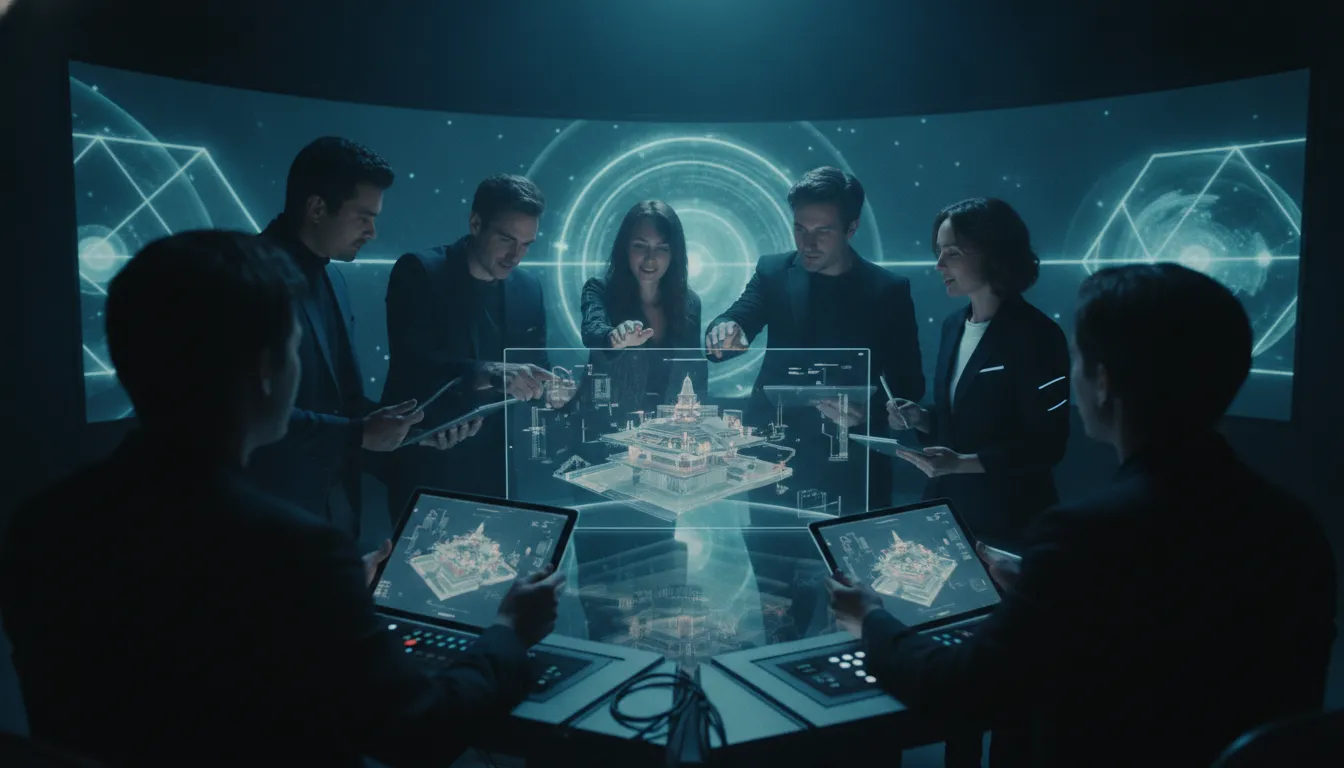

How to Vet an Immersive Experience Design Agency
Immersive experiences are no longer limited to one-off installations or promotional spectacles. Studios and brands are using location-based environments, extended reality, and virtual production to turn familiar intellectual property into worlds audiences can enter, explore, and remember. That opportunity also raises the stakes: the wrong partner can produce a visually impressive concept that fails in narrative coherence, technical execution, audience flow, or commercial purpose. Rework becomes expensive once hardware, venues, talent, and production schedules are committed.
When evaluating an immersive experience design agency, assess four strengths together: narrative craft that gives the experience emotional purpose. Technical delivery that can move an idea reliably into production. Location-based and XR capability suited to the audience and venue, and proof of branded work delivered at a comparable level of complexity. A strong partner should explain how these disciplines connect, not present them as disconnected services.
Explore Arctic7's virtual production capabilities
The distinction matters because immersive design sits at the intersection of storytelling, engineering, and operations. Before comparing pitches, it helps to clarify what this kind of agency actually does and where its responsibilities begin and end.
What an Immersive Experience Design Agency Actually Does
Immersive experience design is a multidisciplinary practice that engages people on sensory, emotional, and intellectual levels. It is not simply the addition of virtual reality to an existing campaign, or the creation of an impressive installation without a clear purpose. The strongest work gives audiences a meaningful role inside a story, world, or environment, then uses technology to make that participation feel natural.
That distinction matters when you are evaluating an immersive experience design agency. A capable partner should be able to connect the creative ambition to a practical route from concept through launch. The work begins with strategy: understanding the IP, audience, business objective, and platforms that need to work together. For an entertainment brand, that may mean defining how a fictional world can extend from a film into a game. A location-based attraction, or an XR experience without losing its identity.
From world-building to audience participation
Creative development gives that strategy form. It can include narrative design, character and environment development, interaction models, spatial storytelling, user journeys, and the visual language of the experience. The question is not only what the audience sees. It is what they discover, influence, remember, and want to explore next.
Technical execution then turns those ideas into a reliable experience. Depending on the brief, an agency may coordinate game-engine development, real-time rendering, interaction systems, motion capture, spatial audio, connected content, or production technology. This requires designers, writers, artists, engineers, producers, and technical directors to work from a shared creative and delivery plan. Without that integration, a concept can look compelling in a pitch while becoming fragile, expensive, or disconnected in production.
Why full-scope capability matters
The delivery environment may be digital, physical, or both. XR can place audiences inside a responsive world, while location-based experiences use architecture, physical effects, performers, screens, and real-time systems to create a shared event. A full-service partner understands how these layers affect accessibility, throughput, safety, maintenance, and the overall story.
Arctic7 was built around this broader view. Its capabilities span Transmedia Strategy, Game Development, Virtual Production, Cinematic Storytelling, Ecosystem Design, and Content Optimization. Together, these service lines support interconnected entertainment ecosystems that extend IP reach, deepen audience engagement, and diversify revenue streams. For IP holders and major entertainment brands. That range is the benchmark: one partner able to protect the world creatively while carrying it across the platforms and production disciplines required to make immersion work.
The Two Disciplines: Narrative Craft and Technical Delivery
Immersive work succeeds when the audience feels guided through a meaningful world rather than placed inside a collection of effects. That requires narrative craft: a clear point of view, character or story logic, emotional pacing, and an understanding of what the audience should remember after the experience ends. It also requires production muscle capable of turning that intent into a reliable, repeatable environment.
For an IP holder, the distinction matters. A concept can be imaginative yet fail in execution if the physical space, real-time content, tracking, lighting, sound, or interaction design cannot support it. Conversely, a technically impressive installation can feel empty when its mechanics are not connected to a coherent story. The right partner joins those disciplines early, so creative decisions remain achievable and technical decisions strengthen the intended experience.
Why production depth changes the creative brief
Arctic7's production background illustrates what that integration looks like in practice. The company pioneered Virtual Art Department (VAD) workflows and completed six in-camera visual effects projects with Lucasfilm. Those capabilities are not separate from experience design. They help teams test environments, align departments, and make informed creative choices before a project reaches its most expensive stages.
The scale of Ant-Man and the Wasp: Quantumania offers another useful proof point: the production involved more than 200 virtual stage walks, over 45 virtual location scouts, and eight hero sets. These figures describe more than volume. They show how a narrative world can be explored through a structured technical process, with virtual environments supporting decisions about blocking, geography, performance, and visual continuity.
Measure the outcome, not just the spectacle
Technical capability should also be judged by what it enables audiences to do. Two academic reviews of immersive and virtual-reality training report measurable benefits for learner reactions and learning outcomes. While separate research finds that immersive VR can effectively develop nontechnical skills. See the evidence in this review of VR-based training outcomes and this study of nontechnical skill development. The implication for branded experiences is practical: immersion is most valuable when it improves understanding, confidence, memory, or behavior, not when it merely surrounds visitors with technology.
When evaluating an immersive production approach, ask how the team moves from story architecture to technical prototype, and how it validates both. A strong partner can explain the creative rationale, the production workflow, and the audience outcome in the same conversation.
Evaluating Location-Based and XR Capability
Location-based entertainment and extended reality require more than an attractive concept. They demand a production partner that understands how physical space, real-time content, tracking, rendering, sound, and audience movement work together. When evaluating an immersive experience design agency, ask whether its team can take an idea from spatial narrative through technical deployment, testing, and operation.
Virtual production is a useful benchmark because it exposes the relationship between creative intent and infrastructure. Epic Games reported that the number of LED virtual-production stages grew from just three in 2019 to approximately 300 globally by October 2022. That expansion signals a broader shift: audiences and IP owners increasingly expect worlds to exist across physical venues. Screens, games, and interactive environments, rather than in one linear format.
The agency should be able to explain what changes when an experience moves from a cinema screen to a location-based installation. How will the environment respond to guests? What happens when several people move through the space at once? How are latency, brightness, sightlines, safety, accessibility, and content updates handled? These questions separate a functioning experience from a compelling pitch deck.
Ask for concrete examples of the underlying stack. A representative LED stage at Universal Studios Lot used approximately 2.8mm pixel pitch. Around 200 ROE Black Pearl 2v2 LED panels, Brompton SX40 processors, OptiTrack optical tracking, and Unreal Engine render nodes. The point is not that every project needs this exact configuration. The point is that a credible partner can discuss why a particular combination of display. Processing, tracking, and real-time rendering was selected, and how those choices affect the audience experience.
Unreal Engine's overview of virtual production is a useful primer for nontechnical stakeholders. In a pitch, however, look beyond software familiarity. Request a walkthrough of the agency's workflow, including previsualization, asset optimization, calibration, live operation, maintenance, and handoff to venue or production teams.
Arctic7 announced expanded immersive, XR, and spatial-computing capabilities in March 2025, extending its transmedia approach into experiences where audiences can interact with worlds in real time. Its virtual production services and immersive design services reflect the kind of connected capability IP owners should investigate: not a standalone installation. But an experience that can reinforce a larger ecosystem across games, film, television, and live environments.
How to Assess Proof of Branded Work
A polished reel can demonstrate taste, but it cannot by itself prove that an agency can protect and extend a valuable intellectual property. When you review an immersive experience design agency, look for evidence that connects creative ambition to accountable delivery. The strongest portfolios make it possible to understand what the property was, what the studio was responsible for, and how the work advanced the broader audience experience.
Start with named franchises and named partners. Vague references to "global brands" make comparison difficult. A credible case study should identify the IP, the production context, and the agency's contribution without disclosing confidential information. Ask whether the team worked on story development, physical production, virtual production, interactive systems, game development, or the connective strategy between them. This distinction matters when your goal is to build an interconnected world rather than a one-off attraction.
Look for measurable scale, not adjectives
Scale should be visible in production metrics. For example, Arctic7's work connected to Ant-Man and the Wasp: Quantumania included more than 200 virtual stage walks, over 45 virtual location scouts, and eight hero sets. Those details reveal the complexity of the work more effectively than phrases such as "world-class" or "end-to-end." They also give a prospective client useful questions to ask: How many locations were evaluated? How were creative decisions documented? Which workflows reduced production risk?
Technical proof should be equally concrete. Arctic7 pioneered Virtual Art Department workflows and completed six in-camera visual effects projects with Lucasfilm. That kind of evidence indicates familiarity with the demands of established franchises, where continuity, approvals, security, and visual consistency are as important as the final image. If a portfolio cites Netflix-scale production work, ask for the relevant role, delivery scope, and outcome rather than treating the brand name as a substitute for detail.
Test the breadth of the IP ecosystem
Finally, check whether the portfolio extends beyond a single medium. Can the partner translate a world into games, film, television, XR, location-based experiences, and physical or extended-reality environments? Review the studios and specialist entities behind the work, including Narwhal Studios, Arctic7's virtual-production entity. The objective is not to collect the longest client list. It is to verify that the proposed partner has the creative, production, and technical depth to make each expression feel like part of the same world.
Before selecting a team, request two or three case studies with references, responsibilities, delivery constraints, and measurable outcomes. A portfolio becomes meaningful when it lets you assess repeatable capability, not merely admire finished work.
Red Flags and Green Flags in an Agency Pitch
A polished pitch is not the same as delivery readiness. When you evaluate an immersive experience design agency. Look past the mood film and ask whether the team can carry an idea from world-building through production, deployment, and measurement. The strongest partners make their contribution legible: they show what they built, explain how it worked, and identify the people and systems responsible for the result.
Use the contrast below as a practical filter. A red flag does not automatically disqualify a studio, but it should trigger a precise follow-up question. A green flag indicates evidence you can verify, not simply a confident claim.
| Red flag | Green flag | What to verify |
|---|---|---|
| No named work, client references, or accountable team members | Verifiable franchise credits, references, and clear project roles | Confirm the agency's actual scope, dates, deliverables, and client contact. |
| A pitch built around visual concepts with no technical pipeline | Documented VAD, ICVFX, Unreal, tracking, and deployment capability | Ask who owns previs, content systems, hardware integration, testing, and onsite operations. |
| Pitch-only demos presented as finished experiences | Shipped location-based, XR, or spatial-computing work | Request a live walkthrough, operating constraints, audience metrics, and lessons from launch. |
| A single-skill shop that stops at strategy or visual design | End-to-end strategy, creative, technical production, and optimization | Map the handoffs from narrative development to build, deployment, and iteration. |
| Generic claims about scale, engagement, or innovation | Specific outcomes, production metrics, and evidence tied to the brief | Separate the agency's contribution from the wider production's result. |
Technical fluency should be visible in the questions the team asks, not just in the software logos on a slide. Can they discuss latency, content versioning, tracking, safety, accessibility, queue management, and the realities of maintaining an experience after opening? A credible partner will also explain where a proposed system is unnecessary or risky. That restraint is often more valuable than adding another layer of technology.
Portfolio depth matters just as much. For an IP holder, a relevant credit should demonstrate more than aesthetic similarity. Look for evidence that the team respected canon, translated a world across formats, and collaborated with production, legal, technology, and audience teams. An agency that can connect strategy, creative execution, and technical excellence is better positioned to extend an IP into an interconnected entertainment ecosystem. Claims about that breadth should still be tested against named work and references, rather than accepted as positioning alone.
Finally, ask for the uncomfortable details: what failed, what changed, and what the team would do differently. Green flags include candid postmortems, realistic budgets, and a delivery plan that names dependencies. Those signals tell you whether you are choosing a production partner or simply buying an impressive presentation.
Building Your Shortlist and Asking the Right Questions
A strong shortlist is not simply a collection of agencies with impressive reels. It is a working hypothesis about which partner can carry your idea from strategic intent to a finished experience. Within the constraints of audience, venue, technology, schedule, and budget. Begin with three to five candidates whose relevant experience matches the ambition of your project. Then ask each one to respond to the same core questions so you can compare substance rather than presentation style.
Can you deliver the full production pipeline?
Ask the agency to map its role from discovery and concept development through design, prototyping, production, installation, launch, and post-launch support. Which capabilities are handled in-house? Which depend on freelancers, vendors, or partner studios? A credible answer should identify owners, dependencies, approval gates, and the point at which technical feasibility is tested. If the agency only presents the creative layer, you may be left to coordinate the production risk yourself.
Request a sample schedule for a project of similar complexity. Ask what typically causes delays, how changes are managed, and who has authority to make decisions when creative and technical requirements conflict. You should also understand the agency's experience with content versioning, real-time engines, tracking, rendering, audio, interactive systems, and venue operations where those elements apply.
How do you approach XR and location-based delivery?
Ask for examples that show more than a headset prototype or a polished concept image. Can the team design for the physical realities of a venue, including visitor flow, accessibility, safety, staffing, maintenance, and repeat use? For XR, ask how the experience behaves across devices, how latency and tracking are managed, and what happens when a sensor, network connection, or rendering system fails. For location-based work, ask who owns installation, commissioning, testing, and technical support after opening.
The agency should be able to explain its virtual production workflow in terms a creative and production leadership team can evaluate. Clarity is more valuable than a list of tools.
What proof can you provide?
Ask for two or three comparable case studies, not only the largest names in the portfolio. Look for evidence of branded collaboration, production scale, measurable outcomes, and the agency's specific contribution. Ask to speak with a reference if the project is confidential. Finally, have the agency separate creative fees, technical production, hardware, travel, licensing, venue costs, and ongoing support in its budget. Clarify who owns the creative assets, source files, software licenses, and audience data. The right partner will make those commercial and operational questions easier to answer, not harder.
Frequently Asked Questions
What does an immersive experience design agency do?
An immersive experience design agency develops experiences that engage audiences through narrative, spatial design, technology, and interaction. Depending on the brief, its work may include strategy, creative direction, game development, cinematic storytelling, virtual production, XR, and content optimization. The strongest partners connect those disciplines rather than treating them as separate deliverables.
How do you choose the right immersive experience design agency for your project?
Start with the experience objective, audience, format, and production constraints. Then assess whether each agency can show relevant work at a comparable scale, explain its creative and technical process, and identify the specialists responsible for delivery. Ask for evidence of collaboration across physical environments, digital platforms, and the wider IP ecosystem, not just polished concept images.
Does an immersive experience design agency handle both physical and digital production?
Many do, but the scope varies. Confirm whether the team can design the physical environment and coordinate the digital layer, including interactive systems, real-time content, XR, spatial computing, or virtual production. Also establish which capabilities are in-house and which depend on external vendors, since that distinction affects accountability, schedule, and budget.
What should I look for in an agency portfolio when vetting them for immersive projects?
Look for named clients or properties, a clear explanation of the agency's role, production scale, technical constraints, and measurable outcomes. A credible portfolio should show how the team moved from strategy and world-building to execution, testing, and launch. Request references or case-study detail where the public portfolio does not explain the decision-making behind the work.
How is the success of an immersive experience project typically measured?
Measurement should reflect the project objective. Useful indicators can include attendance, dwell time, repeat participation, completion rates, audience sentiment, engagement across connected platforms, lead quality, or downstream commercial activity. Agree on the measurement framework before production begins so creative decisions and technical investment can be evaluated against business and audience outcomes.
Ready to Evaluate Your Next Experience Partner?
A useful partner evaluation conversation should cover more than a portfolio. Discuss the audience journey, the role of narrative, technical delivery requirements, production responsibilities, and how success will be measured. Arctic7's transmedia model connects strategy, creative development, and production across games, film, and virtual production. Helping studios and brands assess an experience as part of a larger entertainment ecosystem. If you are comparing partners or shaping an upcoming brief, contact us to discuss the opportunity and the capabilities it requires.
New Immersive & XR Media Capabilities Added to Arctic7's Suite of Games, Film & TV and Digital Services

Arctic7 Shares Details of its Work on Skeleton Crew and Cinematics Partnership with Fateless

The Human Touch: Adding Personality to Project and Product Management
Whether it’s your team, your client, or your stakeholders, understanding the human dynamics is just as critical as hitting milestones.

McDonald's Case Study: Bridging Brand and Play | Arctic7
Bridging Brand and Play: An Interview with Lindsay Blenkhorn Daggitt