


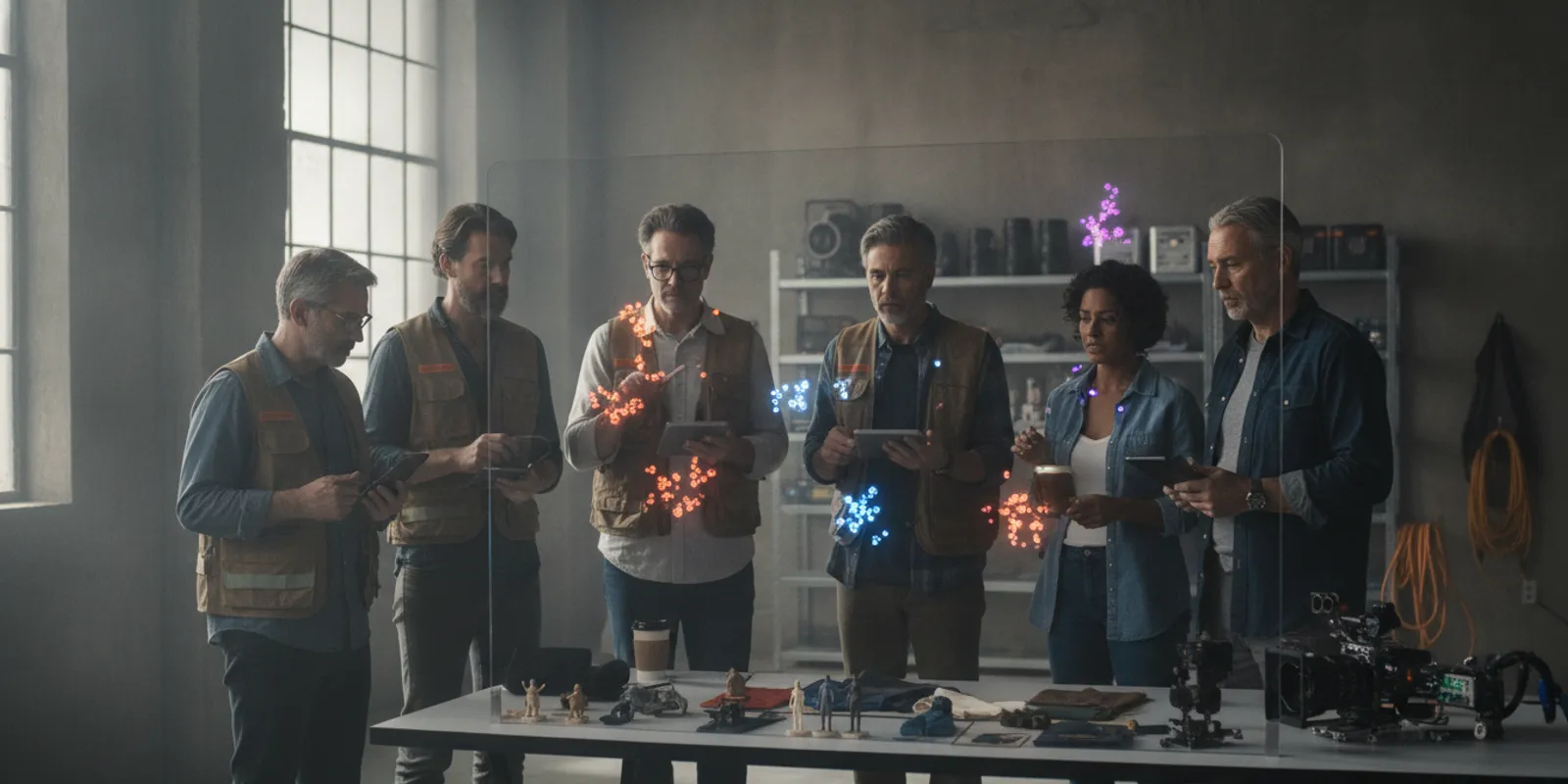

Film Production Project Management: A Framework for Multi-Format Teams
Film production project management is not simply the task of keeping a schedule current. For an IP holder building a film or television production that may connect with games, immersive experiences, or other formats, it is the discipline of turning creative ambition into a coordinated plan: one that protects the story, makes ownership visible, and gives teams a dependable route from development through delivery. The work starts before a crew is fully assembled, with shared decisions about scope, authority, dependencies, and what success means.
Andrew MacLusky, CPO
Explore production support with Arctic7
What does film production project management need to coordinate?
At its core, film production project management coordinates creative decisions and production realities. A usable plan connects the story and audience promise to the people, assets, approvals, technology, and dates required to deliver it. It makes decisions legible across departments rather than assuming that everyone shares the same context. The best plan is not the most elaborate one; it is the one that helps the right people act at the right time.
On a single-format production, teams already manage complex handoffs among development, creative, production, post, marketing, and distribution. A project connected to a wider intellectual property ecosystem adds further questions. Which elements should remain consistent across formats? What can each team develop independently? Who has authority when a change in one deliverable affects another? Answering these early can prevent late-stage surprises without prescribing every creative choice in advance.
A project manager or producer should help make the following visible:
- Purpose and boundaries: the audience, intended experience, approved scope, and elements that are outside the current commitment.
- Accountability: the people who recommend, decide, create, review, and accept each major deliverable.
- Dependencies: decisions or assets that one team needs before it can begin or complete work.
- Control points: the moments when stakeholders review progress, resolve trade-offs, or authorize a change.
- Delivery evidence: what must be complete, checked, and handed over for a milestone to count as done.
These are not administrative details separate from the creative process. If the writing team, production team, and rights stakeholders use different assumptions about a character, location, or approval deadline, the production plan is already carrying risk. Clear coordination gives creative leaders room to focus on the work while making it easier to identify when a decision needs their attention.
How should film production project management begin?
Begin with a short alignment phase before treating a preliminary idea as a fixed production commitment. Bring the decision-makers and delivery leads together to define the project’s intent, clarify what is known and unknown, and agree on how the team will resolve open questions. The outcome should be a working brief and a first map of responsibilities, dependencies, and approvals—not an artificial promise that every detail is settled.
A practical kickoff can be organized around six prompts:
- What are we making, and for whom? Describe the audience experience and the central creative promise in plain language.
- What is in scope now? Separate committed deliverables from future possibilities. A universe may be expandable, but the current production still needs boundaries.
- What must remain coherent? Identify established story facts, character principles, visual rules, and rights constraints that teams need to respect.
- Who decides? Name the accountable decision-maker for each important area, including creative approvals, budget or scope trade-offs, and technical acceptance.
- What needs to happen first? Surface prerequisites such as a script decision, design approval, access to reference material, or a production technology test.
- How will change be handled? Agree on where requests are logged, who assesses their impact, and how decisions are communicated to affected teams.
Record assumptions separately from confirmed decisions. This simple practice keeps a plausible working idea from silently becoming a requirement. For example, a team may be planning around a location or format that has not received final approval. Marking it as an assumption makes its status visible, assigns someone to confirm it, and gives scheduling discussions a realistic caveat.
At this stage, do not confuse a polished presentation with alignment. Ask each lead to explain their understanding of scope, major milestones, and decision rights. Differences are useful signals. They reveal where the brief needs clarification before those interpretations turn into separate work plans.
How do you choose the right production delivery model?
No single delivery model suits every production. A project may need one partner to lead a complete production, an established studio to share development with another team, or a specialist to solve a defined problem. The right choice depends on the capabilities already in place, how much control the owner wants to retain, and whether responsibilities can be joined up across the work.
Use the comparison below as a starting point. The descriptions are decision prompts, not fixed industry rules; an engagement can combine elements from more than one model.
| Delivery model | Useful when | Ownership to clarify | Watch for |
|---|---|---|---|
| Full-scale development | The owner needs a partner to organize and deliver a broad scope from concept through production. | Creative approvals, scope control, acceptance, and handover. | Unclear boundaries between partner execution and owner sign-off. |
| Co-development | An existing studio and a partner need to contribute together and share creative or technical decisions. | Which decisions are shared, which are delegated, and how conflicts are resolved. | Parallel plans, duplicate work, or assumptions about who owns a deliverable. |
| Specialist support | A team has a defined gap, such as narrative development, systems design, or a technical workflow. | Inputs, outputs, review windows, and integration into the broader plan. | A useful specialist deliverable arriving too late or in a format the production cannot use. |
When evaluating partners, discuss the operating model as carefully as the creative credentials. Ask who will coordinate across departments, what decisions remain with your organization, how the partner reports issues, and what happens when the agreed scope changes. If multiple organizations are involved, identify a named point of integration on each side. A collection of capable teams does not automatically function as one production team.
Arctic7 works across game development, virtual production, cinematic storytelling, and transmedia strategy as well as other service lines. A partner with experience across formats can help connect film and television work to the wider IP plan, while a production still needs clearly bounded deliverables and accountable decision-makers. Explore the game development capability or virtual production work when those disciplines are relevant to the project.
Which decisions and dependencies should the plan map?
A dependable schedule is built from relationships among work, not just from a list of dates. Map the decisions and assets that other teams depend on, then give each one an owner and a needed-by point. The goal is to show where a delay or revision could affect other work, so leaders can intervene while options remain open.
For a multi-format IP project, a simple dependency map might include:
- Story decisions: outline, script, character, world, and continuity approvals that guide downstream creative work.
- Design inputs: visual direction, environments, props, and reference materials needed by production or partner teams.
- Production readiness: confirmed scope, team capacity, access, technical tests, and workflow decisions.
- Review windows: dates when stakeholders can provide consolidated feedback rather than fragmented comments arriving over time.
- Cross-format connections: information another format needs, plus what it can safely develop without waiting for the film or television schedule.
- Delivery and handover: required files, documentation, rights checks, technical review, and the receiving team’s acceptance.
Map only meaningful dependencies. A schedule that links every small task to every other task becomes difficult to use. Focus on items that can block progress, create expensive rework, or change what another team is building. For each critical dependency, record the input, provider, recipient, decision owner, expected date, and fallback if it is late.
Then test the map with the people doing the work. A milestone may look reasonable to an executive while depending on a review cycle that does not leave time for revisions. A post-production handoff may assume that assets are approved in a form the receiving team can actually use. The conversation is not about assigning blame; it is about exposing assumptions early enough to adjust them.
Cross-format work benefits from a distinction between continuity dependencies and production dependencies. Continuity dependencies describe story or world information that should align across formats. Production dependencies describe assets, approvals, or technical outputs required to proceed. A game team may need a stable character principle without needing to wait for every finished film asset. Separating the two lets teams collaborate without turning every creative choice into a schedule blocker.
How can the team protect creative alignment without slowing decisions?
Creative alignment does not require every stakeholder to approve every detail. It requires agreement on which principles guide the work, who interprets them, and where an exception needs escalation. Set this up as a practical governance system: define decision categories, assign accountable owners, and reserve broader reviews for questions that affect the project’s creative promise or business direction.
One useful method is to group decisions into three levels:
- Team-level decisions: day-to-day choices within an approved brief, handled by the lead closest to the work.
- Cross-functional decisions: choices that affect another department or format and need input from the relevant leads.
- Executive or rights-holder decisions: changes to scope, core story principles, material commitments, or other matters reserved for senior approval.
For each level, state who recommends, who decides, who must be consulted, and who needs to know. Keep a concise decision log with the question, options considered, decision, owner, date, and affected work. This is especially important when contributors work across locations or organizations. A log preserves context so that a later team does not reopen an issue simply because it cannot find the original reasoning.
Use reviews to resolve defined questions. Sending a large package with a general request for feedback invites uncoordinated opinions. Instead, tell reviewers what is ready, what decision is needed, what is still open, and when input is due. Consolidate responses through an accountable owner, then communicate the decision and its consequences to the people doing the work.
A change process should be lightweight but real. When a request arrives, assess its effect on creative intent, scope, schedule, dependencies, and other formats. The decision-maker can then accept it, defer it, or decline it with a clear record. This does not remove uncertainty from production. It makes the trade-offs explicit and prevents a series of small, untracked revisions from changing the project by default.
For franchise work, a shared creative framework can support consistency without requiring identical outputs in every medium. A film, series, or game may have different pacing and audience interaction. Define the durable principles—such as character motivation, world rules, or thematic intent—and give each format’s creative leads room to express them in ways suited to that medium. Strategy should guide creative execution, not flatten it.
What should a production blueprint include?
A production blueprint turns strategic intent into coordinated work. It gives the team enough detail to start responsibly and enough flexibility to respond as new information emerges. It should be a working document with owners and dates, not a static deck that becomes disconnected from the production as soon as circumstances change.
A useful blueprint includes:
- Creative brief: audience, premise, intended experience, approved scope, and creative principles.
- Deliverable map: the outputs for each workstream, their owners, and the criteria for review and acceptance.
- Integrated milestone plan: key decisions, production stages, reviews, handoffs, and dependencies.
- Governance: decision rights, escalation path, review cadence, change control, and a current decision log.
- Resource and partner assumptions: the skills, teams, external inputs, and capacity the plan depends on.
- Risk and issue approach: a place to record emerging concerns, a responsible owner, and the next action.
- Communication plan: who needs which information, where it lives, and how updates reach all contributors.
- Delivery and handover: the receiving team, technical and creative checks, documentation, and acceptance process.
Keep the blueprint proportionate. A short discovery effort does not need the same operating detail as a complex production with multiple external teams. Start with the decisions and interfaces that matter most, then expand the plan when scope or coordination demands it. A plan that nobody maintains is worse than a smaller plan that the team actually uses.
Use a regular operating cadence to keep information current. A weekly working review can surface blockers and confirm near-term actions; a separate milestone review can resolve bigger scope or creative decisions. The right rhythm depends on the work. The important point is that routine status reporting and decision-making serve different purposes. Do not make every participant attend every meeting just to hear information that could be shared clearly in writing.
Match the blueprint to the project’s delivery arrangement. A full-scale partner may maintain an integrated production plan, while an owner still needs visibility into reserved approvals and acceptance. Co-development requires explicit shared planning and a route for resolving conflicting priorities. Specialist work needs clear inputs and a planned point of integration. For background on the disciplines involved in film projects, the Project Management Institute’s overview of project management at the movies discusses the distinct roles of director, producer, and production manager as foundational members of a film project team.
When should virtual production or other technical workflows enter the plan?
Bring technical workflow decisions into planning when they can influence creative choices, production readiness, or the timing of downstream work. Do not treat technology as a late add-on if the production depends on it for environments, visualization, capture, or coordination between on-set and post-production teams. At the same time, select a workflow for a defined creative and production need, not because a tool is fashionable.
Start by asking what the team needs to see, test, or decide earlier than it otherwise could. Then identify the required assets, technical setup, people, review process, and fallback plan. A test or proof of concept should answer a specific question. If the team cannot state what decision the test will inform, it may be too early to commit production time and resources to it.
Virtual production can bring creative and technical stakeholders into closer collaboration, but the work still depends on preparation and clear ownership. Determine who approves digital environments, how changes are versioned, what must be ready before a shoot, and how production and post-production coordinate. Narwhal Studios is Arctic7’s virtual-production entity and provides a concrete example of the company’s work in this area; the Narwhal Studios page outlines that capability.
For an IP owner, the wider question is how a technical choice affects the ecosystem. Could assets support more than one approved use? What needs to be created specifically for the production, and what can be reused under the applicable creative and rights decisions? Which downstream teams require access, and in what form? Planning these interfaces early can help avoid a situation where one department finishes valuable work that another cannot practically use.

How should leaders measure progress and respond to change?
Measure progress through evidence that the work is ready to move forward, not through activity alone. A meeting held or a percentage reported does not prove that a decision has been made or a deliverable is usable. For each milestone, agree on what must be true before it is marked complete. That evidence could be an approved brief, a reviewed asset, a tested workflow, or an accepted handover.
Leaders can review a compact set of signals:
- Decision health: Are required approvals happening when planned, and are unresolved decisions assigned to an owner?
- Dependency health: Are critical inputs arriving in time, and do downstream teams understand any changes?
- Scope stability: Are new requests being assessed and recorded rather than absorbed invisibly?
- Deliverable readiness: Do outputs meet the agreed review and acceptance criteria?
- Team alignment: Do the leads share the same view of the next milestone and its constraints?
These signals should lead to action, not become a scorecard detached from production. If an approval is late, ask what decision is missing, who can make it, and what work is affected. If scope is changing, clarify whether the change is intentional and what trade-off it requires. If one team repeatedly receives unusable inputs, revisit the interface and acceptance criteria instead of treating every handoff as an isolated failure.
Replanning is part of responsible project management. When an assumption changes, update the schedule and dependency map, communicate the impact, and record the decision. Preserve the original context where useful, but make the current plan unmistakable. This helps executives see where choices are needed and helps production teams avoid working from outdated instructions.
It also helps to distinguish a risk from an active issue. A risk is a possible event that may affect delivery; an issue is already affecting the work. Both need an owner and a next action, but the response differs. The purpose is not to predict every problem. It is to make important uncertainties visible and to give the team a way to act before a manageable concern becomes a larger disruption.
How can IP holders prepare for a production partner conversation?
A productive partner conversation starts with the choices the owner needs to make, not a vague request for a proposal. Share what the project is intended to accomplish, what is already decided, where expertise or capacity is missing, and what kind of responsibility you expect a partner to take. The more clearly you describe the boundaries, the more useful a partner’s recommended approach can be.
Before the conversation, gather a concise set of materials:
- A short description of the IP, intended audience, and creative opportunity.
- The current scope, including confirmed deliverables and options still under consideration.
- Known dates, approval requirements, and dependencies that affect readiness.
- A view of the existing team and the capabilities you want to add or complement.
- Any relevant story, visual, technical, or rights guidance that prospective collaborators need to understand.
- The intended delivery model, if known, and the decisions you expect to retain.
Then ask prospective partners how they would organize the work. Who would lead coordination? How would creative alignment be maintained across formats? What would they need from your team before work begins? How do they make risks and changes visible? What does a useful first phase produce? Clear answers reveal whether the proposed collaboration fits the project’s real needs.
Arctic7 positions itself as a transmedia partner for IP holders, studios, publishers, and developers seeking to connect entertainment across formats. Its transmedia work and project portfolio can help decision-makers understand the range of work that may intersect with a production plan. For broader context on the organization and its capabilities, review Arctic7’s team and services.
The aim is not to outsource every decision. It is to identify where a partner can add creative, production, or technical capability while keeping the owner’s responsibilities clear. A strong conversation should end with a shared understanding of the next decision, the information needed to make it, and the people who need to be involved.

Frequently asked questions
What is film production project management?
It is the coordination of a production’s creative goals, scope, people, decisions, dependencies, schedule, and delivery. For an IP project that spans formats, it also helps teams stay aligned on shared story principles while managing the different needs of film, television, games, or immersive work.
Who should own film production project management?
Ownership depends on the engagement model and the production’s structure. A producer or project lead may coordinate the integrated plan, while creative, technical, and rights holders retain decisions assigned to them. The important step is to document decision rights and the route for resolving cross-team issues.
How early should a project manager be involved?
Involve production coordination while scope, delivery approach, and major dependencies are still being shaped. Early involvement gives the team a chance to test assumptions and build a workable sequence before substantial downstream work depends on unsettled decisions.
How do you manage creative changes during production?
Log the request, assess its effect on creative intent, scope, schedule, dependencies, and other formats, then route it to the appropriate decision-maker. Communicate the result and update the working plan so every affected team is using the same direction.
Can film production project management support a larger IP ecosystem?
Yes. A production plan can identify the shared story principles, cross-format decisions, and deliverables that other teams need while still giving each medium room to work in its own way. It is most useful when owners distinguish genuine dependencies from information that teams can develop independently.
Discuss your production and multi-format goals with Arctic7
Start with a clear creative promise, make ownership and dependencies visible, and keep the plan current as decisions change. That framework gives production leaders and IP holders a more dependable foundation for delivering work across formats.
New Immersive & XR Media Capabilities Added to Arctic7's Suite of Games, Film & TV and Digital Services

Arctic7 Shares Details of its Work on Skeleton Crew and Cinematics Partnership with Fateless

The Human Touch: Adding Personality to Project and Product Management
Whether it’s your team, your client, or your stakeholders, understanding the human dynamics is just as critical as hitting milestones.

McDonald's Case Study: Bridging Brand and Play | Arctic7
Bridging Brand and Play: An Interview with Lindsay Blenkhorn Daggitt


