


Film Production Budget Template for IP Holders
A film production budget template is more than a list of line items. For an IP holder, it connects the story you intend to tell with the people, locations, technology, rights, and deliverables needed to make it—and clarifies how those choices might affect future formats. A useful template makes assumptions visible early, so creative ambition and production scope can be discussed together.
Talk with Arctic7 about a production plan
By Andrew MacLusky, CPO
This guide provides a practical framework for building a film-specific budget, not a financing plan or a substitute for a line producer’s project-specific estimate. Use it to structure conversations, compare scenarios, and identify costs that can be overlooked when a property may extend beyond one film.
What Should a Film Production Budget Template Include?
A dependable film production budget template groups costs by production phase and makes each estimate traceable to a scope assumption. It should distinguish costs that happen once from costs that grow with days, locations, versions, or deliverables. Keep the first pass readable: a decision-maker should be able to see what the project includes, what remains provisional, and what could change the total.
Start with these top-level sections, then add project-specific detail beneath each. This structure is intentionally broad; actual line items depend on the script, production model, labor and jurisdictional requirements, schedule, and delivery plan.
| Budget section | Typical planning items | Key assumption to record |
|---|---|---|
| Development and prep | Script development, research, breakdown, design, planning, tests | What work is needed before principal photography? |
| Cast and crew | Cast, departments, production management, payroll-related costs | How many people, days, and prep or wrap periods? |
| Locations and production | Stage or location use, sets, equipment, transport, catering, safety | How many locations and shoot days are assumed? |
| Virtual production and VFX | Environment creation, stage planning, capture, on-set and post VFX | Which assets and shots are required, and when? |
| Post and delivery | Editorial, sound, music, color, finishing, versions, delivery materials | What final formats and review rounds are in scope? |
| Rights and clearances | Underlying rights, options or licenses, music, archive, legal review | Which rights, territories, terms, and uses need confirmation? |
| Contingency and cross-platform assets | Defined reserve, reusable art or story assets, adaptation materials | What uncertainty or approved future use is being covered? |
Make the spreadsheet useful for both production and leadership. Include columns for account or cost code, description, quantity, unit, rate or estimate, total, owner, status, assumption, and notes. Add separate fields for estimate date and version. If a number is not yet supported by a quote or firm scope, label it as an assumption rather than presenting it as settled.
A consistent unit makes the estimate easier to review. A crew line might be calculated by person-days, a location line by days of access, and a post task by a defined package or number of versions. The template does not need to force every cost into the same unit; it needs to show how the estimate was formed. Where the appropriate unit is not clear, record the method and the person expected to validate it.

How Do You Build a Film Production Budget Template That Fits the Project?
Build the budget from the creative and production plan, not from a round number chosen before the scope is clear. Work from the script and intended audience experience toward the resources and schedule required. For an IP holder, add an explicit question at each stage: which choices serve this film, and which choices also support the wider world or future formats?
- Define the production boundary. State what the current budget covers: development only, prep through delivery, or another defined scope. Name the intended cut, formats, versions, and deliverables. List what is excluded so later requests can be evaluated consistently.
- Break down the story. Identify cast, locations, sets, effects, stunts, props, wardrobe, picture vehicles, special equipment, and other script-specific needs. Note elements that recur or require advance design. The breakdown is a planning input, not a final quote.
- Build a schedule scenario. Translate the breakdown into prep, shoot, and post assumptions. Capture days, locations, company moves, day/night work, and post milestones can all affect staffing and equipment needs. Record the relationship between each estimate and the schedule.
- Assign cost owners. Ask the relevant department or production lead to validate estimates within their area. Identify whether a number is quoted, benchmarked, or still a placeholder. This makes uncertainty visible instead of burying it in a single total.
- Separate base scope from options. Put required deliverables in the working budget and show optional enhancements or future-format work in clearly marked scenarios. Do not quietly add speculative expansion costs to the base production.
- Review, revise, and version. When a creative or schedule assumption changes, identify affected line items and update the estimate date and version. Preserve the prior version so stakeholders can understand why the plan changed.
Consider a simple example. A script calls for a night exterior at a location that also appears in two later scenes. In the first estimate, list access, lighting, transport, and any location-specific production requirements against the relevant shoot days. Then make the schedule assumption explicit: if the scenes can be grouped, some setup work may be shared; if the schedule separates them, repeated access or setup may need separate consideration. The template should not decide which schedule is right. It should make the cost consequence of each scenario discussable.
Use the same scenario logic for creative choices. If a practical set and a digitally extended environment are both under consideration, show the scope assumptions for each, including design, construction or asset work, shooting needs, and post responsibilities. A comparison is useful only when both options describe the same story beat and delivery expectation. Avoid comparing a complete solution in one column with an incomplete placeholder in another.
For documentary-specific context, the International Documentary Association’s introduction to documentary budgeting describes budgeting and scheduling and notes an accompanying Excel budget/schedule template. It is a useful reference point for the relationship between a schedule and a budget, but a scripted film, franchise project, or multi-format production may require additional sections and project-specific assumptions. Explore the IDA’s documentary budgeting and scheduling resource.
Which Costs Are Easy to Miss in Film Production Budgeting?
The most useful budget is not necessarily the one with the most rows. It is the one that makes consequential assumptions easy to find. For IP-led projects, often-overlooked areas include early development work, rights questions, asset creation, and the handoff between production and post. Ask who owns each cost and which decision would cause it to change.
Development and creative preparation
Allow space to understand the property before production commitments harden. Depending on the project, planning may include script work, research, story or character review, visual development, script breakdowns, technical tests, and production design. These activities help teams see production implications earlier. They do not guarantee that every issue will be resolved before filming; they make it possible to identify open decisions and their potential budget effect.
Separate development questions from production-ready deliverables. For example, an early visual exploration may help a team compare possible approaches, while a production asset may need a specified format, level of detail, approvals, and handoff date. Recording each activity and its purpose prevents a broad label such as “design” from concealing different kinds of work. It also makes it easier to pause or defer exploratory work without confusing it with an approved production requirement.
Crew, locations, and schedule dependencies
Do not budget only for shoot days. Prep and wrap periods, travel, accommodation where applicable, equipment, location access, construction, security, transport, and company moves can be part of the production picture. The right line items depend on location, labor arrangements, production design, and schedule. Keep the underlying assumptions beside the estimate so a change in days or locations is not mistaken for a small adjustment.
A practical review asks what changes when a scene moves from one day to another or one location to another. Does the move require a different crew call, equipment package, access window, transport plan, or setup? Are cast and department needs the same across the revised days? A budget that links these questions to schedule assumptions makes trade-offs visible before stakeholders compare only bottom-line totals. Avoid silently leaving a line unchanged when the condition behind its estimate has changed.
Virtual production, VFX, and post-production
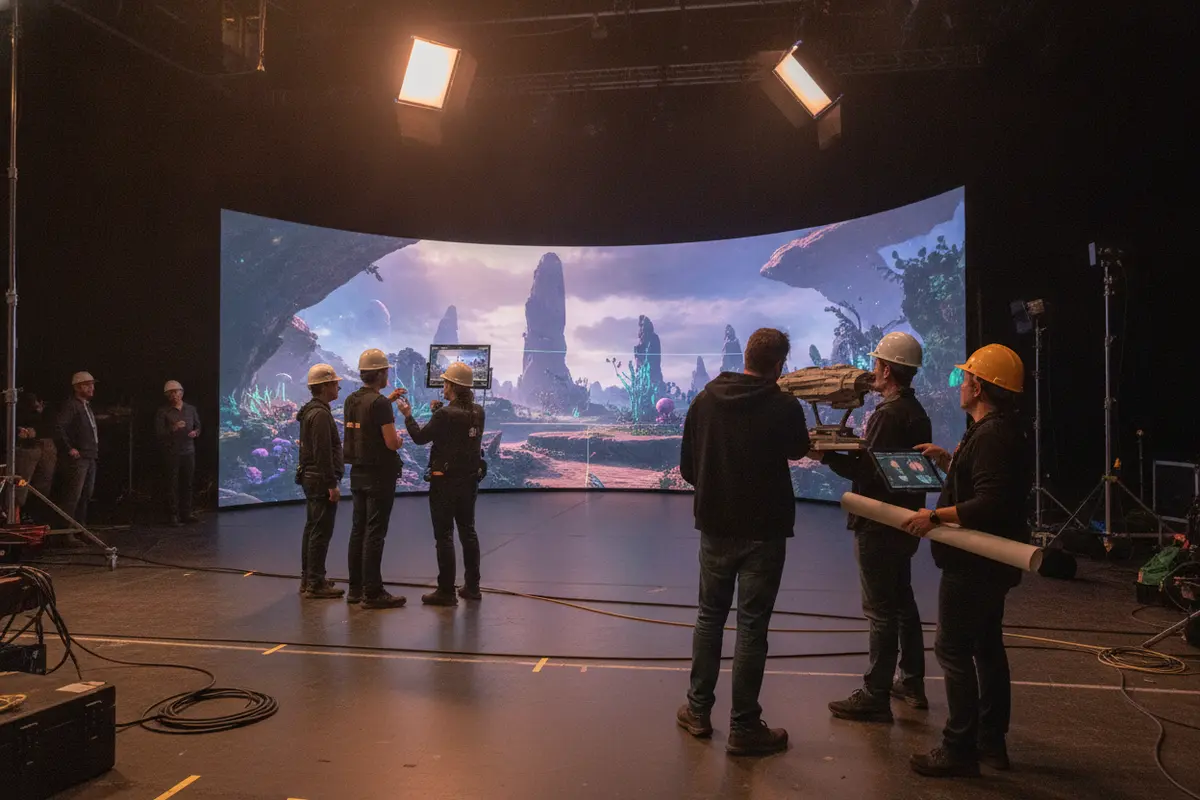
Virtual production is a workflow choice with both creative and operational implications, not simply a stage rental line. Budget planning may need to account for environment and asset creation, technical preparation, stage time, real-time content, crew, capture, and downstream visual-effects work. Identify what is built before the shoot, what is created on set, and what remains for post. Otherwise, the same work can be omitted or counted twice.
Map each visual task to a phase and a clear handoff. For an environment, for example, ask whether the work is concept exploration, a camera-ready environment, an on-set adjustment, or a post-production refinement. Clarify who supplies source files, what review is required, and when a decision must be made to protect the schedule. These are scope questions, not universal cost assumptions. The production team can then compare a virtual-production approach with alternatives against the same creative objectives and expected final images.
Arctic7’s virtual production capability provides context for this kind of workflow discussion. For another view of Arctic7’s studio work, see Orbital Virtual Studios. The relevant budget structure still depends on the creative brief, production design, assets, and delivery needs of the individual film.
Rights, clearances, and approvals
Rights-related work should be a visible planning area, even when the answer is not yet known. Consider the underlying property and any planned use of music, archival material, artwork, trademarks, or other third-party elements. Record the question, responsible owner, status, and use that needs to be cleared. Do not assume that film rights automatically cover every platform, territory, promotional use, or future adaptation. Confirm rights and legal requirements with qualified advisers for the specific project.
Make the line item informative without pretending to resolve the legal question. A useful register might note the element, the intended scene or use, the party expected to confirm status, and the date by which the answer is needed. If permission or availability remains uncertain, show that status plainly and describe the next decision or alternative under consideration. This is especially helpful when a creative choice affects more than one format: an element planned for a film and a later game may require separate review of the actual intended uses.
Cross-platform asset costs
A film may create characters, environments, props, designs, story material, and production assets that could be relevant to games, series, or immersive experiences. Future usefulness is not automatic: assets may need different formats, technical specifications, permissions, or creative development. Keep film-required work separate from optional reuse or adaptation work. If a future use is approved, identify its deliverable, owner, rights basis, and intended handoff rather than treating “reusable” as a budget line with no definition.
For each candidate asset, ask whether it already exists as part of the film deliverable or whether reuse requires additional preparation. A model created for a particular shot may not be organized or documented for another team. A story element may need new development rather than simple transfer. These distinctions help an IP holder avoid both extremes: assuming every film asset is automatically ready for another medium, or overlooking a deliberate opportunity to plan for a defined later use.
For a property intended to extend across media, an interconnected transmedia approach can help frame how the film fits into a broader ecosystem. Decisions about reuse should remain grounded in the actual creative and production plan. The film’s own objectives should remain legible even when teams are considering an expanded plan.
How Should Contingency Work in a Film Production Budget Template?
Contingency is a planning reserve for uncertainty, not a substitute for estimating known work. Set it in context with the project’s current scope and identified risks, and document who can authorize its use. The appropriate amount cannot be prescribed from a generic template; it depends on the production and should be set with relevant production and finance professionals.
Make the reserve transparent by recording:
- Which uncertainties it is intended to address, such as unresolved design, schedule, or location assumptions.
- Who approves a draw and what supporting information is required.
- How a draw changes the remaining reserve and forecast.
- Whether a newly discovered requirement belongs in the base estimate rather than contingency.
Keep contingency distinct from optional scope. A new scene, platform-specific asset package, or additional version is a scope decision, not automatically an unexpected overrun. Show the change as a separately reviewed option so the team can decide whether it belongs in the production.
It helps to distinguish a known-but-unpriced item from an unknown event. If the production already expects a specific deliverable but has not yet received the detailed estimate, mark the deliverable as pending and name the owner and next step. Do not hide it inside the reserve. Conversely, when an unforeseen condition changes an approved assumption, record the change, its effect on the forecast, and the approval for any reserve draw. The budget stays more useful when a stakeholder can see whether a total moved because the plan changed, new information arrived, or uncertainty was realized.
How Do You Connect Film Costs to a Wider IP Plan?
Begin with the film’s own creative purpose and production requirements. Then identify deliberate connections to the larger property: story continuity, shared design language, asset handoffs, or a later experience on another platform. A budget can support an interconnected entertainment ecosystem when it makes those deliverables and dependencies explicit, rather than assuming that one medium will automatically create value in another.
Use a simple cross-platform planning register alongside the budget:
- Asset or decision: What item or creative decision could connect to another format?
- Film requirement: What does the current production need, regardless of future use?
- Potential later use: Which format or team might use it, and why?
- Additional work: What conversion, redesign, technical preparation, or clearance may be needed?
- Owner and approval: Who will decide whether the extra work is in scope?
For example, a production might choose to document a set of character and world decisions for a separate team that is exploring a game. The budget should distinguish the cost of making the film from any added documentation, asset preparation, or creative work requested for that later exploration. If no later use has been approved, record the idea as an option rather than quietly embedding it in production costs. This gives leadership a clear comparison between a film-only plan and a broader, explicitly scoped possibility.
Arctic7 works across game development and film-related work for IP holders. You can review the company’s project portfolio for an overview of its work, or browse its film and television content. A portfolio is not a substitute for scope-based estimates. The production budget should show which activities are approved for the present project and which require a later decision.
What Should You Check Before Sharing the Budget?
Before circulation, run a completeness review with the people responsible for production, creative, rights, and delivery. The goal is not to claim certainty; it is to make the current level of certainty legible to decision-makers. Review the estimate as a connected document: a number without its assumption, owner, and scope is difficult to act on.
- Does the document state its scope, currency, estimate date, and version?
- Can each major total be traced to quantities, assumptions, or a named estimate owner?
- Are development, prep, production, post, delivery, rights, and contingency represented?
- Do schedule and location assumptions match the production plan being reviewed?
- Are virtual-production and VFX tasks assigned to a phase and an owner?
- Are required film deliverables separate from optional cross-platform work?
- Are unresolved rights or clearance questions flagged instead of assumed away?
- Can a stakeholder compare the base plan with an alternative without confusing the totals?
Then test the document with a change, not just a read-through. Ask what happens if a location becomes unavailable, an additional review version is requested, or an asset must be prepared for a separately approved use. The template should help the team identify affected assumptions and owners. It does not need to predict every scenario or settle the decision automatically.
Use the review to identify questions, not to disguise them. If important information remains unknown, label the estimate accordingly and define the next action needed to improve it. A transparent working budget is more useful than a precise-looking total built on hidden assumptions.
Teams that are shaping both film and broader entertainment plans can also review Arctic7’s industry perspectives and services. Keep the project estimate anchored to the approved scope and seek qualified production, legal, and finance advice for decisions that depend on the specific production.
Explore Arctic7’s services for connected entertainment production
Frequently Asked Questions
Is a film production budget template the same as a financing plan?
No. A production budget organizes anticipated costs for a defined scope. A financing plan addresses how a project may be funded. They are related planning documents, but this framework covers cost structure and assumptions rather than financing sources or fundraising.
Should a template include costs for a future game or series?
Only when that work is part of the approved scope being budgeted. Keep film requirements in the base budget and show later-format work as a separate, clearly defined option. This makes the additional deliverables and decisions visible without implying that future expansion is already funded or approved.
How should I budget virtual production?
Map the workflow and deliverables before assigning costs. Identify environment creation, preparation, stage requirements, on-set work, capture, and post-production responsibilities as relevant to the project. Ask production specialists to validate the scope; a generic template cannot determine the right approach or amount for a particular film.
How often should the budget be updated?
Update it when a material assumption changes, such as schedule, scope, locations, creative requirements, or delivery needs, and use a dated version for each review. Keep prior versions so stakeholders can trace what changed and why.
Who should review a film production budget?
Review should involve people who understand the relevant creative, production, rights, and delivery responsibilities. The exact team depends on the project. Legal, labor, tax, and finance questions should be directed to qualified advisers familiar with the production’s circumstances and jurisdictions.
A film budget works best as a shared map of scope, assumptions, and decisions. When it distinguishes film essentials from deliberate cross-platform options, IP holders can plan production with a clearer view of how the work may connect to the wider world of the property.
New Immersive & XR Media Capabilities Added to Arctic7's Suite of Games, Film & TV and Digital Services

Arctic7 Shares Details of its Work on Skeleton Crew and Cinematics Partnership with Fateless

The Human Touch: Adding Personality to Project and Product Management
Whether it’s your team, your client, or your stakeholders, understanding the human dynamics is just as critical as hitting milestones.

McDonald's Case Study: Bridging Brand and Play | Arctic7
Bridging Brand and Play: An Interview with Lindsay Blenkhorn Daggitt


