
Enterprise VR Development for Entertainment Brands
For an entertainment IP, a VR initiative is rarely just a headset experience. It is a new audience touchpoint that must fit the world, protect the brand, work across real deployment conditions, and remain valuable after launch.
Explore Arctic7's immersive XR and VR capabilities
Enterprise VR development is the coordinated process of turning an IP strategy into a scalable immersive experience. Aligning creative, technical, operational, and business stakeholders from concept through long-term content delivery.
That coordination changes the work from a promising prototype into a repeatable program. Narrative intent, interaction design, device choices, accessibility, rollout planning, measurement, and post-launch ownership all need to reinforce one another. The first decision is therefore not which headset to buy. It is how the experience should serve the wider entertainment ecosystem. The team must also agree on its direction before production begins.
What does enterprise VR development mean for an entertainment IP?
Enterprise VR development is the disciplined process of turning an entertainment property into a reliable, repeatable immersive program. It connects story, interaction design, technology, deployment, governance, and post-launch planning so the experience can serve the wider IP without becoming an isolated headset demo or one-off activation.
For an IP owner, the distinction matters. A prototype can demonstrate a compelling moment, test a mechanic, or help stakeholders imagine a direction. An enterprise program must answer harder questions: Which part of the world does the experience expand? Who owns creative and technical decisions? Where will audiences encounter it? How will teams maintain quality across devices, locations, and future releases?
The work therefore begins before production. Narrative and worldbuilding workshops can establish how the immersive experience fits the canon, what new perspective it offers, and which elements should remain consistent across games, film, television, and digital platforms. From there, the team can define a unified strategy and convert it into a production blueprint with platform-specific deliverables.
That blueprint should cover more than the initial build. It may include interaction systems, content pipelines, engine development, and hardware and venue requirements. It should also cover accessibility, testing, analytics, localization, and a clear route for adding or revising content after launch. In practice, enterprise VR development is as much an operating model as a technical discipline.
This approach also changes how an IP owner evaluates a partner. The right team needs to understand creative intent and production realities, while contributing skills in immersive design, Unreal or Unity development, tooling, and cross-platform delivery. Depending on the brief, the relationship may involve full-scale development, co-development, or specialized support at a defined stage.
Arctic7 documents this integrated approach through its immersive XR and VR capabilities, connecting immersive work with its broader transmedia and game development capability. For entertainment leaders, that connection is the point: VR should strengthen the ecosystem around an IP, not sit apart from it.
How should stakeholders align before production begins?
Stakeholder alignment turns an ambitious VR concept into a production decision that creative, technical, commercial, and operational teams can support. Before development begins, define the IP rules, audience promise, platform constraints, approval authority, and launch responsibilities. A shared strategy and production blueprint then give every discipline a clear path from concept to deployment.
For enterprise VR development, the first step is to make the IP transmedia-ready. That means documenting what is canon, what can be adapted, and which characters, environments, mechanics, or visual signatures are protected. IP and legal leads should resolve rights and brand boundaries early, while creative leadership defines the experience's role in the wider world. This prevents a technically impressive build from contradicting the franchise or creating avoidable approval delays.
Build one decision-making system
A practical RACI matrix assigns each major decision to a responsible owner, an accountable approver, consulted specialists, and informed stakeholders. Use it for questions such as:
- Creative and canon: Who owns story, worldbuilding, tone, and character decisions?
- Technology and production: Who selects the development approach, manages technical risk, and signs off on performance and deployment readiness?
- Marketing and audience: Who defines the promise to audiences, launch message, and measurement plan?
- Legal and operations: Who clears rights, privacy considerations, venue requirements, localization, support, and release logistics?
That matrix should sit beside an approval calendar, not replace one. Establish review gates for the concept, narrative treatment, interaction prototype, vertical slice, content lock, and launch candidate. Each gate needs acceptance criteria, a named approver, and an escalation route when stakeholders disagree. Escalation is most effective when it moves a decision to the right level rather than allowing unresolved feedback to circulate indefinitely.
Connect strategy to the production blueprint
Arctic7's documented transmedia method follows a useful sequence: make the IP transmedia-ready, define a unified strategy that aligns stakeholders, then activate a production blueprint with platform-specific deliverables. In practice, that blueprint should connect creative intent to interaction design, engine and pipeline choices, content dependencies, testing, marketing assets, and post-launch ownership.
This is where immersive XR and VR capabilities need to operate as part of the broader ecosystem rather than as an isolated prototype. Agreeing on responsibilities before production begins gives the team room to make ambitious creative choices while preserving canon, controlling risk, and maintaining a credible path to launch.
How do content and interaction design protect the brand world?
Content and interaction design protect an entertainment IP by defining what the audience can do, what the world can remember, and where the experience must remain faithful to established canon. The goal is not to limit agency. It is to give participation a clear role within an authored world, so every choice feels meaningful rather than accidental.
In enterprise VR development, that protection begins before production. A well-defined interaction model can preserve tone, character logic, visual language, and narrative continuity while still allowing audiences to explore. It also creates reusable systems and assets that can support future episodes, platforms, or live content instead of forcing the team to rebuild the experience each time.
- Define the audience's role. Decide whether visitors are observers, protagonists, collaborators, investigators, or inhabitants of the world. That role should shape the experience's permissions, point of view, pacing, and expected emotional payoff. A visitor who is meant to feel like a trusted participant should not be given actions that contradict the franchise's power structure or character motivations.
- Design agency around authored continuity. Identify which outcomes can vary and which story facts must remain stable. Branching dialogue, environmental discovery, and responsive systems can create agency without allowing users to invalidate essential canon. The design brief should document these boundaries in language that creative, technical, and production teams can all use.
- Build onboarding into the fiction. Comfort guidance, controls, objectives, and interaction cues should arrive through the world wherever possible. A companion character, diegetic interface, or staged first encounter can teach the audience how to participate without breaking immersion. This is especially important when the experience must welcome people with different levels of familiarity with VR.
- Create a reusable content system. Treat environments, characters, props, behaviors, sound cues, and narrative rules as connected assets rather than isolated production files. A shared system supports localization, seasonal updates, and extensions into film, games, or virtual production. Arctic7's documented approach includes worldbuilding workshops, prototyping, production pipelines, and post-launch content planning, which helps connect creative intent to long-term execution.
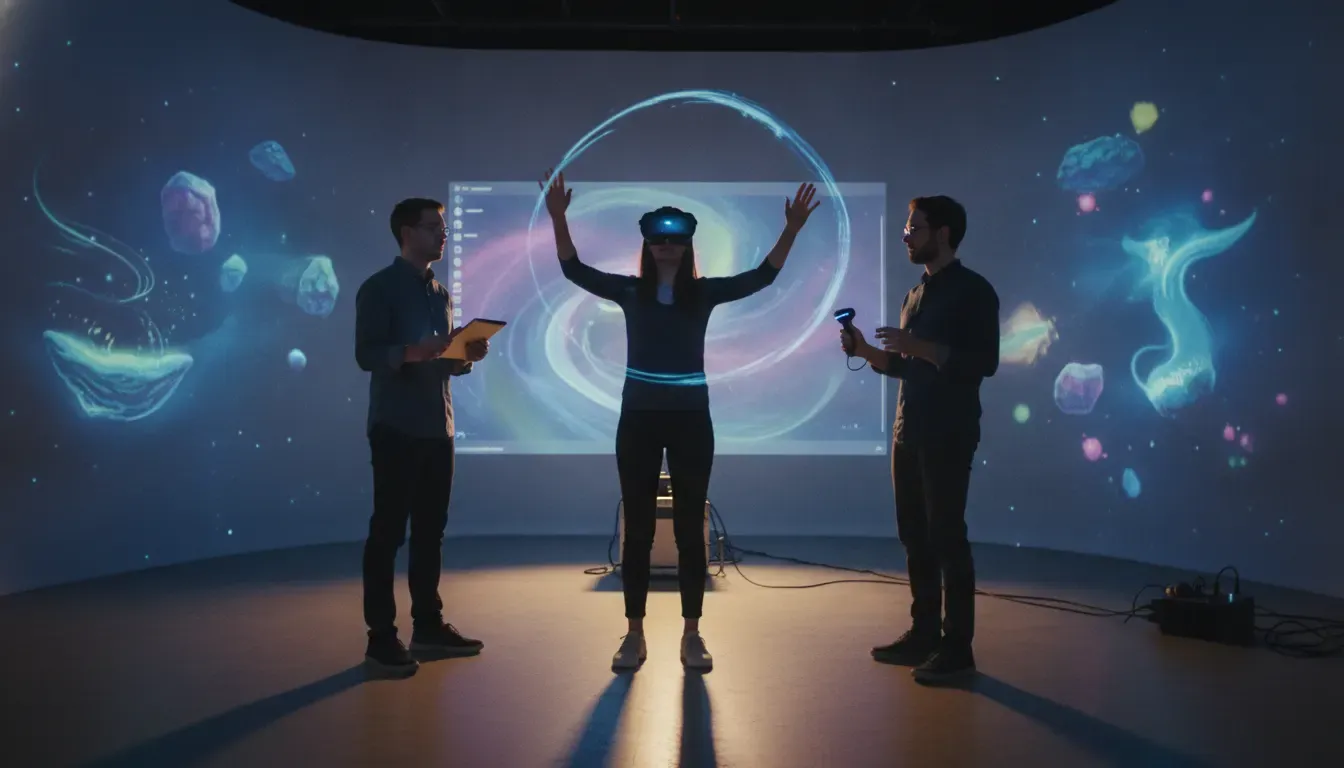
That discipline makes the experience easier to govern and easier to evolve. Teams can review interactions against the franchise bible, test whether onboarding supports comfort and comprehension, and confirm that new content uses the same narrative grammar. For a broader view of how participation can serve story, see Arctic7's guide to immersive VR storytelling. The result is an experience that feels open to the audience while remaining recognizably part of the same world.
Which hardware and deployment model should an enterprise VR program use?
The right hardware strategy follows the experience, audience, and operating environment, not the novelty of a particular headset. Start by defining where the experience will run, who will support it, and how often content will change. Then select a device matrix that balances immersion, tracking, connectivity, sanitation, portability, performance, and the ability to reverse or expand the decision.
A venue-based activation has different requirements from an internal innovation lab or a distributed consumer program. A museum, exhibition, or branded event may prioritize fast reset, robust physical handling, clear staff procedures, and straightforward hygiene between sessions. A controlled studio environment can support more specialized equipment and tighter technical supervision. A remote or at-home program must account for variable networks, user-owned devices, onboarding, comfort, and support without an operator standing nearby.
| Environment | Priorities | Questions to resolve |
|---|---|---|
| Public venue or event | Portability, quick reset, sanitation, staff support, reliable tracking | How will sessions be supervised, cleaned, queued, and recovered when a device fails? |
| Controlled studio or lab | Performance, repeatability, development access, instrumentation | What can the team measure, update, and test before wider rollout? |
| Distributed or home use | Onboarding, connectivity tolerance, accessibility, remote support | Which assumptions about space, network quality, device ownership, and user skill are safe? |
Build a device matrix, not a single-device assumption
Document the minimum supported configuration, preferred configuration, and fallback path. The matrix should cover display and input differences, tracking requirements, available play space, audio, rendering performance, update mechanisms, and session length. It should also identify what happens when tracking degrades, connectivity drops, or a user needs to exit quickly. This turns hardware selection into an operational decision rather than a procurement exercise.
Portability matters beyond transportation. A portable system may enable touring activations, partner venues, or rapid pilot changes, but it can introduce setup variance and additional support work. A fixed installation may deliver more consistent performance while limiting where the experience can travel. Choose deliberately, and preserve reversibility by separating content, interaction logic, device-specific settings, and deployment configuration wherever possible.
For a broader view of VR/AR hardware strategy and costs, treat the device decision as one part of the lifecycle plan. Arctic7's documented capabilities include prototyping, Unreal and Unity development, production pipelines, and post-launch content planning. These capabilities support an enterprise VR development program that can evolve after its first deployment.
How should an enterprise VR experience move from pilot to rollout?
A pilot should do more than prove that a headset can render an impressive world. It should reduce the risks that matter at scale: unclear creative intent, confusing interaction, unreliable technology, inaccessible participation, and an operating model that cannot support real audiences. Treat each stage as a decision gate with evidence that earns the next investment.
- Concept gate: Define the audience, IP promise, venue context, and intended behavior before building a full environment. The gate should produce a concise experience brief, a narrative or worldbuilding map, audience hypotheses, and success measures. For a branded or entertainment property, stakeholders should agree on what is canonical, what can be adapted for immersion, and what the audience should remember or do afterward. A small prototype can test the central proposition without pretending to validate the whole program.
- Interaction gate: Test whether people understand their role, available agency, guidance, and feedback. Observe first-time users rather than relying only on internal reviews. Evidence should include session recordings or structured observations, task completion and abandonment patterns, comfort feedback, and notes on how different audience types navigate the experience. Accessibility should enter here, not at final polish. Test readable visual hierarchy, clear audio alternatives, seated or mobility-conscious participation where relevant, and a simple way to pause or exit.
- Technical gate: Prove that the experience performs consistently on the intended device and network configuration. Measure frame stability, loading behavior, tracking, input reliability, session duration, and recovery from common failures. Instrument telemetry so the team can distinguish a creative problem from a device, software, or connectivity problem. The output should be a tested build, a known-issues register, a deployment checklist, and a recovery path for interrupted sessions or hardware faults.
- Operational gate: Run the pilot as an actual service, not a developer demonstration. Document setup, sanitation or equipment handling, queue flow, briefing, supervision, reset time, incident escalation, and staff responsibilities. Train operators against realistic scenarios, including a participant who needs assistance, a device that drops connection, and an audience member who wants to stop immediately. Evidence should include observed throughput, staffing assumptions, support time, and a runbook that another team can follow.
- Rollout gate: Expand in controlled stages, beginning with a limited venue or audience cohort. Compare audience behavior, completion, repeat participation, satisfaction, technical incidents, and operational effort against the pilot baseline. Review telemetry and qualitative feedback together before adding locations, content, or devices. A rollout plan should name ownership for releases, analytics, accessibility reviews, maintenance, and incident response. That turns immersive XR and VR capabilities into a repeatable program rather than a one-off activation.
What accessibility and audience-safety requirements belong in the brief?
Accessibility and audience safety should be defined before production, not added after the experience is built. An enterprise VR brief should identify who can participate, what may cause discomfort, how users receive guidance, and how staff respond when someone needs help. That planning protects the audience and makes deployment more dependable.
Start with the full range of sensory and physical considerations. Vision requirements may include readable interface elements, sufficient contrast, clear focal cues, and alternatives when depth perception or visual tracking becomes difficult. Hearing access can include captions, visual prompts, and instructions that do not depend on audio alone. Mobility planning should account for seated participation, limited movement, guardian boundaries, and experiences that do not require users to turn, crouch, or reach extensively.
Motion and balance deserve their own review. The brief should identify artificial locomotion, rapid acceleration, camera movement, height changes, flashing effects, and other mechanics that may create discomfort or disorientation. Where possible, give users control over movement and intensity. Build in a clear pause function, an immediate exit path, and an orientation sequence that explains what will happen before immersion begins.
Design for different cognitive and language needs
Audience safety also includes cognitive load. Keep instructions concise, introduce interaction patterns progressively, and avoid forcing users to remember several controls at once. Make language choices explicit, including captioning, localization, reading level, and whether a host or facilitator can provide assistance. A non-headset alternative, such as a screen-based or observer mode, ensures the story remains accessible to people who cannot or do not want to wear a headset.
Finally, assign responsibility for the live environment. Staff need a briefing, a way to monitor participant wellbeing, and a documented response for technical faults, distress, or equipment concerns. These requirements belong alongside narrative, hardware, and deployment decisions in the production plan. Arctic7's immersive XR and VR capabilities provide a relevant reference point for framing that work across creative and technical disciplines.
How do long-term content operations keep the experience relevant?
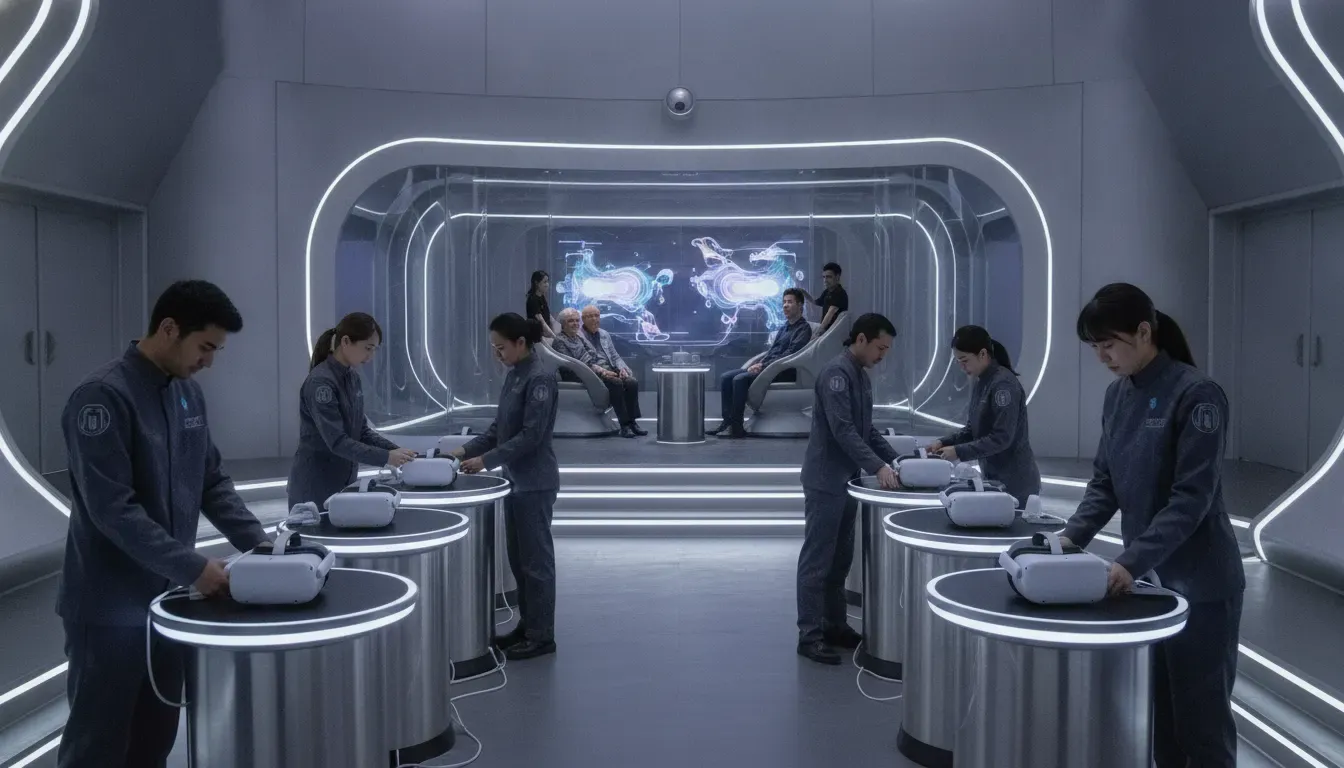
Long-term relevance depends on treating an enterprise VR experience as a living part of the IP, not a finished headset build. Clear release ownership, governed assets, localized content, rights tracking, analytics, device support, and planned maintenance let teams improve the experience without weakening its world. Seasonal updates and carefully managed franchise extensions can then create new reasons to return.
Assign ownership beyond launch
Before release, define who owns the backlog, approvals, platform compatibility, incident response, and publishing calendar. This is especially important when an experience spans an IP holder, a production partner, venue operators, and regional teams. Version governance should cover source assets, builds, plugins, interaction logic, and rollback procedures. A controlled release process makes it possible to update one component without unintentionally changing the canon, performance profile, or audience journey elsewhere.
Plan for audiences, platforms, and rights
Localization is more than translating interface copy. It may require adapting voice performance, cultural references, accessibility settings, onboarding, and support materials for each market. Rights expiry also needs a visible place in the roadmap. Licensed music, performances, characters, environments, and promotional assets should have renewal or replacement dates before they become a launch-day emergency.
Analytics should answer useful operational questions: where audiences disengage, which interactions are repeated, which devices create friction, and whether seasonal content earns meaningful participation. Those signals can guide maintenance priorities without turning the experience into an untested stream of changes. Device support should be reviewed as platforms, operating systems, and venue conditions evolve.
Build a content engine for the wider franchise
Post-launch planning creates room for seasonal moments, new narrative branches, and extensions into adjacent formats. Arctic7 documents capabilities across game development, live services, and post-launch content planning, supported by engagement models ranging from full-scale development to co-development and specialized support. Its transmedia approach can connect the VR experience to a broader production blueprint, while Narwhal Studios brings relevant virtual-production and real-time collaboration expertise.
For IP owners, the objective is not constant novelty. It is a durable operating model that protects the world, learns from audience behavior, and gives each update a clear creative purpose. Teams evaluating this model can review Arctic7's immersive XR and VR capabilities alongside its game development capability.
What should an IP owner ask an enterprise VR development partner?
An enterprise VR development partner should bring more than headset-specific production skills. Ask how the team will govern your IP, choose platforms and venues, design for varied audiences. Prove the concept through a measured pilot, integrate content with engineering, and support the experience after launch. The right partner will also challenge a poor-fit recommendation.
Start with IP governance. Who owns the source files, interaction systems, technical documentation, and derivative assets? How are canon decisions approved, and which stakeholders have authority when creative, commercial, and technical priorities conflict? A credible partner should make those decision rights visible before production, not resolve them informally when deadlines are already under pressure.
Then test the assumptions behind the experience. Ask which audience, venue, device mix, session length, and operating environment the proposal serves. A museum installation, a branded event, and a home-based experience may share a world but require different interaction patterns, support models, and accessibility considerations. The partner should show how those tradeoffs affect scope rather than presenting a universal hardware answer. Arctic7's VR/AR hardware strategy and costs resource offers useful context for that discussion.
Request evidence from a pilot, but examine the evidence carefully. Does it demonstrate meaningful audience behavior, comfort, narrative comprehension, technical stability, and an achievable path to rollout? A polished demo proves only that a moment can be staged. The stronger signal is a documented learning loop that connects audience feedback to design changes, production decisions, and measurable launch gates.
Finally, ask who remains accountable when the experience is live. Look for content and engineering integration, versioning, localization, analytics, platform maintenance, and a defined post-launch support model. Arctic7 documents capabilities spanning narrative and worldbuilding, Unreal and Unity development, production pipelines, immersive/XR work, virtual production, and post-launch content planning. Its transmedia approach can also connect the VR experience to a wider entertainment ecosystem, rather than treating it as an isolated activation. Explore its immersive XR and VR capabilities, game development capability, and virtual production capabilities as part of your evaluation.
The most valuable answer may be a considered no. A partner willing to reject an unsuitable platform, venue, feature, or rollout plan is protecting the IP and the audience, not reducing ambition. Ask what conditions would make the team recommend a smaller pilot, a different medium, or a later launch. That answer reveals whether the relationship is built around durable value or simply delivering the first proposal.
Talk with Arctic7 about your next branded VR experience
Frequently Asked Questions
What does enterprise VR development include beyond building a prototype?
It includes stakeholder alignment, narrative and interaction design, hardware and deployment planning, accessibility, testing, launch operations, measurement, and post-launch content planning. For an entertainment IP, the work should also connect the VR experience to the wider world, audience, and platform strategy.
How should an IP owner choose an enterprise VR development partner?
Look for evidence across immersive experiences, game development, virtual production, and long-term content operations. The right partner should be able to align creative and technical stakeholders and work in Unreal or Unity when appropriate. They should support full-scale development, co-development, or specialized services based on your internal capabilities.
How do you select hardware for an enterprise VR experience?
Start with the audience, venue, interaction model, supervision needs, deployment environment, and support requirements. Then compare device and platform options against comfort, portability, maintenance, content performance, and rollout consistency. Hardware should serve the experience and operating model, not dictate the creative concept.
What keeps an enterprise VR experience relevant after launch?
Assign clear ownership for updates, versioning, technical maintenance, localization, analytics, and audience feedback before launch. A modular content plan makes it easier to refresh story elements, interactions, or environments without rebuilding the entire experience, helping the program remain connected to broader franchise activity.
Ready to shape your next VR experience?
Turning an enterprise VR concept into a durable branded or entertainment experience requires alignment across creative strategy, production, and long-term execution. Talk with Arctic7 about your next project and explore a strategic immersive production partnership.
New Immersive & XR Media Capabilities Added to Arctic7's Suite of Games, Film & TV and Digital Services

Arctic7 Shares Details of its Work on Skeleton Crew and Cinematics Partnership with Fateless

The Human Touch: Adding Personality to Project and Product Management
Whether it’s your team, your client, or your stakeholders, understanding the human dynamics is just as critical as hitting milestones.

McDonald's Case Study: Bridging Brand and Play | Arctic7
Bridging Brand and Play: An Interview with Lindsay Blenkhorn Daggitt