



Virtual Production LED Wall Price: A Budget Guide
For IP holders, the promise of an LED wall is about creative freedom—the ability to build and explore your world without the constraints of physical locations. You can craft any environment, control every ray of light, and capture final-pixel shots in-camera. But turning that creative potential into a reality requires a solid financial plan. Understanding the virtual production led wall price is the first practical step in that process. This isn't just about buying a screen; it's about investing in a new production pipeline. Here, we’ll explore the costs associated with this technology, helping you align your creative vision with a budget that makes sense for your studio.
Key Takeaways
- Budget for the entire ecosystem, not just the screen: The final cost of an LED wall includes essential expenses like installation, power, ongoing maintenance, and a skilled crew. A comprehensive budget accounts for these factors to reflect the true investment.
- Invest in the specs that directly serve your story: Key technical details like pixel pitch and refresh rate are major cost drivers. Match these specifications to your production's specific needs—such as frequent close-ups versus wide shots—to avoid overspending on features you won't use.
- Evaluate the long-term return on investment: An LED wall's value is measured in its ability to reduce costs for location shoots and post-production. This long-term financial efficiency is more important than the initial price when deciding if it's the right asset for your studio.
What Exactly Is a Virtual Production LED Wall?
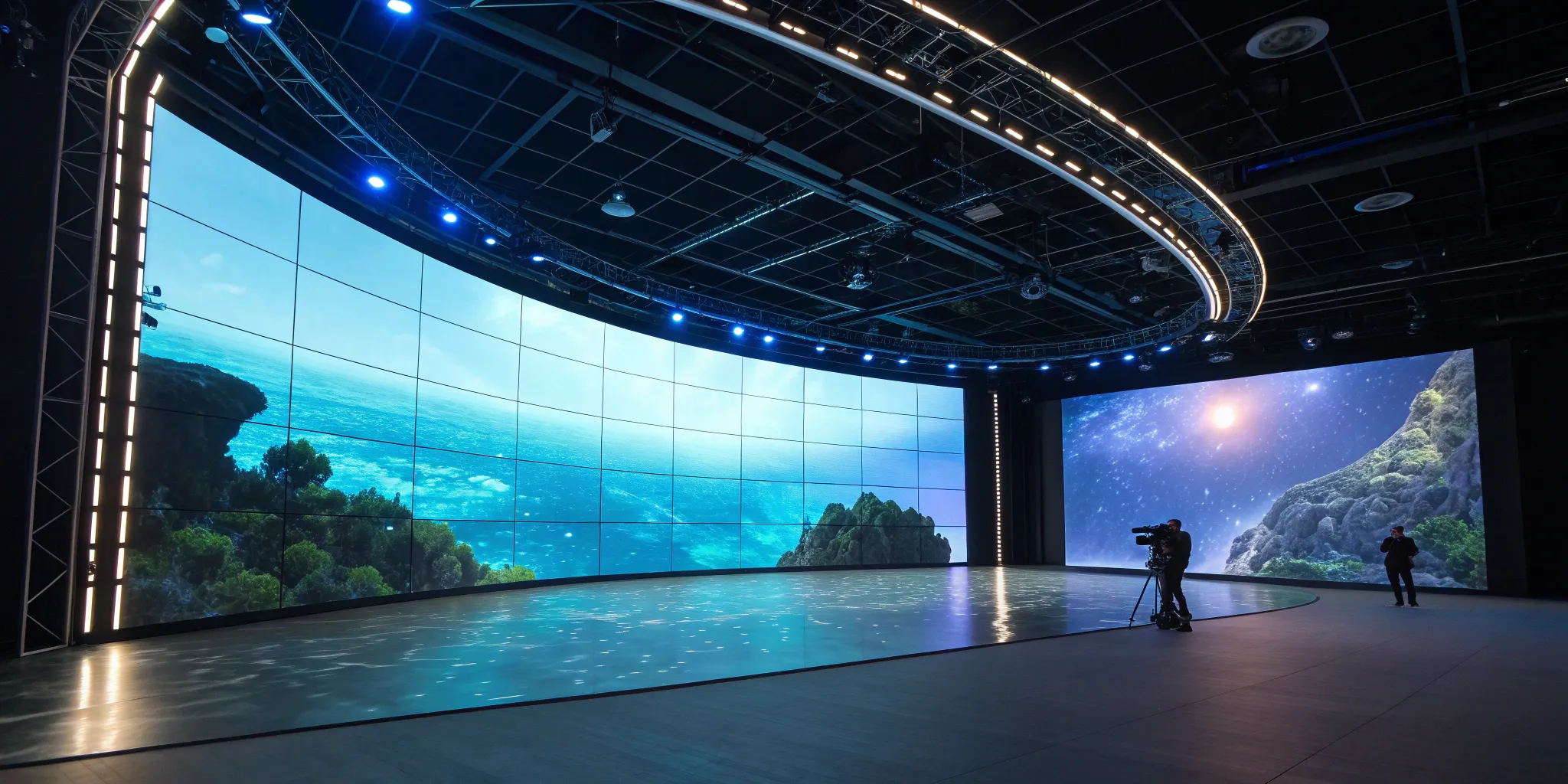
If you’ve ever wondered how your favorite sci-fi shows create such convincing alien worlds, the answer is likely an LED wall. Think of it as the next evolution of the green screen. Instead of a static green background that gets replaced later in post-production, a virtual production LED wall is a massive, curved screen made of high-resolution LED panels. It displays digital environments in real-time, right on set.
This means your actors can see and interact with the world around them, from a bustling futuristic city to a serene fantasy landscape. The wall doesn't just provide a backdrop; it also emits light, casting realistic reflections and shadows on actors and props. This creates a seamless blend between the physical and digital worlds, all captured directly in-camera. It’s a core component of the virtual production services we use to bring expansive worlds to life.
The Tech Behind the Screen
At its heart, an LED wall is a sophisticated display system designed specifically for filmmaking. It’s not just one giant screen but a series of smaller LED panels seamlessly joined together to create a large, immersive canvas. These panels use advanced technology to achieve incredibly high resolutions and refresh rates, which prevents flickering or other visual artifacts when filmed.
The real magic happens when the LED wall is paired with a game engine, like Unreal Engine. This allows the digital environment on the screen to react to the camera’s movement in real-time. As the camera pans, tilts, or moves through the set, the perspective of the background shifts accordingly, creating a perfect illusion of depth. This is the technology that powered the stunning visuals in projects like Marvel Studios' Ant-Man and The Wasp: Quantumania, allowing for dynamic and believable scenes without ever leaving the studio.
How LED Walls Are Changing Filmmaking
The shift to LED walls is about more than just cool visuals; it’s fundamentally changing the production pipeline for the better. For starters, it offers significant creative freedom. Directors and actors can make decisions on the fly because they can see the final shot as it’s being filmed, not months later. This leads to stronger performances and a more cohesive final product.
From a practical standpoint, LED walls can dramatically reduce costs and timelines. You can say goodbye to expensive location shoots and weather delays. One study found that using an LED wall cut production costs for a single ad from $285,000 to $114,000. By minimizing the need for extensive green screen compositing, you also cut down on post-production hours, getting your project to audiences faster. It’s a smarter, more efficient way to build worlds and tell incredible stories.
How Much Does a Virtual Production LED Wall Cost?
Pinning down a single price for a virtual production LED wall is tricky because the final cost depends entirely on your project's scale and ambition. To make it easier, we can break down the costs into three general tiers: entry-level, mid-range, and high-end. Understanding these brackets will help you frame your budget and align your creative vision with what's financially practical. Whether you're just starting out or building a state-of-the-art volume for a major franchise, there's a solution that fits your needs.
Entry-Level: Up to $50,000
If you're working with a smaller budget or taking your first steps into virtual production, this is your starting point. For up to $50,000, you can acquire a smaller, flat LED wall suitable for product shots, music videos, or simple background replacements. The virtual production LED wall price at this level generally ranges from $1,000 to $3,000 per square meter, allowing independent creators to experiment without a massive capital investment. While you won't be building a massive, immersive volume, an entry-level setup is more than capable of producing stunning visuals and streamlining your workflow for specific scenes, making it a great way to get familiar with the technology.
Mid-Range: $50,000–$200,000
This tier is where many professional television shows, commercials, and independent features find their sweet spot. With a budget between $50,000 and $200,000, you can build a more substantial LED wall, potentially with a slight curve for greater immersion and more convincing in-camera effects. The quality and resolution of the panels improve significantly here. The price of a virtual production LED wall in this range accommodates a much wider variety of production needs, giving you the flexibility to shoot more complex scenes with dynamic digital environments. This is the workhorse category for serious virtual production that needs to deliver high-quality results consistently.
High-End: $200,000+
When you see breathtaking visuals in a major blockbuster, you're likely looking at a high-end LED volume. Budgets starting at $200,000 and climbing into the millions are standard here. At this level, you're investing in massive, curved stages comprised of hundreds of top-tier LED panels—a single small panel alone can cost around $2,000. These stages, like those used in our work for partners like Marvel Studios, offer unparalleled creative freedom, allowing directors to capture final-pixel shots in-camera. This investment is for major studios aiming to create fully immersive digital worlds that set a new standard for cinematic storytelling and audience engagement.
What Factors Influence the Price?
When you start looking at virtual production LED walls, you'll quickly notice there's no simple price tag. The final cost is a blend of several key variables, and understanding them is the first step to making a smart investment for your project. The price for a professional setup can range from $150,000 to well over $2 million, depending on the scale, resolution, and specific technology you choose.
Think of it less like buying a TV off the shelf and more like commissioning a custom piece of high-performance equipment. The size of the screen, the clarity of the image, the reputation of the manufacturer, and the complexity of the setup all play a major role in the final number. Let's break down these core factors so you can get a clearer picture of what drives the cost and where your budget will be going.
Size and Dimensions
It might seem obvious, but the bigger the wall, the higher the price. Most pricing is calculated per square meter, and you can expect to see costs ranging from $1,000 to $3,000 per square meter depending on the wall's other specifications. A larger wall requires more LED panels, more processing power, and a more robust support structure, all of which add to the cost.
However, the goal isn't just to get the biggest wall you can afford. It's about matching the size to your production needs. A massive, curved volume is perfect for creating immersive, sweeping landscapes, while a smaller, flat wall might be all you need for interviews or contained scenes. The shape also matters—curved walls create a more seamless backdrop but often come with a higher price tag and more complex installation requirements.
Pixel Pitch and Resolution
Pixel pitch is one of the most critical specs influencing both cost and quality. It refers to the distance between the centers of individual pixels on the LED panel, measured in millimeters. A smaller pixel pitch means the pixels are closer together, creating a denser, higher-resolution image. This is essential for on-camera work, as a fine pitch prevents the moiré effect, an undesirable visual distortion that can appear when filming screens.
For virtual production, a pixel pitch between 1.5mm and 2.9mm is typical. The finer the pitch, the more expensive the panel. Your decision here should be driven by your creative needs. If your scenes involve a lot of close-ups or detailed backgrounds, investing in a smaller pixel pitch is non-negotiable. For productions that primarily use wider shots, you might be able to opt for a slightly larger pitch and allocate that budget elsewhere.
Brand and Build Quality
As with any major technology purchase, the brand matters. Established manufacturers like ROE Visual, Absen, and ARRI have built reputations for reliability, color accuracy, and performance under the demanding conditions of a film set. Investing in a top-tier brand often means you're getting panels with higher refresh rates, superior brightness, and better consistency, which are all crucial for capturing clean, realistic footage.
While a premium brand may have a higher upfront cost, it often delivers greater long-term value. High-quality panels are more durable, require less maintenance, and are backed by better warranties and support. This reliability translates into smoother productions with less downtime. In fact, the efficiency gains from using dependable virtual production technology can be substantial, with some studios seeing production cost reductions of more than 50% compared to traditional methods.
Installation Complexity
The sticker price of the LED panels is just one part of the equation. As one industry report notes, "While the initial purchase price of an LED wall might seem like the primary expense, there are several other factors to consider that can significantly impact the total cost of ownership." Installation is a major one. Setting up a virtual production stage is a complex process that involves much more than just mounting panels on a wall.
Your total investment will need to cover structural engineering for the support frame, high-capacity power distribution, specialized cooling systems, and integration with camera tracking and processing hardware. A simple flat wall will be less complex to install than a 270-degree curved volume with an LED ceiling. This is where partnering with an experienced team is critical. A skilled transmedia partner can manage the entire integration, ensuring every component works together flawlessly from day one.
How Do Top Brands Price Their Walls?
When you start shopping for an LED wall, you’ll quickly notice that brand names carry a lot of weight—and for good reason. The manufacturer behind your screen influences everything from pixel quality and reliability to customer support and long-term value. While the market is full of options, a few key players have established themselves as industry leaders, each catering to different production needs and budgets.
Understanding how these top brands position themselves can help you narrow down your choices. Some focus on delivering premium, cutting-edge technology for blockbuster-level projects, while others provide reliable, cost-effective solutions for smaller studios or independent creators. Choosing the right brand isn’t just about the initial price tag; it’s about finding a partner whose technology aligns with your creative vision and financial framework. Let’s look at a few of the most respected names in the virtual production space.
Our Recommended Partners
Navigating the world of LED manufacturers can feel overwhelming, but we’ve seen a few brands consistently deliver exceptional results. Companies like ARWALL, ROE Visual, and Absen have earned their reputations by producing high-quality, reliable screens that stand up to the demands of modern filmmaking. Each one offers a different value proposition, making them suitable for a range of projects. Whether you’re building a state-of-the-art volume for a major studio or a more modest setup for a commercial shoot, one of these brands likely has a solution that fits your needs. We recommend them because they represent a great cross-section of what the market has to offer in terms of quality, performance, and price.
ARWALL's Pricing
Think of ARWALL as a premium choice for productions where cutting-edge technology and long-term value are top priorities. Their solutions are built for high-end performance, and their pricing reflects that commitment to quality. You can expect their setups to range from $150,000 for smaller configurations to as much as $2–$5 million for large-scale, permanent installations. This investment gets you more than just panels; it includes robust hardware, seamless integration, and the assurance that you’re working with technology trusted by major studios. For IP holders looking to create truly immersive worlds without compromise, ARWALL provides the top-tier tools to make it happen.
ROE Visual's Costs
ROE Visual strikes an excellent balance between premium quality and competitive pricing, making them a favorite across the industry. Their LED walls are known for their reliability and stunning visual performance, which is why you’ll find them on sets for everything from television series to major feature films. Costs for a ROE Visual setup typically fall between $120,000 and $3 million. This wide range allows them to cater to both mid-range and high-end projects, offering flexibility without a significant drop in quality. If you’re looking for a trusted, versatile solution that delivers professional-grade results, ROE Visual is a fantastic contender.
Absen's Budget-Friendly Options
For studios, brands, or independent creators who need to make every dollar count, Absen offers a more accessible entry point into the world of virtual production. They provide quality LED solutions that are more budget-friendly, with prices often starting around $80,000. While they may not have all the bells and whistles of the most premium brands, Absen delivers reliable performance that is more than capable for many commercial, corporate, and independent projects. Choosing a more affordable option like Absen allows smaller teams to leverage the power of virtual production without the massive capital investment, making it a smart choice for proving ROI or getting a new venture off the ground.
Which Specs Matter Most for Your Budget?
When you start looking at spec sheets for LED walls, the sheer number of variables can feel overwhelming. But here’s the secret: only a few key specifications will have the biggest impact on both your final visuals and your budget. Understanding these allows you to make smart trade-offs, investing where it counts and saving where you can without compromising quality. It’s not about getting the most expensive panel; it’s about getting the right panel for your creative vision.
The price of a virtual production LED wall can swing from $150,000 to over $2 million, and that massive difference often comes down to four things: pixel pitch, refresh rate, brightness, and long-term serviceability. Getting these right is fundamental to building a reliable and effective virtual set. Our transmedia services often involve guiding partners through these technical decisions to ensure the hardware perfectly serves the story. Let's break down what each of these specs means for your project and your wallet.
Pixel Pitch (1.5mm–2.9mm)
Pixel pitch is the distance from the center of one pixel to the center of the next, measured in millimeters. A smaller number means the pixels are closer together, creating a higher-resolution image that looks crisp even when the camera is close. This is also one of the biggest cost drivers. As a general guideline, the price for a virtual production LED wall can range from $1,000 to $3,000 per square meter, with finer pixel pitches sitting at the higher end of that spectrum.
So, do you need the tightest pitch available? Not always. The ideal pixel pitch depends on your shooting style. If your scenes involve wide shots where the camera is far from the wall, you can use a larger pitch (like 2.9mm) and save significantly. For close-ups and detailed shots, a finer pitch (like 1.5mm) is essential to avoid seeing individual pixels or moiré patterns.
Refresh Rate for Filming
The refresh rate tells you how many times per second the image on the screen is redrawn. For on-camera use, this is a non-negotiable spec. A low refresh rate will cause flickering or black bands to appear in your footage, which is a nightmare to fix in post-production. You need a wall designed specifically for filming, not for live events or digital signage.
Look for refresh rates of at least 3840 Hz, though higher-end panels offer 7680 Hz for completely flicker-free output, even when shooting at high frame rates or with fast camera movements. This ensures what you see on set is exactly what you get in the final cut. It’s a critical component for projects like our work on Ant-Man and The Wasp: Quantumania, where visual integrity is paramount.
Brightness and Color Accuracy
Brightness, measured in nits, determines how luminous your LED wall can get. This is crucial for creating realistic lighting effects and ensuring the virtual background convincingly illuminates your actors and physical set pieces. Higher brightness capabilities give your Director of Photography more creative flexibility to blend virtual and practical light. Color accuracy, or the panel’s ability to reproduce a wide color gamut, is just as important for achieving a specific cinematic look.
While you want a wall that’s bright enough, you don’t always need the absolute brightest option. A wall with 1,500 nits is often more than sufficient for a controlled studio environment. Over-specifying on brightness can unnecessarily inflate the cost, so consider your typical lighting setups when making a decision.
Serviceability and Access
While the initial purchase price gets most of the attention, the total cost of ownership is what truly impacts your budget over time. Serviceability—how easily the wall can be repaired—is a huge part of this. LED panels can and do fail, and you need a plan for when that happens. Does the wall allow for front access, meaning you can swap a module from the front without dismantling the entire structure? Or does it require rear access?
Front-serviceable panels are often more expensive upfront but can save you immense time and labor costs during maintenance. Choosing a cheaper panel that’s difficult to repair can lead to more downtime and higher operational expenses, turning a short-term saving into a long-term headache.
What Are the Hidden Costs of Ownership?
The sticker price of an LED wall is just the first line item on your budget. To get a true picture of the investment, you need to look at the total cost of ownership. These ongoing expenses, from electricity to expert support, are what keep your virtual production stage running smoothly and delivering incredible results. Thinking about these costs upfront helps you plan effectively and avoid surprises down the road. A strategic partner can help you map out these long-term operational needs, ensuring your investment is sustainable and successful. At Arctic7, our transmedia services include helping you build a complete financial picture for your production technology.
Power Consumption
An LED wall is a powerful tool, and it requires a significant amount of power to operate. The energy draw can be one of the most substantial ongoing costs you'll face. Depending on the size, pixel pitch, and brightness settings of your screen, a large LED wall can cost anywhere from $50 to $250 per hour to run. When you multiply that by an 8- or 10-hour shoot day, the costs add up quickly. It’s essential to factor this into your operational budget, as it will be a recurring expense for as long as you use the wall. Planning for your power needs also involves ensuring your facility can handle the electrical load, which might require infrastructure upgrades.
Maintenance Contracts
To protect your significant hardware investment, a maintenance contract is non-negotiable. These agreements ensure your LED wall remains perfectly calibrated and functional, preventing costly downtime during a shoot. Typically, you can expect maintenance contracts to range from 8% to 15% of the initial hardware cost each year. For a $2 million system, that means an annual budget of $160,000 to $300,000 for support. These contracts usually cover routine check-ups, color calibration, software updates, and priority access to technicians for emergency repairs, giving you peace of mind that your stage will always be ready for action.
Support and Training
The most advanced technology is only as effective as the people who operate it. Your team will need specialized training to manage the LED wall, content engines, and camera tracking systems. The cost of this training often scales with the complexity of your setup; a larger, higher-resolution wall requires a more skilled crew. You’ll need to invest in training for your virtual art department, stage operators, and systems engineers. Alternatively, many studios choose to work with partners who provide this expertise. Having a team of seasoned professionals ensures you get the most out of your technology from day one and can tackle any creative or technical challenge that arises.
Parts and Upgrades
Like any technology, your LED wall will require occasional repairs and eventual upgrades. Individual LED panels can fail, and having a stock of spare parts on hand is crucial to avoid production delays. You should budget for a supply of extra modules, receiving cards, and power supplies. Furthermore, the technology is constantly evolving. To keep your stage competitive and capable of producing the highest-quality visuals, you may need to upgrade components like your video processor or even the panels themselves every few years. While this requires investment, maintaining a state-of-the-art system is what allows you to achieve the production efficiencies that make virtual production so valuable.
Should You Buy, Lease, or Rent Your LED Wall?
Deciding how to acquire an LED wall is one of the biggest financial and strategic choices you'll make when stepping into virtual production. It’s not just about the initial price tag; it’s about aligning the technology with your project pipeline, budget, and long-term goals. Each path—buying, leasing, or renting—comes with its own set of benefits and trade-offs. Think of it as choosing between owning a home, signing a long-term apartment lease, or booking a vacation rental. The right answer depends entirely on your specific needs. Let's break down what each option looks like so you can make the best decision for your studio.
Why Buy?
Purchasing an LED wall is a major commitment, but for studios with a steady stream of projects, it can be a game-changer. Owning your wall gives you complete control over your production schedule and the freedom to customize the setup for every shoot. The upfront investment is significant, with prices ranging from $150,000 to over $2 million depending on the cost factors like size and resolution. However, if you plan to use it constantly, ownership can be more cost-effective over time than repeated rentals. It’s an investment in your studio’s infrastructure, turning a key piece of production technology into a permanent asset.
When to Lease
If you’re not ready for the full financial plunge of buying but need more access than a short-term rental can provide, leasing is your sweet spot. This option offers a great balance of flexibility and consistency. Leasing helps you manage costs beyond the initial purchase, covering things like maintenance, storage, and crucial technology upgrades. In a field that evolves as quickly as virtual production, leasing ensures you always have access to modern equipment without the risk of your expensive asset becoming obsolete. It’s a strategic move for studios that want to integrate virtual production into their regular workflow without the long-term burden of ownership.
The Case for Renting
For one-off projects, pilot episodes, or simply testing the virtual production waters, renting is the most practical and cost-effective choice. You get access to a state-of-the-art LED volume stage for a fraction of the purchase price, with daily rates typically falling between $30,000 and $100,000. This approach eliminates any concerns about maintenance, storage, or long-term investment. You can focus entirely on your creative vision, leaving the technical management to the rental studio. Working with a partner that offers comprehensive virtual production services can make the process even smoother, as they handle the entire technical setup for you.
Common Pricing Mistakes to Avoid
Investing in a virtual production LED wall is a significant step, and it’s easy to get tripped up by the numbers. Making a smart decision means looking beyond the initial price tag and understanding the full scope of the investment. To help you budget effectively and avoid any surprises, let's walk through some of the most common pricing mistakes we see people make. Thinking ahead about these potential pitfalls will set your project up for success from the very beginning.
Looking Only at the Sticker Price
It’s tempting to focus on the initial quote, but the sticker price for an LED wall is just the tip of the iceberg. Depending on the scale, resolution, and brand, the upfront cost can range from $150,000 to over $2 million. This number doesn't account for essential components like processors, mounting hardware, or the control systems needed to run the wall. Think of it like buying a car—the base model price is attractive, but the features that make it truly functional add to the final cost. A comprehensive budget requires looking at the entire virtual production ecosystem, not just the screen itself.
Forgetting Ongoing Expenses
Once your LED wall is installed, it will continue to have costs associated with it. Power consumption, for example, can be a significant operational expense, especially for large, high-brightness walls. You’ll also need to budget for routine maintenance to keep the panels calibrated and in perfect condition. Over time, you might also consider software updates or hardware upgrades to keep your stage competitive. Factoring these ongoing expenses into your total cost of ownership from the start prevents them from becoming unexpected financial burdens later on.
Choosing the Cheapest Quote
While everyone loves a good deal, opting for the cheapest quote without careful evaluation can be a costly mistake. A lower price might reflect lower-quality components, a lack of essential support services, or a less experienced installation team. These shortcomings can lead to more downtime, higher repair costs, and a less-than-perfect final image on screen. Instead of focusing solely on the price, evaluate the value. Does the quote include on-site training, a robust warranty, and responsive technical support? A slightly higher initial investment in a quality product from a reputable partner often saves you money and headaches in the long run.
Overlooking Future Service Needs
Your relationship with your LED wall provider shouldn't end after installation. As technology evolves, you'll need a partner who can provide ongoing support, service, and guidance on upgrades. Before you sign a contract, ask about the provider’s long-term service options. What does their warranty cover? How quickly can they provide replacement parts? A reliable partner will help you maintain your wall’s performance and ensure it continues to deliver value for years. Considering the long-term cost vs. value is key to maximizing the efficiency and creative potential of your virtual production stage.
Is an LED Wall a Good Investment?
An LED wall is a significant capital expense; there's no getting around it. But thinking of it only as a cost is missing the bigger picture. For studios and IP holders, an LED wall is a strategic investment in a more efficient, flexible, and creatively liberating production model. When you look past the initial price tag, you’ll find that the long-term savings and operational benefits can deliver a substantial return. It fundamentally changes how you approach production, shifting costs away from unpredictable location shoots and lengthy post-production cycles toward a controlled, streamlined studio environment.
This technology empowers you to build worlds without the logistical constraints of the real one. Instead of compromising your creative vision to fit a location budget, you can bring any environment to your stage, from fantastical alien planets to historically accurate cityscapes. This control not only saves money but also opens up new storytelling possibilities that might have been too expensive or impractical to attempt otherwise. For IP holders looking to expand their universes across different media, this level of creative and financial control is a game-changer. It allows for a more cohesive and ambitious approach to world-building, ensuring consistency and quality whether you're producing a feature film, an episodic series, or an interactive experience. The investment, therefore, isn't just in a piece of hardware; it's in a future-proofed production workflow that prioritizes creative freedom and operational excellence.
Save on Location Fees
One of the most immediate and tangible benefits of an LED wall is the dramatic reduction in location-related expenses. Instead of spending time and money on scouting, permits, and travel for your entire cast and crew, you can bring any environment directly to your stage. This technology allows you to create photorealistic backdrops that eliminate the need for physical sets and distant location shoots. Imagine filming a scene in the Swiss Alps in the morning and on a Martian landscape in the afternoon—all without leaving the studio. This not only saves on travel and accommodation but also removes the logistical headaches of managing a production in multiple locations, offering a far more cost-effective solution for your projects.
Cut Down on Post-Production
Virtual production with an LED wall revolutionizes the post-production workflow by enabling in-camera visual effects (ICVFX). Unlike a traditional green screen, where backgrounds are added months later, an LED wall displays the final environment during the shoot. This means complex visual effects, realistic lighting, and accurate reflections are captured directly by the camera. As a result, you drastically reduce the time and budget allocated to compositing and VFX work after filming wraps. One analysis found that LED walls reduced single ad production costs from $285,000 to just $114,000, showcasing the immense potential for savings by getting the shot right on the day.
Achieve a Faster ROI
While the upfront cost is high, the combined savings from location fees and post-production work lead to a faster return on investment. For episodic television, the savings can range from $200,000 to $500,000 per season. When you own the stage, you also create a new revenue opportunity by renting it out to other productions. With daily rental rates for stages running between $25,000 and $75,000, the LED wall becomes a valuable asset that generates income. This dual benefit of cost savings on your own projects and revenue from rentals helps you recoup your initial investment much more quickly than you might expect.
Improve Production Efficiency
Beyond the financial savings, an LED wall makes the entire production process more efficient. Directors and cinematographers can see the final composite shot in real-time, allowing for immediate creative adjustments on set. Actors can perform in an immersive environment, reacting to the world around them instead of a blank green screen, which often leads to more authentic performances. This streamlined workflow means you can capture final shots right on set, reducing the guesswork and fixes typically handled in post. The result is a faster, more collaborative, and creatively cohesive process from start to finish.
How to Calculate Your Total Investment
Figuring out your total investment in a virtual production LED wall goes beyond the initial price tag. To get a realistic picture of your budget, you need to look at the complete ecosystem: the hardware itself, the day-to-day operational expenses, and the team you bring on to make it all work. Thinking through these three areas will help you build a comprehensive financial plan that accounts for the full scope of your project, ensuring there are no surprises down the line. A smart investment starts with a clear understanding of every cost involved, from the day the wall is installed to the final shot of your production. By breaking it down, you can see how each component contributes not just to the cost, but to the long-term value and creative potential of your IP.
Factor in Hardware and Installation
The LED wall itself is the most significant upfront cost, with prices that can range from $150,000 to over $2 million. The final number depends heavily on the size, pixel pitch, and brand you choose. As a general rule, you can expect the virtual production LED wall price to fall between $1,000 and $3,000 per square meter. But the hardware is only part of the equation. Installation is a complex process that requires specialized technicians to handle everything from building the support structure to calibrating the panels. This isn't a DIY project—professional installation is critical for performance and safety, and its cost should be factored in from the start.
Account for Operational Costs
Once your LED wall is up and running, you’ll have ongoing operational expenses. These are the hidden costs that can impact your total cost of ownership over time. Power consumption is a major one, as these high-resolution screens require a significant amount of electricity. You should also budget for regular maintenance to keep the panels in perfect condition, as well as potential software licenses and hardware upgrades. While these costs add up, it’s important to weigh them against the savings. For example, one report found that using LED walls reduced single ad production costs from $285,000 to $114,000, showing a clear path to long-term value.
Partner with an Experienced Integrator
Bringing in the right partner is one of the most important investments you can make. An experienced integrator or transmedia studio does more than just set up the tech; they ensure your entire virtual production pipeline is designed to serve your creative vision. They help you choose the right hardware, design a workflow that fits your team, and avoid common pitfalls that can lead to costly delays. Considering that renting a pre-existing LED volume stage can cost anywhere from $30,000 to $100,000 per day, investing in a partner to build your own stage correctly from day one is a smart financial move. This is where our comprehensive services can guide your project from concept to execution, ensuring your investment pays off.
Related Articles
- Ant-Man and the Wasp: Quantumania: A Case Study in Global Virtual Production | Virtual Production
- Interview: Film & TV Services Explained | Virtual Production
- Virtual Production
- Fathead | Virtual Production
Frequently Asked Questions
Is this technology only for big blockbuster movies? Not at all. While blockbusters use massive, high-end stages, there are scalable solutions for commercials, television shows, and independent projects. The key is matching the technology to your specific needs. A smaller, more budget-friendly setup can be incredibly effective for contained scenes or product shots, allowing more creators to benefit from the workflow.
Why can't I just use a regular event LED screen for filming? It comes down to what the camera sees. Screens designed for live events don't have the high refresh rates needed for film cameras, which results in distracting flickering and banding in your footage. Virtual production walls are specifically engineered with fine pixel pitches and extremely high refresh rates to look perfect on camera, creating a seamless and believable image.
What's more important for my budget: a bigger wall or a higher-resolution one? This really depends on your shooting style. If your project involves a lot of close-ups where actors are near the screen, you should prioritize a higher resolution, which means a smaller pixel pitch, to avoid visual distortions. For projects with mostly wide shots where the background is more distant, you can opt for a larger wall with a slightly lower resolution and still get incredible results.
How much technical expertise does my team need to operate an LED wall? Operating an LED wall effectively requires a specialized skill set. You'll need a team that understands real-time game engines, color calibration, and camera tracking systems. Many studios choose to partner with a transmedia expert who can provide a trained crew. This approach removes the steep learning curve and ensures you get the most out of the technology from day one.
Is renting a better first step than buying for a single project? Absolutely. For a one-off project or if you're just exploring virtual production, renting is the smartest move. It gives you access to a top-tier stage and crew without the massive capital investment and long-term commitment of ownership. This allows you to focus on the creative side and see if the workflow is right for you before considering a bigger investment.
New Immersive & XR Media Capabilities Added to Arctic7's Suite of Games, Film & TV and Digital Services

Arctic7 Shares Details of its Work on Skeleton Crew and Cinematics Partnership with Fateless

The Human Touch: Adding Personality to Project and Product Management
Whether it’s your team, your client, or your stakeholders, understanding the human dynamics is just as critical as hitting milestones.

McDonald's Case Study: Bridging Brand and Play | Arctic7
Bridging Brand and Play: An Interview with Lindsay Blenkhorn Daggitt

